
TEN Holdings: Regulatory Overhang, Persistent Losses, and the Economics of Small-Cap Broadcasting
TEN Holdings faces mounting regulatory and financial pressure as it works to sustain its Nasdaq listing and stabilize its broadcasting operations. The company’s recent capital raise and leadership changes offer short-term relief, but persistent net losses and ongoing government investigations highlight the fragility of its current business model.
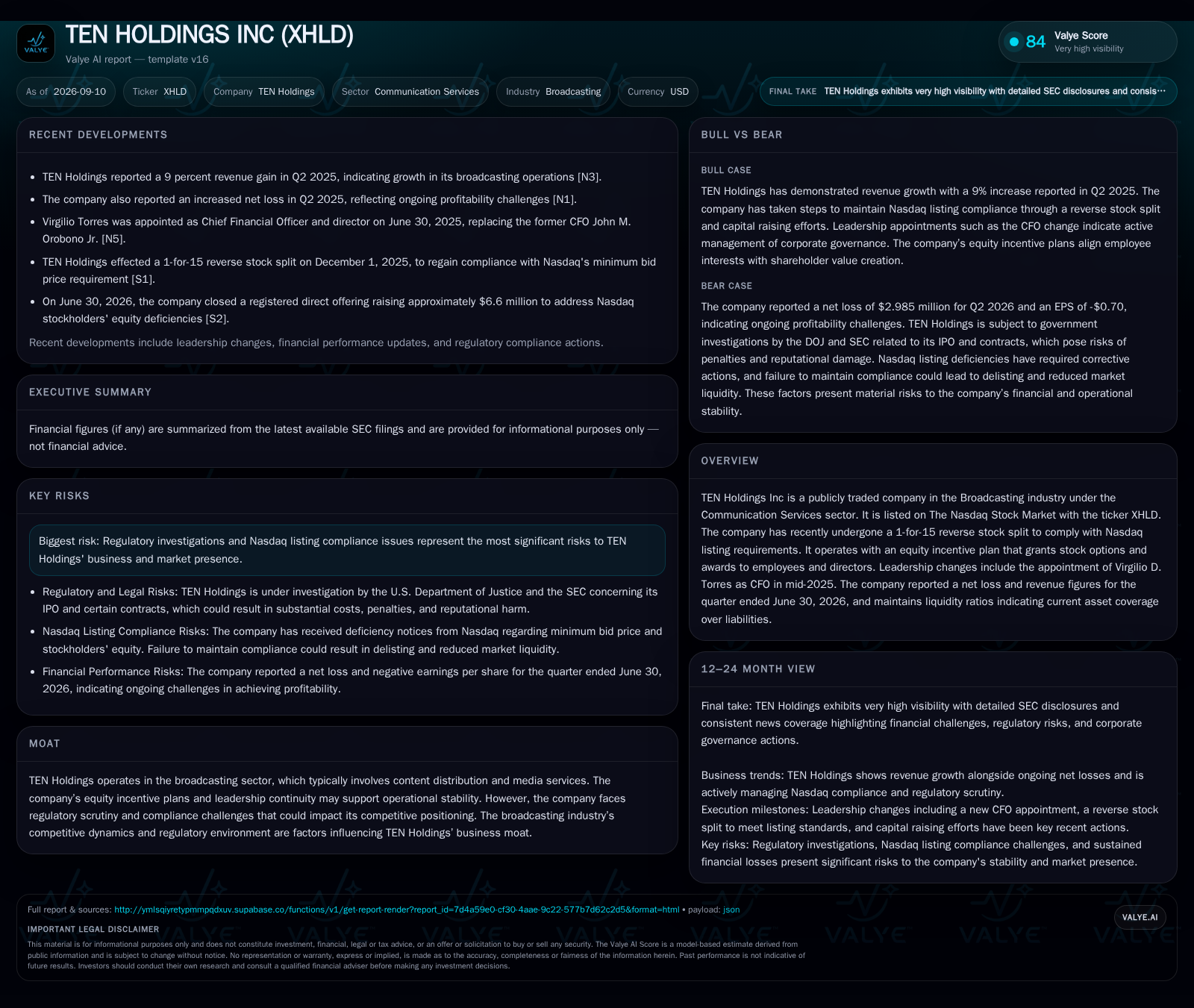
TEN Holdings remains under significant operational and regulatory strain, with Q2 2026 losses, DOJ/SEC probes, and a history of Nasdaq compliance challenges. A recent capital raise and leadership changes provide some breathing room, but the core economics of small-scale broadcasting and the cloud of legal risk limit near-term visibility and longer-term upside. Investors should focus on revenue mix, cost control, and regulatory outcomes as key determinants of future value. [S1] [S2]
TEN Holdings Inc. is emblematic of the challenges facing small-cap broadcasters: modest revenue, persistent losses, and a volatile regulatory backdrop. Despite a recent capital infusion and leadership reshuffling aimed at stabilizing operations and retaining its Nasdaq listing, the company’s future is clouded by ongoing DOJ and SEC investigations, as well as a chronic inability to generate profits.
Liquidity Infusion, Compliance Maneuvers, and Regulatory Headwinds Shape Present Reality
TEN Holdings reported Q2 2026 revenue of $731,000 against a net loss of $2.985 million, translating to a basic and diluted EPS of -$0.70. These results underscore the persistent challenge of scaling revenues enough to cover fixed costs in the broadcasting sector. [S2]
To address Nasdaq’s minimum equity requirements, the company completed a $6.6 million direct offering in June 2026 and had cash and equivalents of $5.83 million at quarter-end, with a current ratio of 3.01 and a cash ratio of 1.9. This temporarily relieves some balance sheet pressure, but does not resolve underlying operating losses. [S2]
Regulatory investigations by the DOJ and SEC concerning the company’s IPO and contracts represent a material and open-ended risk, with the potential for significant costs, penalties, and reputational harm. [S1]
Leadership changes—including the appointment of a new CFO in 2025 and a reverse stock split to maintain Nasdaq listing—reflect a reactive stance to external pressures rather than proactive operational improvement. [S1] [S2]
The Fixed-Cost Dilemma and Revenue Scale in Small-Cap Broadcasting
The core economic challenge for TEN Holdings is the mismatch between its modest revenue base and the fixed cost structure typical in broadcasting. Content acquisition, production, distribution rights, and regulatory compliance costs do not scale down easily, making profitability elusive for small players unless they achieve either significant audience growth or develop high-margin, differentiated content.
The Q2 2026 net loss of $2.985 million on $731,000 revenue suggests negative operating leverage: incremental revenue is currently insufficient to cover overhead and direct costs. Without evidence of a scalable digital platform, meaningful syndication revenue, or premium advertising rates, the company’s current revenue mix likely leans on low-margin, traditional broadcasting streams.
The recent capital raise provides a temporary buffer but does not address the underlying cash burn. If the company cannot transition to a more variable cost model (e.g., via outsourced content or digital distribution) or grow top-line meaningfully, repeated capital raises or cost-cutting may be required—each with diminishing returns and potential dilution.
A critical dimension to the fixed-cost dilemma is the limited flexibility in cost structure inherent to traditional broadcasting. Unlike digital-native media companies, broadcasters face substantial sunk costs in infrastructure, licensing, and regulatory fees that do not diminish with declining revenue. This inflexibility means that even marginal declines in audience or advertising rates can disproportionately impact profitability. In this context, TEN Holdings’ inability to scale revenue rapidly creates a persistent cash flow gap that capital raises only temporarily patch. Transitioning to a hybrid model that leverages digital distribution could theoretically introduce more variable costs and reduce fixed overhead, but such a shift demands upfront investment and carries execution risk in a crowded digital content ecosystem.
Navigating a Crowded Media Landscape Without Clear Differentiation
TEN Holdings operates in a highly fragmented and competitive broadcasting sector, contending with national media conglomerates, digital-first content providers, and local independent stations. Larger peers benefit from scale in content acquisition, distribution, and ad sales, making it difficult for smaller players to negotiate favorable terms or attract premium advertisers.
The broadcasting industry is also facing secular headwinds: audience fragmentation, declining linear TV viewership, and the migration of advertising spend to programmatic and digital channels. Without evidence of a unique audience niche, proprietary content, or strong distribution partnerships, TEN Holdings is at risk of being squeezed on both revenue and cost fronts.
Regulatory scrutiny further weakens the company’s competitive hand, as ongoing investigations may deter potential partners, advertisers, or acquirers, and could result in contractual restrictions or higher compliance costs relative to peers.
The competitive dynamics in small-cap broadcasting also reflect entrenched barriers to scale and differentiation. Larger media conglomerates benefit from economies of scale in content procurement, multi-platform distribution, and centralized sales forces, enabling them to offer advertisers broader reach and integrated campaigns. For TEN Holdings, competing on price or content breadth is challenging without similar scale advantages. The company’s ability to carve out a defensible niche depends on either unique local market penetration or specialized content that attracts loyal audiences. However, audience fragmentation driven by streaming services and digital platforms further fragments attention, making it difficult to build critical mass in any single demographic segment.
What Would Drive a Turnaround? Evidence Needed for Revenue Diversification and Legal Resolution
A plausible path to upside would require a confluence of positive developments: 1) successful resolution of DOJ/SEC investigations with minimal penalties, 2) stabilization or growth of core broadcasting revenue, and 3) a shift toward higher-margin digital or syndicated content offerings.
Confirmation would come from new or expanded content partnerships, evidence of digital platform launches or audience growth, and a marked reduction in quarterly operating losses. A public closure or favorable settlement of regulatory probes would lift the legal overhang and potentially restore confidence among advertisers, partners, and investors.
The company could also benefit from industry consolidation if it positions itself as an attractive acquisition target—though this would depend on cleaning up legal and financial uncertainties first.
Sustained Losses and Legal Overhang Define the Most Likely Trajectory
Absent a material change in revenue mix or cost structure, the most plausible scenario is continued operating losses, punctuated by periodic capital raises and ongoing regulatory uncertainty. The company’s current liquidity cushion could be rapidly depleted by legal costs or further revenue shortfalls.
Evidence confirming this scenario would include further net losses of similar magnitude, lack of new content or distribution deals, and continued references to regulatory investigations in filings. A failure to secure recurring, high-margin revenue streams or to demonstrate meaningful cost reductions would reinforce the base case.
Falsification would require a clear inflection in revenue growth, tangible margin improvement, or a public resolution of the DOJ/SEC matters.
Legal Penalties or Delisting Could Trigger a Liquidity Crisis
The adverse scenario centers on the crystallization of regulatory risk—namely, material penalties, settlements, or litigation costs arising from the DOJ/SEC investigations. This could quickly drain the company’s cash reserves and force asset sales, restructuring, or even bankruptcy proceedings.
A secondary risk is failure to maintain Nasdaq listing due to continued equity deficiencies or a persistent low share price, which would further reduce liquidity and investor access, potentially triggering covenant defaults or loss of key business partners.
Confirmation of this scenario would be signaled by adverse legal judgments, additional Nasdaq deficiency notices, accelerated cash burn, or a public announcement of strategic alternatives (e.g., sale, merger, or liquidation).
Milestones That Could Shift the TEN Holdings Thesis
Quarterly revenue growth or contraction, especially any breakout above the current ~$731,000 level, would help assess whether the company is gaining operational traction. [S2]
Disclosure of digital platform launches, new syndication deals, or premium content partnerships would indicate efforts to diversify and improve margins, if disclosed.
Updates on the status or resolution of DOJ and SEC investigations, including any settlement terms or penalties, would materially impact both cash flow and reputation. [S1]
Sustained net losses or signs of increasing operating cash burn would test the durability of the current liquidity position and capital raise efficacy. [S2]
Further Nasdaq deficiency letters or compliance actions, including threats of delisting, would signal ongoing listing risk and potential liquidity constraints. [S1] [S2]
Changes in executive leadership or board composition could signal either proactive turnaround efforts or instability, depending on context.
Issuance of additional equity or debt to fund operations would increase dilution risk and may indicate ongoing reliance on external funding, if disclosed.
Disclaimer: This is research-only, informational analysis and not investment advice. It may include AI-generated interpretation and general industry context. Always verify important details using primary sources.

Comments