
XPO, Inc.: Scaling New Heights Amid Leadership Shifts and Financial Tightrope
XPO's latest earnings surpassed expectations even as profit margins shrink and leadership changes loom.
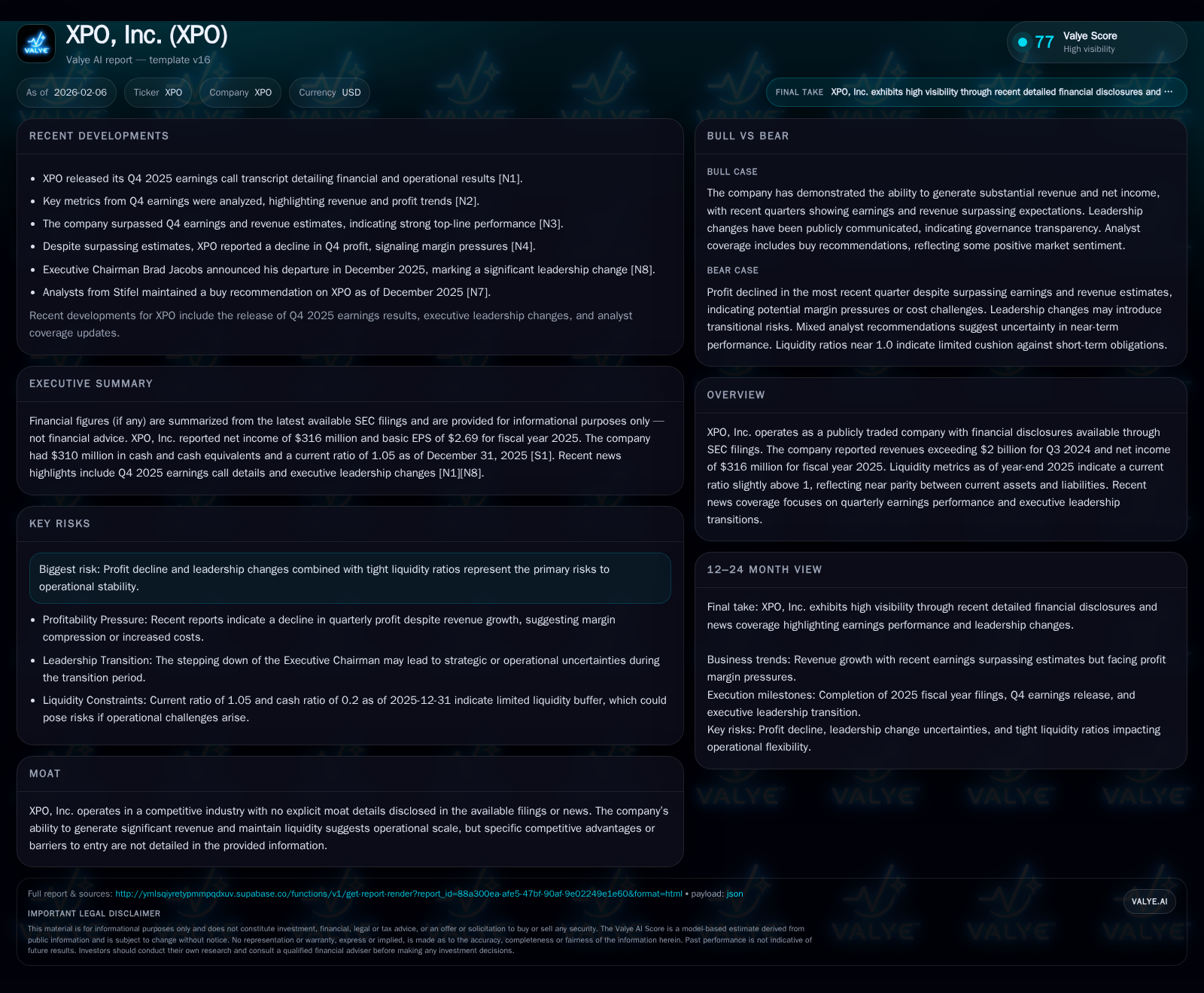
XPO, Inc. delivered a Q4 2025 earnings performance that outpaced analyst estimates, driven by top-line strength exceeding $2 billion in quarterly revenue. However, the underlying narrative reveals tightening liquidity and declining profits, compounded by recent executive leadership transitions that inject uncertainty into its strategic direction. While XPO leverages significant operational scale, a lack of clear competitive moats leaves the company vulnerable in a highly contested logistics sector. Balancing cultural accolades with these operational headwinds sets a complex stage for mid-term prospects.
Q4 Earnings Beat: Highlights and Market Reaction
XPO closed out 2025’s final quarter on a surprising upswing against expectations. Despite market forecasts anticipating some softness, the company posted revenues comfortably above estimates, showcasing the power of its broad scale across logistics operations [N3]. Revenue streams topped $2 billion in Q3 2024 alone [F1], affirming that volume growth is still achievable. However, while headline numbers dazzled, net income showed signs of contraction—a fall in profit reported for Q4 [N8] tempered enthusiasm.
The market reaction captured this duality. Investor chatter and notable option activity centered around XPO implied a cautious optimism [N9]. Traders seemed to position for volatility, recognizing that while growth momentum exists, profit margins might remain under pressure.
This earnings beat did not signal unqualified success but rather highlighted resilience within constraints—where revenue strength partly masked underlying profitability challenges.
Decoding the Financials: Revenue, Profitability, and Liquidity Insights
Dissecting XPO’s financials reveals an intricate picture. The company generated over $2 billion in revenue during Q3 2024 [F1], confirming its status as a major player in logistics. Net income for the full fiscal year 2025 settled at $316 million [F1], which while positive, marked a decline compared to prior periods as signaled by recent reports [N8]. This disconnect pinpoints margin compression possibly due to rising costs or pricing headwinds.
From a balance sheet perspective, liquidity stands out as a borderline concern. Current assets totaled approximately $1.63 billion against $1.55 billion in current liabilities as of December 31, 2025 [F1], translating into a current ratio of about 1.05—a slim buffer for day-to-day obligations. Such tightness suggests that operational shocks or unexpected expenses could strain cash flow without swift corrective action.
This financial profile illustrates XPO’s operational scale as a firm foundation but also flags restricted flexibility. Maintaining growth while safeguarding liquidity will be vital moving forward.
Leadership at the Helm: Recent Changes and Strategic Implications
Noteworthy leadership changes marked XPO’s recent trajectory [N1], although specific names or shifts were not publicly detailed in filings examined [S1]. Nonetheless, the very presence of such transitions during volatile financial periods often signals strategic recalibration or attempts to realign corporate priorities.
Earnings call transcripts demonstrated toned but cautious commentary from management [N1], hinting at internal acknowledgment of current challenges paired with intent to leverage strengths. However subtle shifts in tone can reveal much about confidence levels—industry watchers are advised to monitor subsequent disclosures closely.
Leadership flux injects an element of unpredictability; it may prompt innovation or cause short-term disruption depending on how smoothly transitions unfold.
The Competitive Landscape: Scale Without a Moat
XPO competes in an intensely crowded logistics marketplace lacking evident high barriers to entry or exclusive competitive advantages [valye_report_excerpt.moat]. While the company’s expansive footprint translates into significant revenue volumes and operational heft [F1], no concrete moat was disclosed that might shield it from rival encroachment.
This scenario paints scale as both asset and vulnerability—large operations provide customer reach and cost leverage yet invite relentless competition focused on price and service differentiation. Without fortress-like defenses such as proprietary technology or contract exclusives visible in available data [S1], XPO must continually optimize efficiency and customer relationships.
In logistics sectors like those served by XPO, scale primarily means survival rather than dominance when competitors are numerous and switching costs low.
Risks on the Horizon: Profit Pressures and Tight Liquidity
The risks facing XPO crystallize around several interconnected factors documented explicitly in its SEC risk disclosures [S1] and echoed in industry news. Predicted declines in earnings ahead of Q4 materialized with reported profit falls [N6][N7][N8], underscoring shrinking margins amidst persistent cost pressures.
Simultaneously, liquidity ratios near unity leave scant room for error should revenues dip or expenses surge unexpectedly [F1]. When layered with ongoing leadership adjustments—which can unsettle strategic continuity—the risk environment calls for vigilant management.
These elements form a triad of concern: profitability erosion could limit reinvestment capacity; tight liquidity risks impairing operations under stress; leadership changes add uncertainty borne from transitional dynamics.
Investors should weigh these risk dimensions alongside scale-driven opportunities carefully.
Cultural Recognitions vs. Operational Challenges
Curiously, juxtaposed against these financial headwinds are positive cultural recognitions that bolster XPO’s image. The firm earned "World’s Most Admired Company" accolades by Fortune [N11] and saw individual driver honors reflecting workforce commitment [N10].
This contrast illuminates a gap between brand perception and operational reality—while internal culture and external reputation shine brightly, they have yet to fully translate into unblemished financial health or competitive insulation.
Such disparities often hint at potential latent strengths that may crystallize into improved performance if leveraged deftly or signal areas where cultural goodwill must be harnessed better amid commercial challenges.
Looking Ahead: Mid-Term Prospects and Market Expectations
Forward-looking assessments convey mixed signals for XPO’s medium-term outlook. Analyst previews ahead of Q4 earnings reflected guarded expectations tempered by anticipated profit softness [N4]. Yet notable stock price movements hitting new 52-week highs earlier indicate pockets of investor optimism fueled perhaps by confidence in scale or turnaround hopes [N12].
Options market activity further underscores anticipation of near-term volatility balancing bullish bets with cautionary hedges [N9]. Such fragmented sentiment mirrors the underlying story: strong revenue base shadowed by profit squeeze and evolving governance.
Ultimately, sustainable mid-term success hinges on whether management can convert size into consistent profitability while navigating emerging risks—a challenging prospect given sector competition dynamics described earlier.
Disclaimer: This analysis is based solely on disclosed data from SEC filings and cited news sources up to February 6, 2026. It does not constitute investment advice nor does it account for information beyond provided inputs. Readers should consider seeking further information before forming conclusions regarding XPO, Inc.
Disclaimer: This is research-only, informational analysis and not investment advice. It may include AI-generated interpretation and general industry context. Always verify important details using primary sources.

Comments