
Xtend AI Robotics: Modest Revenue, Deep Losses, and the Unanswered Questions of Scale
With $14.9 million in quarterly revenue and a $44.6 million net loss, Xtend AI Robotics faces critical questions about the economics and scalability of its business. Its reported liquidity position provides short-term leeway, but the lack of operational disclosure leaves investors guessing about path to profitability and competitive edge.
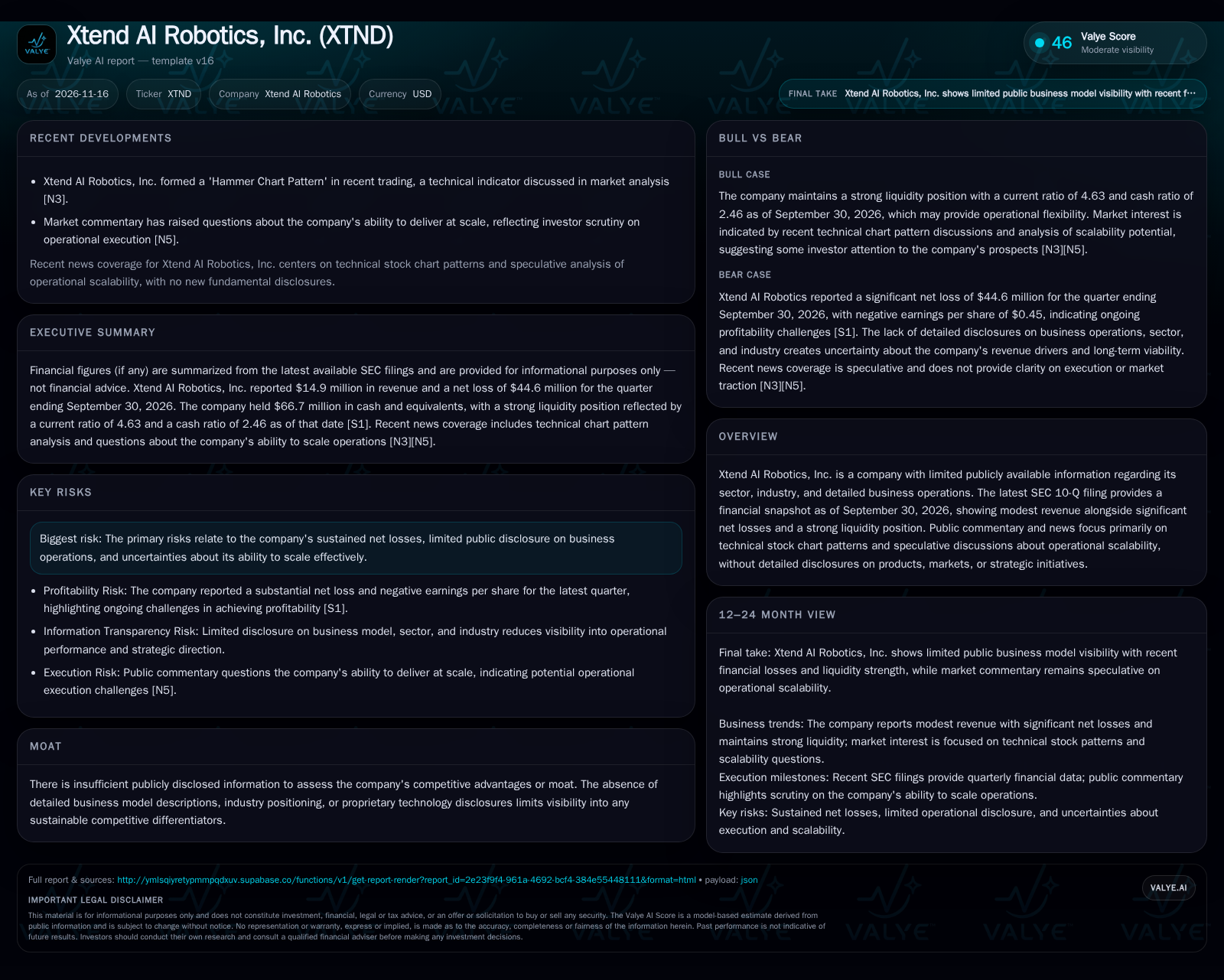
Xtend AI Robotics reported $14.9 million in revenue and a $44.6 million net loss for the quarter ending September 30, 2026, maintaining $66.7 million in cash and a current ratio of 4.63. While reported liquidity position, the company’s sector, business model, and revenue drivers remain undisclosed. Market commentary is focused on technical chart patterns and skepticism about Xtend’s ability to scale, leaving the investment case highly speculative and dependent on clarity around operational execution and economics. [S1] [N3] [N5]
Xtend AI Robotics, Inc. presents a paradox: the company boasts substantial liquidity and modest revenue, yet is hampered by steep losses and an absence of operational transparency. With $14.9 million in revenue against a $44.6 million net loss for the latest quarter, and $66.7 million in cash, investors are left to speculate on the underlying business mechanics and growth prospects. Recent market commentary focuses more on technical trading patterns than fundamentals, underscoring the lack of clarity on how—or if—Xtend can scale profitably in its undisclosed field.
Financial Snapshot Highlights Liquidity Cushion but Persistent Losses
Xtend AI Robotics reported $14.9 million in revenue and a net loss of $44.6 million for the quarter ending September 30, 2026. The company’s cash and cash equivalents stood at $66.7 million, supporting a current ratio of 4.63 and a cash ratio of 2.46. The company reported cash and liquidity metrics for the period; these figures do not by themselves establish operating runway, investment capacity, financial flexibility, or financing capacity. However, the magnitude of quarterly losses raises questions about burn rate and the sustainability of this liquidity cushion if profitability does not improve. Publicly available information does not clarify the sources of revenue, cost structure, or the drivers of these losses. Market commentary is focused on stock technicals and the company's ability to deliver at scale, with little operational detail or evidence of business momentum. [S1] [N3] [N5]
How Economics Could Work: Revenue, Cost Structure, and Capital Needs
Without disclosed details on products, customer segments, or go-to-market strategy, the economic engine of Xtend AI Robotics remains speculative. The reported revenue of $14.9 million suggests some commercial activity, but the scale of net loss ($44.6 million) points to either high fixed costs, aggressive R&D and SG&A investment, or low gross margins. If the company is focused on robotics or AI hardware/software solutions, typical cost drivers would include hardware bill of materials, software development, engineering headcount, and potentially high customer acquisition costs. The question is whether revenue is derived from product sales, SaaS contracts, services, or a mix—each with very different margin and cash flow profiles.
If Xtend is pursuing a land-grab or platform strategy, heavy upfront investment could be justified by eventual operating leverage—yet there is no evidence of network effects, recurring revenue, or high-margin software in the public filings. The absence of commercial mechanics also clouds the assessment of pricing power, customer stickiness, or the ability to scale revenue faster than costs. Until more detail emerges, the business model could plausibly range from capital-intensive hardware to potentially higher-margin AI-driven software or services.
Opaque Market Position Leaves Competitive Threats and Advantages Unclear
Xtend AI Robotics’ lack of disclosed sector, industry, or product focus precludes a concrete assessment of its competitive position. If operating in robotics or AI, the company would likely face competition from well-capitalized technology firms, established robotics vendors, and emerging AI startups. Potential sources of advantage might include proprietary algorithms, specialized hardware integration, or unique datasets—but none are documented. The absence of commercial or technical disclosures also means that barriers to entry, intellectual property portfolio, or ecosystem lock-in (such as platform or network effects) cannot be verified.
Market commentary questioning Xtend’s ability to deliver at scale implies that investors and analysts are skeptical about its operational execution and ability to compete effectively. In sectors like robotics and AI, switching frictions, integration depth, and recurring software contracts can create defensible moats, but in the absence of evidence, it is equally plausible that Xtend is exposed to margin pressure, customer churn, or rapid technological substitution. Until the company provides more granular disclosure, its competitive dynamics remain a significant unknown.
What Would Signal a Path to Scalable, Profitable Growth?
A favorable outcome for Xtend AI Robotics would require evidence that its current losses are the result of purposeful investment in scalable, high-margin opportunities—such as a differentiated robotics platform or proprietary AI solution with strong customer demand. The upside scenario depends on the company demonstrating operating leverage: revenue growth outpacing increases in fixed costs, improving gross margins, or a shift toward recurring, high-value contracts.
Confirmation of this scenario would come from future disclosures showing accelerating revenue, narrowing losses, and clear customer wins or partnership announcements. Evidence of product-market fit—such as repeat orders, expanding customer cohorts, or integration with larger platforms—would bolster the case. If the company can articulate a defensible moat (e.g., unique technology, ecosystem effects, or high switching costs) and show movement toward breakeven, investor confidence could rebound quickly. Conversely, the absence of margin improvement or clarity on revenue drivers would falsify the bullish case.
Absent Clarity, Expect Volatility and Cautious Market Engagement
The most plausible near-term trajectory for Xtend AI Robotics is continued modest revenue and ongoing losses as the company attempts to clarify its business model and demonstrate operational execution. Until more detail is provided on revenue sources, cost structure, or strategic direction, the market is likely to treat the stock as speculative, with price action driven by technical factors and sentiment rather than fundamentals.
Regular, transparent updates on commercial progress, customer traction, or product development would be needed to shift sentiment from skepticism to cautious optimism. Conversely, continued opacity or deteriorating financials would reinforce the perception of high risk.
Sustained Losses and Opacity Could Lead to Diminished Confidence and Funding Pressure
If Xtend AI Robotics is unable to reduce its losses or clarify its operational model, the risk is that investor confidence continues to erode, eventually constraining access to capital markets or partnership opportunities. Sustained high burn rates, combined with lack of commercial visibility, could force the company into defensive measures such as cost cuts, asset sales, or dilutive financings.
This scenario would be confirmed by persistent negative earnings without offsetting revenue growth, further reductions in cash balance, or signals that customer or partner traction is lacking. If news commentary shifts from technical patterns to concerns about solvency or going-concern risk, or if the company is forced to raise capital on unfavorable terms, the bear case would be validated.
What Will Determine Whether Xtend AI Robotics Gains Traction or Falters?
Quarterly revenue growth rate and the mix of revenue sources, if disclosed, to assess whether the company is scaling or merely sustaining modest activity.
Gross margin trends, which would clarify whether the company’s business model is capital-intensive and low-margin or moving toward higher-value offerings.
Cash burn rate relative to liquidity, to monitor whether runway is shortening and when additional capital might be required.
Disclosures of customer concentration, contract duration, or recurring revenue, if provided, to evaluate stability and visibility of future cash flows.
Announcements of partnerships, major customer wins, or integration deals, which would serve as external validation of product-market fit.
Clarity on sector, product suite, or unique technological differentiators, as this would help benchmark against peers and assess competitive advantage.
Management commentary or investor communications that outline strategic priorities, execution milestones, and targeted financial outcomes.
Any regulatory or legal filings that could signal operational risks, intellectual property issues, or sector-specific headwinds.
Disclaimer: This is research-only, informational analysis and not investment advice. It may include AI-generated interpretation and general industry context. Always verify important details using primary sources.

Comments