
XWELL, Inc. Refreshes Wellness Strategy with Airport Spa Expansion and Bio-Surveillance Pivot
XWELL updates operational posture in Q1 2026 amid rising losses and arbitration over key airport locations, while pursuing growth via health-focused traveler services.
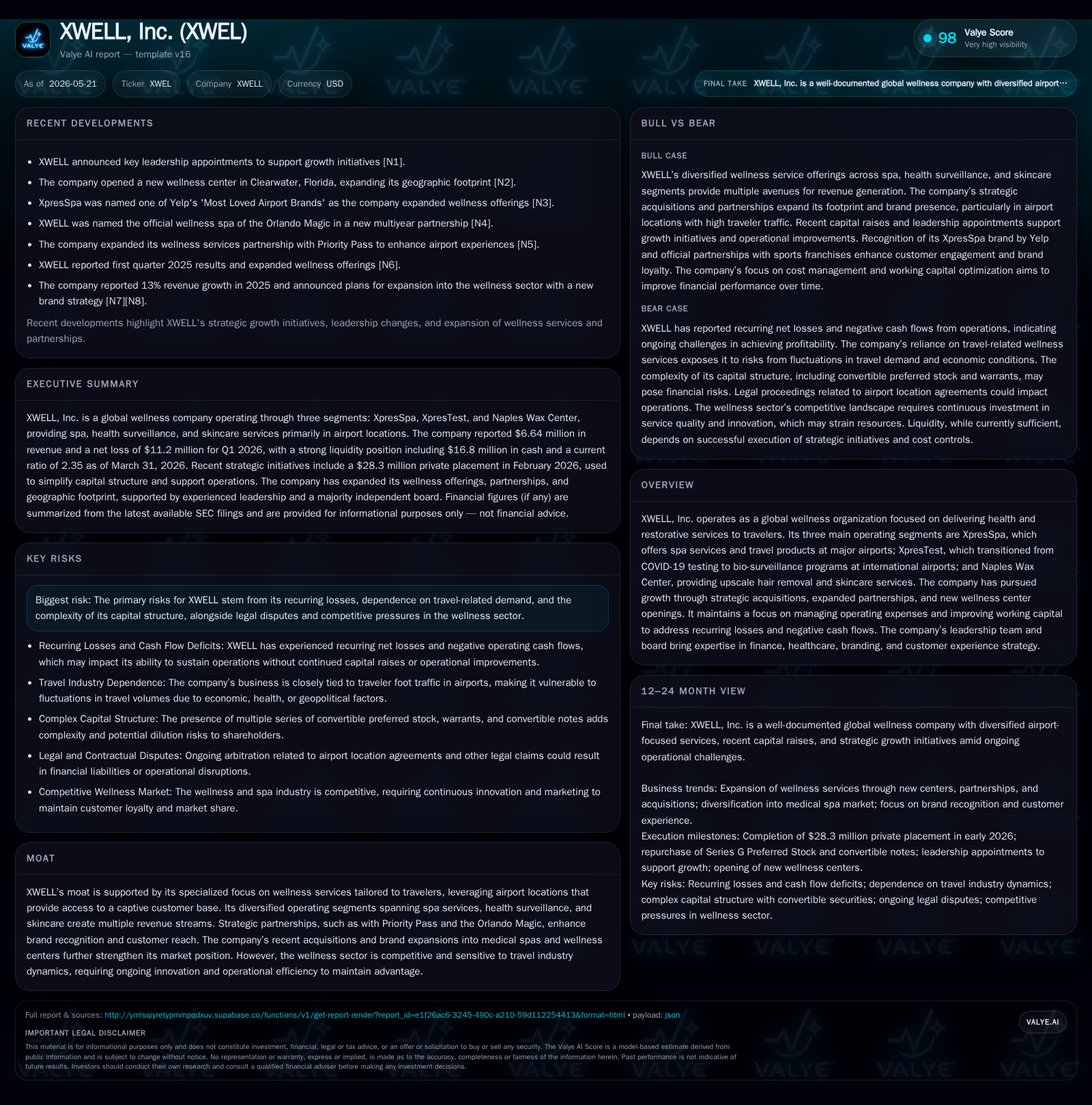
In its latest quarterly filing, XWELL, Inc. reported a deepened net loss driven by legal challenges and ongoing investment in its airport wellness segments. The company’s business model hinges on delivering spa, health surveillance, and skincare services to captive traveler populations primarily in airports. Competitive pressures and reliance on travel volume pose cyclical risks, but opportunities lie in expanding bio-surveillance offerings post-pandemic and integrating acquisitions. Liquidity was bolstered by a convertible preferred stock private placement used partly to reduce debt complexity, supporting ongoing operations despite negative cash flow.
Latest Quarterly Operating Update: Challenges and Developments
XWELL’s 10-Q filing for the quarter ended March 31, 2026 ([S2]) reveals a pronounced expansion of net loss to $11 million compared to $4.6 million in the same period last year. This deterioration stems primarily from elevated operating costs combined with legal uncertainties surrounding key airport operations. XpresSpa Holdings, a subsidiary managing spa locations in major airports including Hartsfield-Jackson Atlanta International Airport (ATL), faces arbitration initiated by the City of Atlanta regarding contractual disputes with Cordial Endeavor Concessions LLC over operation rights in two ATL terminals ([S17]). The conclusion of this arbitration poses a material risk to revenue continuity at these critical sites.
Meanwhile, the company continues to face negative operating cash flows. Though depreciation remains modest relative to total costs, general administrative expenses surged markedly year-over-year, highlighting ongoing investment pressures or restructuring costs ([S19]). Despite these challenges, management reports implementing expense reduction initiatives alongside controlled capital expenditures aiming to curb losses.
Business Model Underpinning XWELL's Wellness Services Portfolio
XWELL's revenue generation pivots on servicing travelers through three distinct but complementary segments:
- XpresSpa: offering massages, skincare treatments, and travel-ready wellness products at major hubs; these venues capitalize on the captive nature of airport travelers requiring relaxation or self-care between flights.
- XpresTest: originally focused on COVID-19 diagnostic testing services shifted strategically toward broader bio-surveillance programs at international airports as public health protocols evolved post-pandemic.
- Naples Wax Center: comprising upscale hair removal and skincare salons operating outside airports targeting both travelers and local clientele seeking specialty salon services ([S1], [S2]).
Revenue mechanics involve transactions predominantly with end consumers — travelers willing to pay a premium for convenient health or leisure services en route. The offering’s specialization for transit environments creates natural switching costs due to location exclusivity and integrated branding with partners like Priority Pass that facilitate customer access ([S1]). Additionally, diversified streams across spa services and emerging health surveillance reduce reliance on a single product line but amplify operational complexity.
Industry Overview: Competitive Intensity and Customer Dynamics
The airport-based wellness sector intersects hospitality, personal care, and healthcare niches characterized by competitive intensity from both retail wellness chains and medically oriented spas in urban markets. Demand is structurally reliant on passenger volumes though modulated by travel cycle fluctuations that introduce some cyclicality into usage patterns ([S1]).
Regulatory considerations especially affect XpresTest’s bio-surveillance activities given international health security standards and variable government policies. Price sensitivity exists among traveler demographics; however, convenience and time constraints generally support premium pricing power where service speed and quality differentiate offerings.
Capacity constraints exist principally in gaining or renewing leases within high-traffic terminals—a competitive bottleneck impacting ability to scale rapidly. Brand partnerships serve as critical distribution leverage points enhancing foot traffic conversion rates but require sustained marketing investments.
Growth Opportunities in Travel Wellness and Health Surveillance
XWELL plans revenue expansion through multiple strategic vectors:
- Scaling XpresSpa locations into additional high-traffic airports augmenting overall service footprint.
- Diversifying XpresTest’s bio-surveillance portfolio beyond pandemic-specific testing into integrated public health monitoring aligning with increasing global health vigilance—potentially capturing higher volume contracts tied to international travel compliance frameworks ([S1]).
- Pursuing selective acquisitions vetted by the Strategic Affairs Committee focused on synergistic operators enhancing market breadth or introducing novel wellness modalities ([S1]).
- Leveraging alliance networks such as Priority Pass elevates customer acquisition efficiency while co-branding arrangements like with Orlando Magic boost general brand equity.
These initiatives correlate directly with measurable indicators such as increased bookings per location, growing contract wins for surveillance services at new airport hubs, and improving utilization rates pushing towards profitability thresholds.
Risks and Constraints Impacting Operational Performance
Primary vulnerabilities include:
- Ongoing net losses compounded by negative operational cash flow necessitate continuous focus on cost containment without sacrificing growth potential ([S2]).
- Exposure to external shocks tied to airline industry downturns or travel restrictions which can abruptly curtail foot traffic volume affecting all segments ([S1]).
- Legal pressures stemming from the ATL airport arbitration may disrupt or eliminate revenues from important locations pending rulings ([S17]).
- Complex capital structure involving multiple series of convertible preferred stock coupled with embedded derivative liabilities creates financial leverage risk; interest payments at an effective rate near 8.8% also press on liquidity ([S2]).
- Competitive pressure demands ongoing innovation while ensuring service quality to prevent customer attrition in retail-centric environments where alternatives are readily accessible.
Absent successful resolution of these issues or favorable market tailwinds, margin recovery remains challenged.
Near-Term Milestones and Key Indicators to Monitor
Key upcoming developments offering insight into trajectory include:
- The final decision outcome of the Atlanta airport arbitration case will materially impact future operating results from those facilities ([S17]).
- Integration progress of newly acquired wellness centers alongside rollout cadence of bio-surveillance enhancements should reflect in booking increases or positive feedback loops noted in quarterly KPIs ([S1], [S3]).
- Monitoring operating cash flows each quarter gauges effectiveness of expense controls against revenue mix shifts following strategic adjustments ([S2]).
- Tracking customer volume trends via partner programs such as Priority Pass accesses provides leading indicators of traveler engagement levels.[S1]
Successful advancement on these fronts could signal tangible momentum towards sustainable profitability.
Concise Financial Profile and Liquidity Overview
As of Q1 2026 quarter-end, XWELL holds approximately $16.8 million in cash and equivalents with total debt estimated near $3.4 million as of December 2025 ([F1], [S2]).
This position was strengthened significantly by proceeds from a February 2026 private placement issuing Series H Convertible Preferred Stock generating over $28 million gross proceeds; part was allocated toward repurchasing higher-cost Series G Preferred Stock notes reducing financing burdens ([S11]). Interest expense recognized during Q1 amounted to roughly $53 thousand before redemption adjustments but reflects an effective cost of borrowing nearing 8.8% annualized rate due largely to amortization components associated with convertible notes ([S2]).
While healthy liquidity buffers provide operational runway extending beyond twelve months per management assessments, persistent negative net income underscores the imperative for revenue growth aligned with tighter cost structures.
This analysis synthesizes publicly filed information from SEC disclosures without providing investment advice or research views.
Disclaimer: This is research-only, informational analysis and not investment advice. It may include AI-generated interpretation and general industry context. Always verify important details using primary sources.

Comments