
YETI in 2026: Premium Brand Leverages Innovation and Global Reach Amid Channel and Margin Volatility
YETI’s premium outdoor products strategy is yielding international growth and margin improvement, but channel mix shifts, product recalls, and macroeconomic crosscurrents test the durability of its business model. The company’s ability to maintain pricing, quality, and innovation will likely determine whether momentum can be sustained as competition intensifies and consumer sentiment remains fragile.
YETI’s Q3 2026 results highlight a strong international and wholesale rebound, gross margin gains from tariff refunds and pricing, but also expose vulnerability to DTC softness and product recall costs. The company’s global supply chain and premium positioning offer both opportunity and risk as it seeks to balance innovation-led growth with margin discipline in a competitive, inflation-sensitive market. [N4] [N7] [N2] [N6] [S2]
YETI Holdings, Inc. enters late 2026 at a strategic crossroads: international momentum and improved gross margins are counterbalanced by direct-to-consumer channel softness and the operational cost of product recalls. As the company leans on its premium brand, aggressive product innovation, and omni-channel model to drive growth, the ability to manage rising expenses and defend market share against both legacy and emerging rivals will be crucial. The next phase for YETI will test whether its pricing power and customer loyalty can withstand persistent macroeconomic headwinds and intense competition.
International Growth and Channel Shifts Define YETI’s Recent Performance
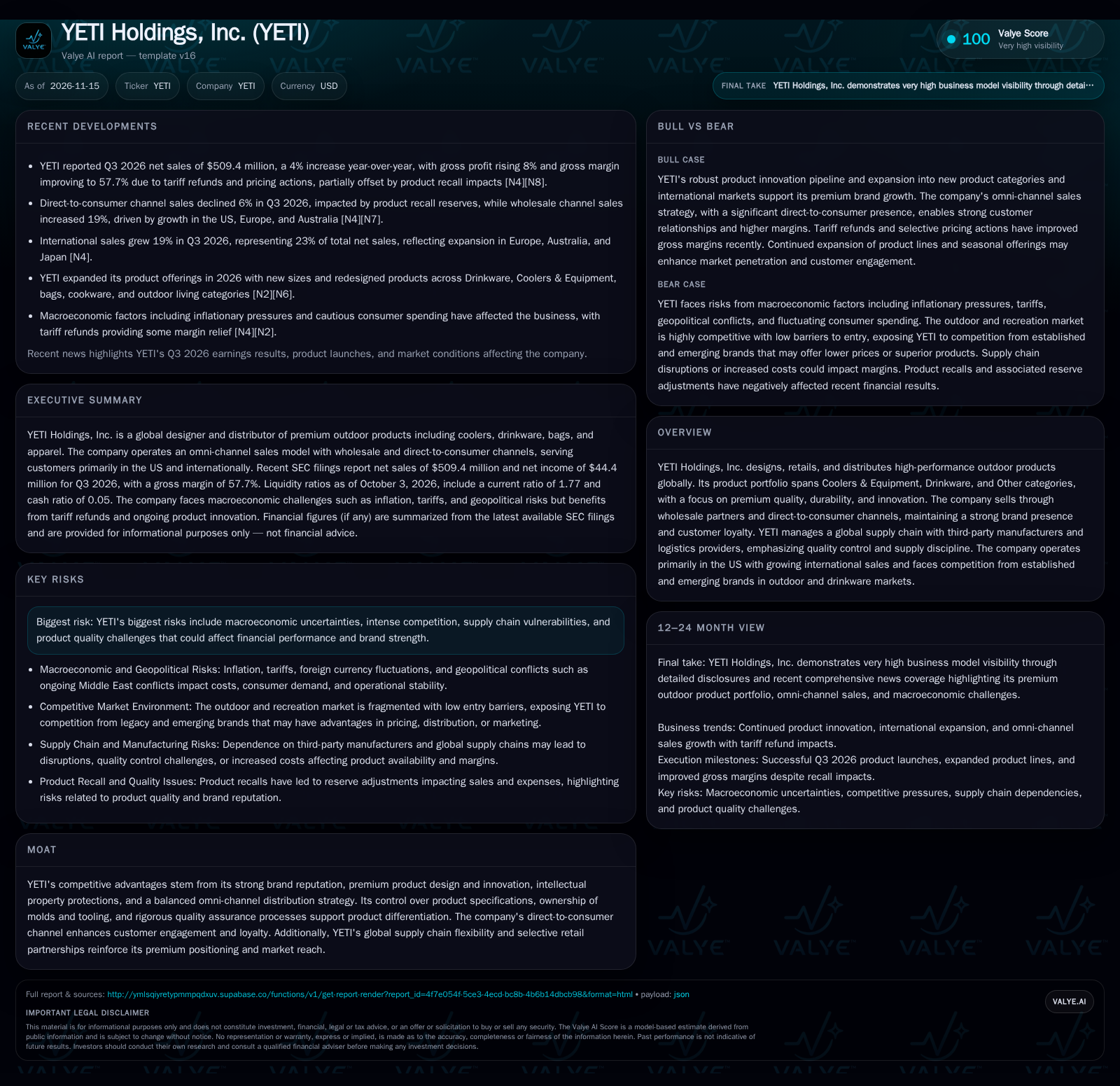
YETI’s Q3 2026 results reveal a business in transition: wholesale channel sales increased 19%, helping offset a 6% direct-to-consumer (DTC) revenue decline driven by product recall reserves. International sales climbed 19% year-over-year and now constitute 23% of total net sales, signaling meaningful traction outside the core U.S. market. Gross margin improved on the back of tariff refunds and selective price increases, but these gains were partially offset by recall-related costs and commodity inflation. SG&A expenses rose 7%, reflecting higher distribution, marketing, and recall reserves. These data points illustrate a company benefiting from global expansion and supply chain tailwinds, but also grappling with volatility in its high-margin DTC channel and the financial drag of quality issues. [N4] [N7] [N2] [N6] [S2]
How YETI’s Model Converts Premium Brand Equity into Profits—And Where Friction Emerges
YETI’s economics hinge on premium pricing, brand-driven demand, and a hybrid channel mix. The DTC channel—60% of 2025 net sales—historically delivers superior gross margins due to direct customer engagement, data capture, and reduced channel markups. The wholesale channel, while lower margin, provides scale, distribution breadth, and exposure to mainstream retailers. Recent growth in wholesale and international markets suggests volume leverage, but also introduces new margin and working capital dynamics. [S2]
Gross margin improvements in 2026 were facilitated by one-time tariff refunds and selective price increases, but commodity inflation and product recall reserves have partially offset these benefits. SG&A cost growth—driven by recall expenses, logistics, and stepped-up marketing—highlights the challenge of scaling brand and product innovation while absorbing operational shocks. Because YETI does not own manufacturing and relies on third-party suppliers, it enjoys variable cost benefits but may also face supply chain risk and less control over cost escalation. [S2]
Capital needs are moderate given the asset-light model; however, inventory management, product launches, and international expansion can drive working capital swings. Operating leverage is plausible as fixed costs scale, but product recall events and aggressive innovation cycles can introduce volatility in both gross and operating margins. [S2]
Premium Positioning Versus a Fragmented and Price-Sensitive Market
YETI’s competitive strength derives from its premium brand, product innovation, and intellectual property protections. The company’s focus on quality, durability, and design differentiation supports pricing power and customer loyalty—especially among outdoor enthusiasts and gifting segments. However, the outdoor and drinkware categories are increasingly crowded with both legacy brands and emerging direct-to-consumer entrants targeting price, customization, or niche features. [S2]
Barriers to entry in drinkware and soft goods are low, enabling rapid proliferation of competitors and private-label offerings. While YETI’s omni-channel reach and selective retail partnerships help defend shelf space, these advantages can erode if competitors match perceived quality or undercut on price. International expansion increases exposure to new competitors and less brand-aware consumers, requiring significant marketing and adaptation investment. The company’s rigorous quality control and anti-counterfeiting efforts are necessary to defend brand equity, but recall events highlight the reputational risks inherent in premium positioning. [S2]
Sustained Innovation and International Penetration Drive Profitable Expansion
A positive chain of events could see YETI leveraging its innovation pipeline and premium brand to accelerate penetration in key international markets. Continued product launches—including new sizes, redesigns, and seasonal collections—could deepen customer engagement and increase average order value, particularly if DTC channels recover from recall-related headwinds. If YETI can maintain selective pricing power and realize supply chain efficiencies, gross margin could further improve even as it scales globally. [S2]
Confirmation of this scenario would include a rebound in DTC sales growth, continued double-digit international expansion, and stable or rising gross margins net of non-recurring items. Sustained SG&A discipline—evident in marketing ROI and distribution cost management—would support operating leverage. Evidence of growing brand awareness and repeat purchasing in new markets would further validate the upside case.
Product Launches Fuel Steady Growth, but Channel Mix and Cost Pressures Cap Margin Gains
The most plausible trajectory is that YETI continues to grow mid-to-high single digits as new product introductions and international expansion compensate for mature U.S. demand and ongoing DTC channel volatility. Wholesale gains provide volume, but mix shifts toward this lower-margin channel and lingering recall costs limit margin expansion. SG&A remains elevated as the company invests in marketing and logistics to support global reach and brand defense. [S2]
Validation of this path would include ongoing, but moderating, wholesale and international sales growth, tepid DTC recovery, and stable but plateauing gross margins. Persistent SG&A growth in line with revenue, and effective management of inventory and working capital, would be consistent with this scenario. Signs of stable market share in core categories and manageable competitive encroachment would also support the base case.
Recall Fallout, Margin Compression, and Intensifying Competition Take Hold
An adverse outcome could emerge if product recall issues persist, eroding DTC channel performance and damaging brand trust. If macroeconomic caution deepens, price-sensitive consumers may shift to lower-cost alternatives, pressuring both volumes and pricing. Rising input costs—unmitigated by further tariff relief—could compress gross margins, while the need to defend share leads to escalating marketing and promotional spend. [S2]
This scenario would be confirmed by continued DTC declines, decelerating international growth, and shrinking gross margins despite one-time benefits. SG&A outpacing revenue, rising inventory levels, or increased discounting would signal mounting pressure. Evidence of market share losses to private label or innovative disruptors—especially in core cooler and drinkware categories—would further validate the downside risk.
Signals That Will Determine the Durability of YETI’s Premium Thesis
The trajectory of DTC channel revenue growth or decline, particularly after recall adjustments, if disclosed, will be critical to assessing YETI’s margin structure and brand strength. [S2]
Gross margin trends net of one-time tariff refunds and recall impacts will clarify whether pricing power and supply chain efficiency are sustainable. [S2]
The pace and profitability of international sales growth, especially in Europe, Australia, and Japan, will test the scalability of YETI’s global brand investments. [S2]
SG&A as a percentage of revenue and the underlying drivers—distribution, marketing, recall reserves—would help determine operating leverage and cost discipline. [S2]
Frequency and scale of future product recalls or quality issues, if disclosed, would directly impact reputation and cost structure. [S2]
Inventory turns and working capital metrics, if disclosed, would indicate how well YETI is managing channel fluctuations and new product introductions. [S2]
Market share trends in core product categories, if available, would provide an external validation of competitive positioning. [S2]
Disclaimer: This is research-only, informational analysis and not investment advice. It may include AI-generated interpretation and general industry context. Always verify important details using primary sources.

Comments