
Yimutian Inc. Expands ADS Facility While Advancing AI-Driven Agricultural Commerce
Yimutian’s strategic increase of its ADS facility enhances capital access while AI innovations push its leading digital agricultural platform forward.
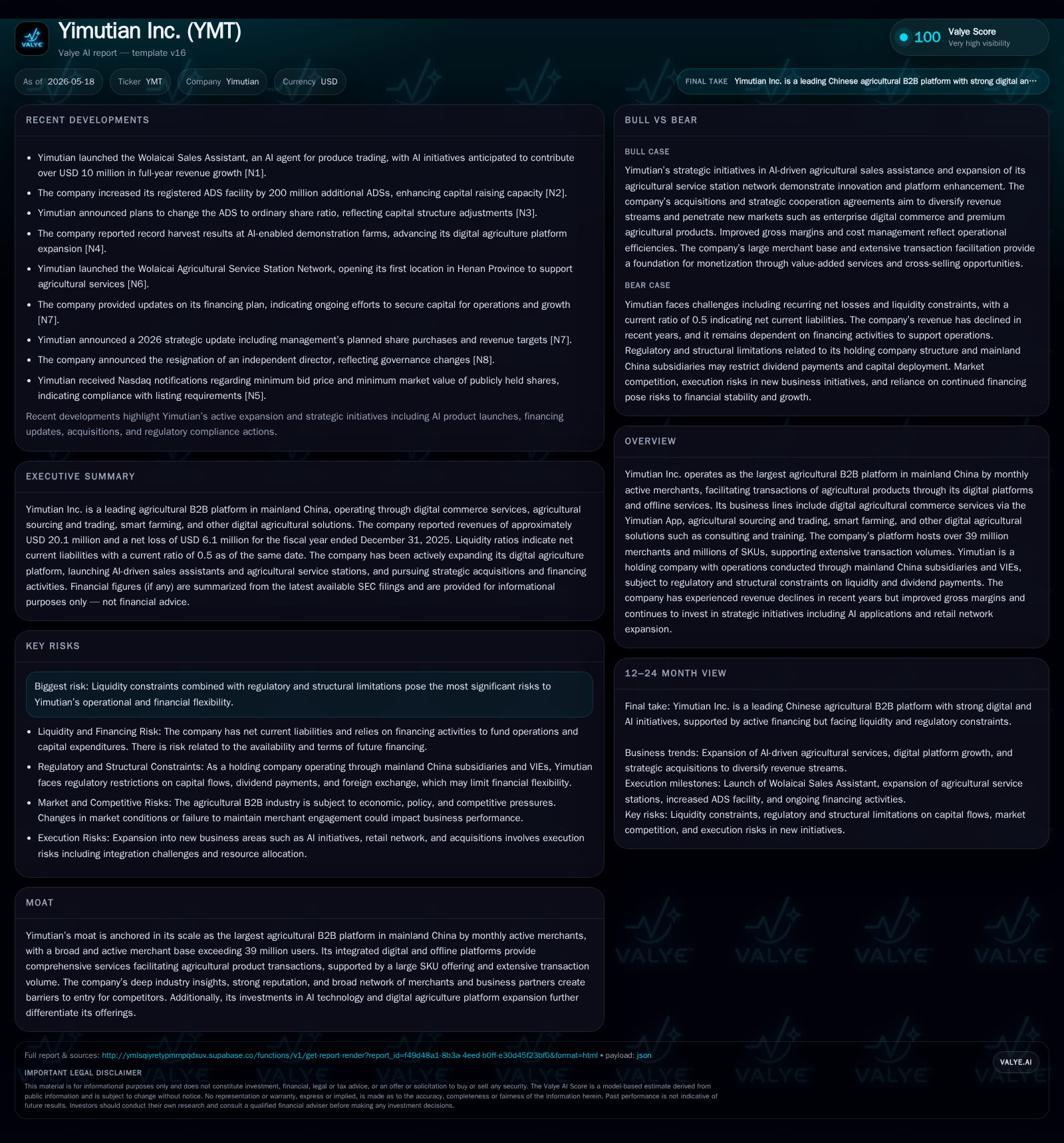
In its latest quarterly filing, Yimutian Inc. expanded its American Depositary Shares (ADS) facility by 200 million shares, a move aimed at improving trading liquidity and capital flexibility amid Nasdaq listing pressures. The company remains China’s largest agricultural B2B platform by active merchants, leveraging scale and technology integrations like AI agents to drive transaction growth and service innovation. Despite steady revenue declines and net losses, recent AI deployments and smart farming initiatives support progress toward scalable growth. However, regulatory constraints on dividend distributions and limited liquidity pose ongoing risks to operational agility.
Recent Operating Update: Elevated Capital Flexibility via ADS Facility Expansion
Yimutian’s May 2026 quarterly filing revealed an important structural shift in its U.S.-listed shares management: it increased the registered American Depositary Shares (ADS) facility by an additional 200 million ADSs [S2], a significant step toward enhancing trading volume capacity and broadening potential equity raising avenues. This expansion complements earlier notifications from Nasdaq concerning minimum bid price requirements, underscoring the imperative for the company to maintain listing compliance and market liquidity [S3],[N5]. The adjustment also aligns with Yimutian’s strategy to ensure sufficient market float amidst shareholder concentration concerns.
This move should improve secondary market trading dynamics by increasing availability of ADS units convertible into ordinary shares while providing the issuer greater leverage for financing maneuvers without immediate dilution. Given Yimutian's status as a Cayman Islands holding company operating primarily through Chinese subsidiaries and VIEs, such flexibility is central amid cross-border capital constraints.
Business Model and Service Differentiation in China’s Agricultural B2B Ecosystem
Yimutian operates as mainland China’s largest agricultural B2B platform by monthly active merchants, boasting over 39 million registered merchants as of December 2025 [S1]. The company functions through multiple synergistic business lines:
- Digital agricultural commerce via Yimutian App: a technologically advanced marketplace enabling efficient circulation of agricultural goods complemented by a robust SKU breadth (~22 million SKUs).
- Offline sales assistance through Douniu App that matches offline sellers with wholesale buyers, blending digital reach with traditional transactional trust.
- Agricultural sourcing and trading services focused on reliable connections between cultivation-site sellers and demand-side buyers.
- Smart farming operations using data-driven cultivation guided by AI insights.
- Ancillary digital agriculture solutions encompassing consulting, brand promotion, and training programs.
Revenue is primarily derived from membership fees paid by merchants who subscribe for enhanced service tiers, along with transaction facilitation fees that monetize actual trade volumes conducted on the platform. Despite a gradual decline in paying merchant percentages relative to total active users — a strategic choice stemming from removing certain paid features to broaden base accessibility [S1] — this model fosters stronger network effects by locking in extensive user engagement across multiple activity touchpoints.
The hybrid integration of online-to-offline (O2O) capabilities enhances both switching costs and user stickiness. Deep insights into agricultural supply chains allow Yimutian to offer customized research view engines and matchmaking algorithms powered increasingly by AI, setting it apart from less technologically sophisticated competitors.
Competitive Positioning within a Fragmented Sector Landscape
China's agricultural B2B ecosystem is characterized by fragmentation with numerous small-scale players; Yimutian distinguishes itself through unparalleled scale — hosting more monthly active merchants than any other player in mainland China — which fosters strong network effects that raise barriers to entry [S1].
Its differentiated proposition rests on combining vast digital marketplace depth with offline support infrastructure essential for logistics coordination in a fragmented rural environment. Furthermore, early adoption of AI technologies enhances matching efficiency, data-driven pricing insights, and merchant experience personalization.
Such capabilities not only improve unit economics but help sustain pricing power in a sector traditionally beset by thin margins and intermediated value chains. Nonetheless, regulatory headwinds including restricted capital movement offshore and compliance obligations constrain rapid international expansion or aggressive dividend payout policies — factors shaping a cautious growth pathway [S1],[N3].
Growth Drivers: AI Integration, Platform Scale, and Service Innovation
Recent launches demonstrate Yimutian’s strategic pivot towards embedding AI-enabled services as growth engines. The Wolaicai Sales Assistant—a proprietary AI agent—targets produce trading optimization aiming to incrementally add over $10 million in annual revenues via improved transaction velocity and research view quality [N1]. This marks a clear monetization lever directly associated with enhanced technology stack investments.
Smart farming advances exemplified by record harvest yields at Wozhongtian demonstration farms further showcase the company’s ambition to evolve beyond platform facilitation into upstream production integration [N2]. These farms serve as living laboratories validating data-driven cultivation methodologies fostering sustainable supply chain improvements.
Digital agriculture consulting & training extends value-added service offerings beyond pure transaction facilitation to knowledge-based engagement, creating higher margin revenue streams while deepening platform reliance among merchant segments.
Together these vectors support a structurally driven growth hypothesis where technology adoption drives both volume acceleration (via marketplace liquidity) and margin expansion (through premium digital services).
Risks and Constraints: Liquidity Pressures and Regulatory Oversight
As of December 31, 2025, Yimutian’s current assets stood at $22.0 million against current liabilities of $44.3 million, producing a current ratio of approximately 0.5—a level indicative of tight short-term financial flexibility [F1]. Net losses totaled approximately $6.7 million in that year despite narrowing operating losses due to margin gains [F1],[S13].
Moreover, China’s regulatory environment imposes structural limitations on dividend payouts notably through mandatory statutory reserves set aside annually up to prescribed thresholds before distributions can be considered [S1],[S5]. Offshore holding-company structures exacerbate complexity due to foreign exchange controls that slow or curtail capital repatriation limiting cash available for shareholder returns or strategic reinvestment outside China.
These factors impose stringent governance-related friction on financing strategies necessitating careful cash flow management alongside ongoing efforts to diversify revenue streams such as expanding sourcing & trading services while controlling costs [S22]. Failure to secure additional external liquidity under acceptable terms could constrain operational continuity or investment cadence adversely.
Investor Focus: Upcoming Milestones and Operational Signals to Monitor
Key performance indicators that will signal progress include:
- Paying merchants ratio relative to active users: order-of-magnitude recovery or stabilization here would validate monetization resilience post removal of paywalls [S1].
- Adoption rates and revenue contribution from AI-powered tools such as Wolaicai Sales Assistant highlighting scalability of tech enhancements [N1].
- Performance metrics from smart farming initiatives including yield data at demonstration farms offering proof points for upstream integration potential [N2].
- Execution around expanded ADS facility utilization particularly regarding changes in ADS-to-ordinary share conversion ratios impacting float dynamics [S2],[N4].
- Regulatory updates or Nasdaq listing compliance developments that could materially affect trading operations or capital sourcing pathways [N5].
- Management commentary on cost control effectiveness amid EBITDA pressure relief attempts will also be closely watched alongside cash flow trajectory disclosures.
Brief Financial Summary: Profitability Trends and Balance Sheet Considerations
For fiscal year ended December 31, 2025, Yimutian generated revenues of approximately $20.1 million USD amid declines from prior years; however it achieved an improved gross margin of 84.6% benefiting from lower cost structures relative to revenues [F1],[S13]. Operating income remained negative near -$6 million USD with net losses approximating -$6.7 million USD reflecting ongoing investment in platform development including R&D reductions paired with elevated G&A expenses tied largely to public-company costs after IPO [F1],[S13].
Balance sheet scrutiny shows current liabilities nearly double current assets with significant working capital deficits underscoring persistent liquidity stress points necessitating external funding strategies outlined in FS notes including shareholder loans and bank borrowings during 2025 fiscal year [F1],[S22],[S21]. Capital expenditures remain nominal given asset-light model emphasizing SaaS-like platform operations supplemented by strategic investments in proprietary IP assets for digital agriculture innovation [S7].
Overall financial positioning suggests cautious optimism hinging on realizing scaling benefits from AI monetization initiatives coupled with prudent cost management amidst fundamental sector cyclicality risks tied to agricultural production volatility.
Financial position in context
Current assets of $22mm and current liabilities of $44mm imply a current ratio near 0.5x for 2025-12-31 [F1]
This analysis strictly excludes investment research views or price targets as per Valye News policy guidelines.
Disclaimer: This is research-only, informational analysis and not investment advice. It may include AI-generated interpretation and general industry context. Always verify important details using primary sources.

Comments