
Ziff Davis Balances Growth with Rising Competition and Acquisition Risks
Ziff Davis, Inc. leverages a diversified digital media portfolio amid evolving AI challenges and significant indebtedness.
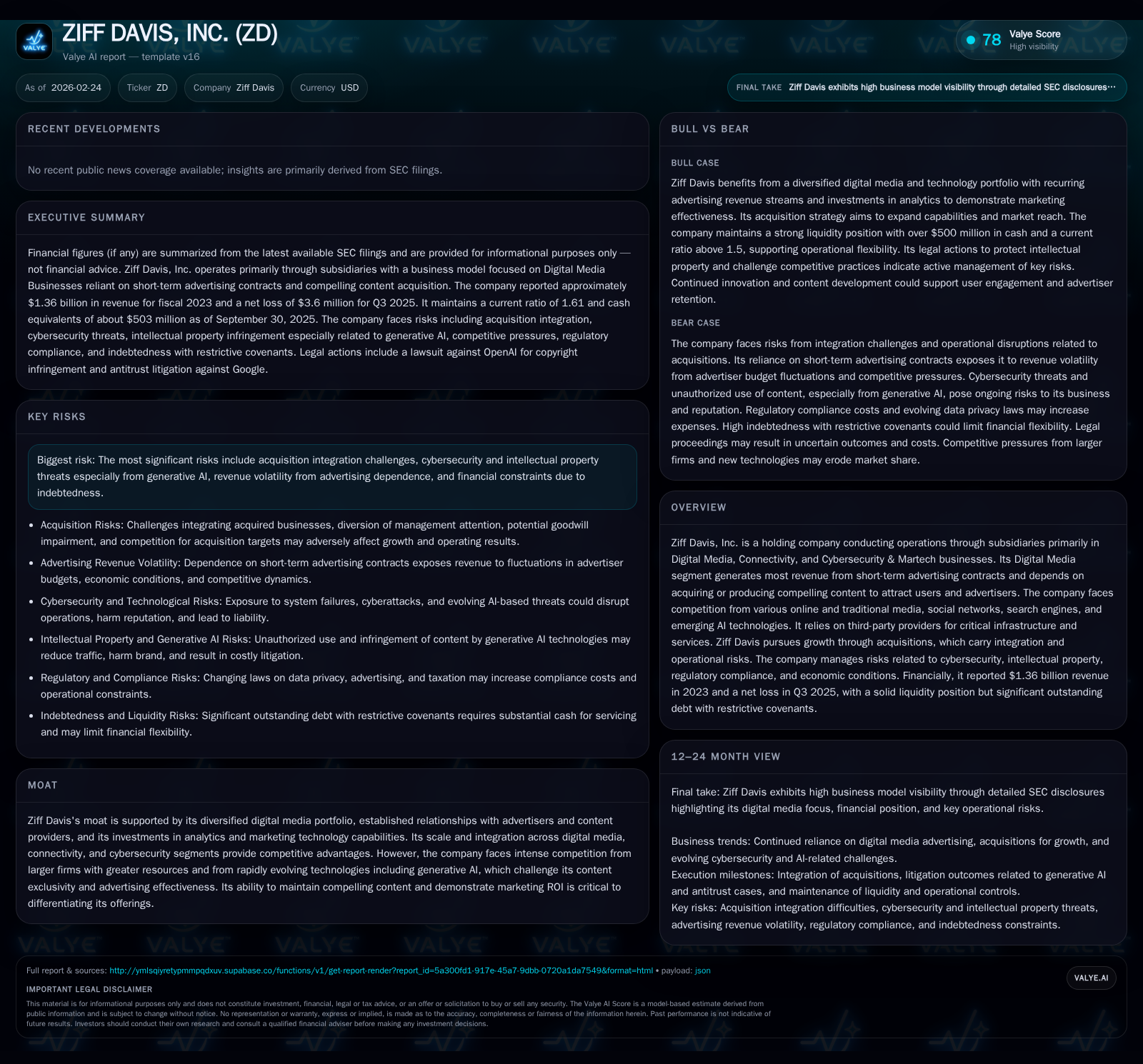
Ziff Davis has demonstrated notable revenue growth since its 2021 restructuring, reaching $1.36 billion in 2023, driven by its Digital Media, Connectivity, and Cybersecurity & Martech segments. Despite this growth, the company faces considerable risks from short-term advertising contracts, increasing competition from larger players and generative AI technologies, as well as complexities related to acquisition integration and indebtedness. Its financial profile shows improving operating income and positive free cash flow generation, but net income and return on equity remain modest. Future growth hinges on successful acquisitions, content innovation, and navigating regulatory frameworks around data privacy and AI. Investors should watch upcoming litigation outcomes against OpenAI and Google as potential catalysts affecting competitive positioning and intellectual property rights.
Company Overview and Historical Performance
Ziff Davis, Inc., operating primarily through its subsidiaries across Digital Media, Connectivity, and Cybersecurity & Martech businesses, reported total revenues of approximately $1.36 billion in fiscal year 2023 [F1]. This represents strong growth from pre-2022 levels following corporatestructural transformation where revenue more than tripled compared to $408.6 million in 2021. However, revenue declined slightly from $1.39 billion in 2022 to $1.36 billion in 2023 (-1.9% YoY), indicating some plateauing after rapid expansion [F1].
The company’s operating income has seen volatility but generally trended upward post-2022 restructuring: after peaking at nearly $199 million in 2022, it dipped during 2023 to approximately $133 million before surging again to about $183 million in 2025 — a striking +61% increase over the previous year [F1]. Net income showed mixed results with dips as low as roughly $41 million in FY2023 followed by an improvement to around $47 million in FY2025 despite a -24.9% YoY decline relative to FY2024’s $63 million [F1]. The return on equity remained modest at approximately 2.7% for 2025 when relating net income to shareholders’ equity near $1.75 billion [F1].
Operating cash flow showed steady resilience climbing from around $319.9 million in FY2023 to over $407 million in FY2025 (+4.3% YoY last reported), underpinning capital expenditure growth which rose moderately to about $119 million in the same period [F1]. This yielded free cash flow that remains strongly positive (~$288 million for FY2025) sustaining ongoing share repurchases that totaled nearly $174 million last year alongside no recent dividend payments—highlighting prioritization of capital return through buybacks rather than dividends [F1].
Historical performance (annual)
| FY | Rev ($mm) | Net ($mm) | CFO ($mm) | OpInc ($mm) | Rev YoY | Net YoY |
|---|---|---|---|---|---|---|
| 2025 | 47 | 407 | 183 | -24.9% | ||
| 2024 | 63 | 390 | 114 | +51.9% | ||
| 2023 | 1364 | 42 | 320 | 133 | -1.9% | -34.9% |
| 2022 | 1391 | 64 | 336 | 199 | +240.4% |
Note: Omitted columns lack sufficient annual XBRL coverage in the provided tags (need ≥2 annual points): Capex, Div. Source: SEC companyfacts cache [F1].
Capital returns and efficiency (annual)
| FY | Buybacks ($mm) | FCF ($mm) | ROE% |
|---|---|---|---|
| 2025 | 174 | 288 | 2.7 |
| 2024 | 185 | 284 | 3.5 |
| 2023 | 109 | 211 | 2.2 |
| 2022 | 78 | 230 | 3.4 |
Source: SEC companyfacts cache [F1].
Notes: Revenue YoY percent for FY22 calculated based on FY21-to-FY22; Operating Income & Net Income include all reported amounts where available; data for FY24/25 revenue not explicitly disclosed; Buybacks data shown only where available.
Industry Positioning and Competitive Landscape
The bulk of Ziff Davis’s revenue derives from the Digital Media segment which depends heavily on short-term advertising contracts tied closely to producing compelling content that attracts user engagement [S1], [S9]. The company faces intense competition from a wide array of online platforms including social networks and dominant search engines that command significant share of digital ad spend [S9]. Emerging generative AI technologies introduce fresh challenges by enabling efficient creation or aggregation of content that may erode Ziff Davis’s exclusivity or reduce traffic if users migrate or if AI-generated content substitutes ad monetizable impressions [S2], [S9].
This is compounded by rising regulatory scrutiny over data privacy laws globally—with frameworks such as GDPR/EU Data Act impacting Ziff Davis’s ability to collect or monetize user data freely—and increasing compliance costs related to consumer protection laws such as HIPAA regarding health-related content within Everyday Health Group brands [S15], [S16], [S23]. Adjustments required for evolving compliance obligations risk making offerings less attractive or enforce operational changes.
Connectivity and Cybersecurity & Martech segments face their own competitive pressures from specialized cloud service providers, network testing firms, and security software vendors often possessing greater scale or localized market dominance internationally [S9], [S18]. Ziff Davis leverages cross-segment synergies by integrating analytics capabilities with marketing technology investments creating differentiated advertiser value propositions but must continuously innovate against faster-moving competitors.
Litigation and Regulatory Risks Impacting Growth Trajectory
Among the most material risks are ongoing legal battles targeting technology giants leveraging Ziff Davis’s copyrighted material without fair compensation or appropriate permissions amid widespread use of generative AI systems [S1], [S2], [S11]. A notable case filed April 24, 2025 alleges copyright infringement against OpenAI which operates broadly in generative AI space while a February 6, 2026 lawsuit accuses Google LLC of antitrust violations linked to publisher ad servers impacting ad exchange dynamics crucial for Ziff Davis's monetization efforts [S1], [S21].
Successful outcomes could reinforce intellectual property protections boosting long-term competitive moats; adverse rulings would exacerbate threats from unauthorized content usage undermining business models dependent on original content production.
Risks also stem from dependence on third-party vendors for critical infrastructure (e.g., hosting services), billing systems susceptible to credit card declines affecting timely collections, and regulatory actions especially concerning healthcare advertising given complex anti-kickback statutes applicable to pharmaceutical sponsorships integrated within Everyday Health Group revenues [S21], [S6], [S7], [S11]. Potential liabilities include multi-jurisdictional fines or operational restrictions.
Financial Flexibility Constraints from Elevated Indebtedness
Ziff Davis holds considerable outstanding debt characterized by multiple notes with varying coupon rates (e.g., convertible notes at ~1.75% and senior notes at ~4.625%) plus revolving credit facilities bearing financial covenants that could restrict operational agility including limitations on dividends, acquisitions or share repurchases should covenant breaches arise under stressed conditions [S5], [S8], [S20].
Debt servicing requires large portions of operational cash flow reducing funding availability for growth opportunities or innovation investments despite solid free cash flow generation (~$288 million in FY25) [F1]. There remains risk associated with refinancing needs or liquidity shocks especially as macroeconomic conditions fluctuate.
Share repurchase activity remains notable with roughly $174 million expended during fiscal year ending December 31, 2025 continuing a multi-year trend though dividend payments have been suspended since prior years emphasizing capital allocation toward buybacks rather than direct shareholder payouts which may reflect management preference aligned with stock valuation dynamics and internal financing priorities [F1], [S10].
Future Growth Drivers and What To Watch
Growth prospects rely strongly on Ziff Davis’s ability to identify accretive acquisitions that complement existing digital assets without disproportionate integration disruptions—a historically highlighted risk factor given operational complexities of consolidated subsidiaries under varied regulatory jurisdictions including European markets with distinct data mandates ([N1], [S27]).
Driving fresh user engagement via innovative content creation remains paramount given fragmented attention spans across platforms competing for advertising dollars amplified further by AI-driven personalization techniques demanding rapid market responses.
Monitoring outcomes of key litigation targeting OpenAI’s use of Ziff Davis content will serve as potent catalysts potentially setting precedents affecting industry IP norms while antitrust proceedings against Google might alter ad exchange economics substantially influencing future revenue visibility.
Lastly, regulatory evolutions concerning privacy protections (e.g., EU Data Act compliance trajectories), healthcare advertising regulation shifts impacting Everyday Health Group verticals, as well as potential tightening of communication laws like TCPA affecting connectivity services need close observation for their operational impact.
Conclusion
Ziff Davis presents a case study of a digitally focused media holding company balancing robust historic growth achieved through strategic acquisition-led expansion against intensifying sectoral headwinds arising from evolving AI-powered competition, regulatory complexity particularly around IP rights protection, data privacy regime shifts, legal challenges targeting monopsony-like ad exchanges controlled by tech giants, and constrained financial flexibility due to sizeable indebtedness.
Operationally successful navigation will depend on deepening proprietary content strength coupled with next-gen marketing solutions attracting advertisers hungry for measurable ROI amidst shifting consumption paradigms influenced heavily by emerging AI tools and societal focus on data stewardship.
This analysis synthesizes publicly available information without recommending any investment action regarding securities of Ziff Davis, Inc. It aims solely at providing comprehensive industry-contextualized understanding for informed decision-making.
Disclaimer: This is research-only, informational analysis and not investment advice. It may include AI-generated interpretation and general industry context. Always verify important details using primary sources.

Comments