
Zeo Energy: Vertical Integration, Leasing Mix, and Expansion Ambition in a Margin-Pressured Solar Market
Zeo Energy is pursuing rapid growth in residential solar and energy efficiency services through a vertically integrated model, strategic acquisitions, and a strong internal sales force. However, margin pressure, capital intensity, and listing compliance risks underscore the importance of scaling profitably and navigating volatile market conditions.
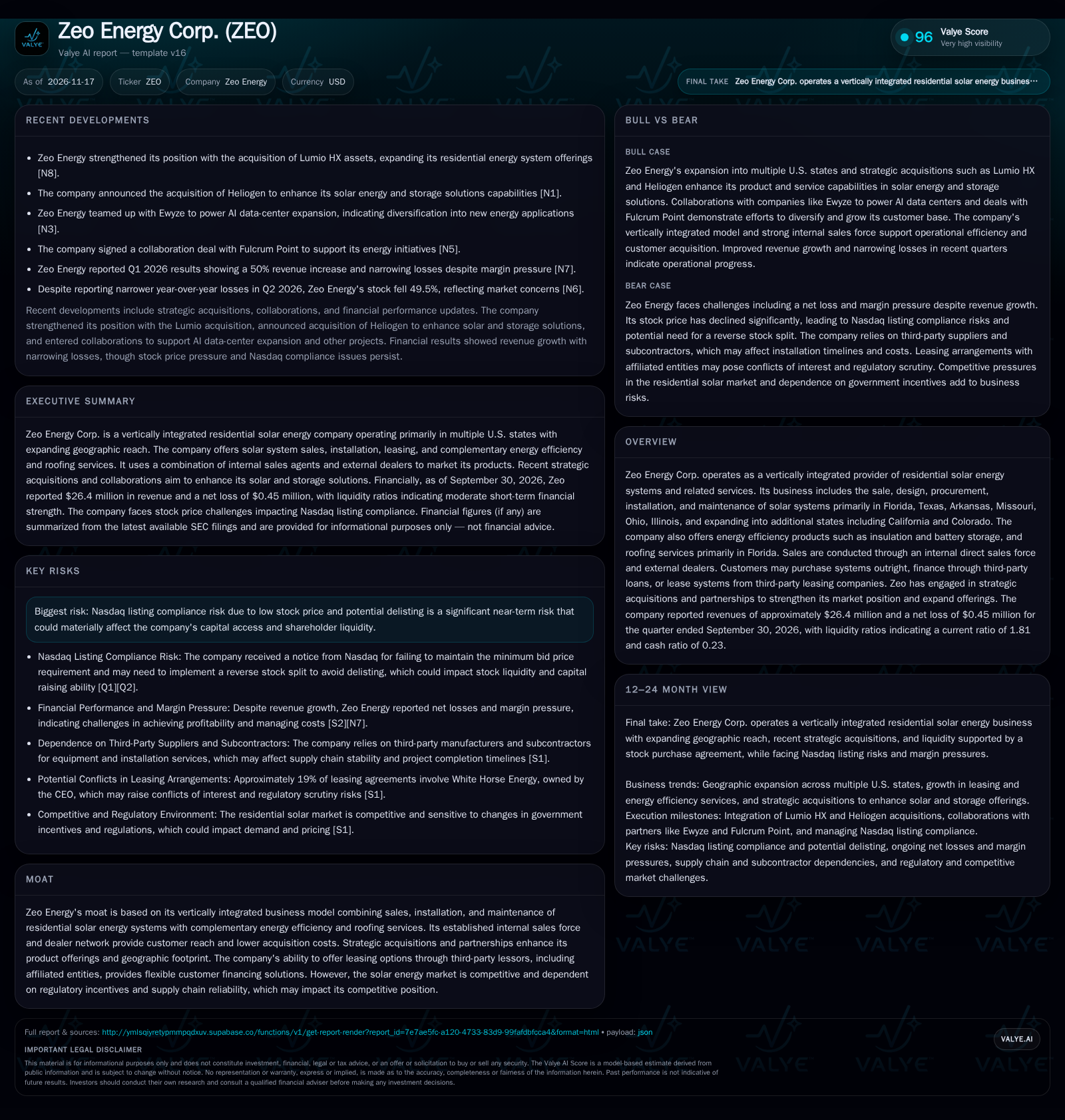
Zeo Energy reported $26.4 million in Q3 2026 revenue with a net loss of $0.45 million, reflecting persistent margin pressure amid geographic expansion and a heavy reliance on third-party leasing. Strategic moves—including asset acquisitions and diversification into adjacent energy applications—seek to broaden its footprint, but the company faces heightened competition, supply chain risks, and possible Nasdaq delisting due to a sharp stock price decline [S2] [N6] [N8].
Zeo Energy Corp. stands at a critical juncture as it expands its residential solar and energy efficiency business across multiple U.S. states. The company’s vertically integrated model—combining direct sales, installation, and ongoing services—has enabled a swift market push, further fueled by strategic acquisitions and partnerships. Yet, this growth comes with persistent net losses, margin pressure, and a heavy reliance on third-party leasing arrangements, exposing Zeo to both operational and financial complexity. With its stock price under significant pressure and Nasdaq listing at risk, Zeo’s ability to scale profitably and manage execution risks will determine whether its ambitious expansion can translate into lasting value.
Latest Developments Reshape Zeo’s Risk-Reward Profile
Zeo Energy reported $26.4 million in revenue and a net loss of $0.45 million for the quarter ending September 30, 2026, highlighting the ongoing challenge of scaling profitably in a competitive market [S2]. [S2] Notably, approximately 74% of residential solar systems installed in 2025 were leased through third-party operators, with around 19% of those leases involving White Horse Energy, an affiliate owned by Zeo’s CEO, introducing potential related-party and regulatory scrutiny [S1]. Zeo’s stock price has declined by 49.5% year-to-date, resulting in a Nasdaq notice for minimum bid price non-compliance and raising the possibility of a reverse split to avoid delisting [N6] [Q2]. The company’s acquisition of Lumio HX assets and partnerships with Ewyze and Fulcrum Point demonstrate a continued push for geographic and product expansion [N3] [N5] [N8].
How Zeo’s Revenue Model and Cost Structure Shape Its Path to Profitability
Zeo Energy’s business model is anchored in the sale, installation, and maintenance of residential solar systems, complemented by energy efficiency products and roofing services [S1]. The company’s vertically integrated approach allows for control over the customer experience and some cost optimization, but the economics are heavily influenced by the mix of outright sales, third-party financed purchases, and, most notably, leases. Leasing—accounting for roughly three-quarters of installations—shifts much of the upfront capital burden and credit risk to third-party lessors, enabling faster customer acquisition in a high interest-rate environment, but it can also compress gross margins and delay revenue recognition compared to direct sales [S1].
The use of subcontractors for installation and energy efficiency services introduces variable costs, which can help flex with demand but also exposes Zeo to supply chain volatility and cost inflation, particularly in labor and materials. The company’s current scale—approximately 260 internal sales agents and 10 dealers as of end 2025—suggests high fixed costs in sales and support [S1].
Competitive Dynamics: Integration, Scale, and the Battle for Customer Economics
Zeo Energy operates in a fiercely competitive residential solar and energy services market, contending with both national and regional players offering similar products and financing models. Its vertically integrated structure and sizable internal sales force provide some differentiation, potentially enabling lower customer acquisition costs and greater control over the customer journey [S1]. However, the company’s reliance on third-party leasing partners (including affiliated entities) may limit its ability to capture full lifetime value from customers compared to vertically integrated pure-play solar companies that own their lease portfolios.
Strategic acquisitions—such as Lumio HX—aim to broaden Zeo’s capabilities and geographic footprint, but integration risks and the challenge of realizing synergies should not be underestimated [N8]. Partnerships in adjacent energy segments (e.g., AI data center power with Ewyze) could open new revenue streams and diversify risk, but these efforts are still early-stage and must prove scalable [N3]. The company’s ability to deliver a seamless customer experience, maintain installation quality, and offer attractive financing will be tested as it expands into new states and faces pressure from both established and emerging competitors. Regulatory incentives and local permitting also play a significant role in shaping competitive advantage in this sector.
What a Breakout Success Would Look Like for Zeo
In a favorable scenario, Zeo Energy leverages its vertically integrated platform to drive rapid growth in new and existing markets, achieving operating leverage as installation volumes rise. Successful integration of acquired assets (such as Lumio HX) and effective partnerships (notably with Ewyze and Fulcrum Point) could enable Zeo to offer differentiated bundled solutions—solar, storage, and energy efficiency—appealing to a broader customer base [N3] [N5] [N8]. If the company can improve installation efficiency, exert pricing discipline, and maintain low customer acquisition costs through its internal sales force, margin expansion may follow.
A critical confirming signal would be a sustained reduction in net losses or a shift to profitability, driven by higher gross margins and improved cash generation [S2]. Additional evidence would include an increase in direct sales or higher-margin product mix, successful geographic expansion without material execution setbacks, and renewal or expansion of the White Lion stock purchase facility supporting growth investment [S1]. If Zeo’s partnerships in the data center and commercial segments yield meaningful revenue, this would further strengthen the case for a scalable, diversified business.
Scaling Brings Both Growth and Margin Compression for Zeo
The most plausible outcome is that Zeo continues to grow its top line through expansion into new states and incremental gains from its acquisitions and partnerships. However, margin pressure is likely to persist due to inflation in labor and materials, competitive pricing, and the structural economics of third-party leasing [S1] [S2]. The company’s net losses may narrow over time as fixed costs are spread across a larger revenue base, but persistent cost headwinds and continued reliance on external capital could limit significant margin improvement.
Ongoing Nasdaq listing compliance concerns may require a reverse split, but barring a severe capital crunch, Zeo is likely to maintain operations and pursue incremental improvements in installation efficiency and sales productivity [N6] [Q2].
When Execution Risks and Market Forces Collide
In a negative scenario, Zeo’s rapid geographic and product expansion strains its operational and financial resources, leading to further margin erosion and persistent net losses. Supply chain disruptions, cost inflation, or delays in integrating acquisitions could slow installation timelines and increase project costs, resulting in missed revenue targets and deteriorating cash flow [S1] [S2]. Should the company fail to regain Nasdaq compliance, a delisting event could restrict access to public capital markets and erode investor confidence, compounding liquidity challenges [Q2].
Additional downside risks include regulatory scrutiny or reputational harm from related-party leasing arrangements, or a material downturn in demand if government incentives are reduced or interest rates rise further. Confirmation of this scenario would include widening net losses, deteriorating liquidity, failed or delayed acquisitions/integrations, and an inability to execute a successful reverse split or alternative capital-raising transaction.
Milestones That Will Define Zeo’s Trajectory in Solar and Energy Services
Quarterly gross margin trends and progress toward profitability—especially as the mix of leasing versus direct sales evolves—would help test Zeo’s ability to achieve sustainable economics if disclosed.
Updates on the integration of Lumio HX assets and any new synergies or cross-selling wins would provide evidence of acquisition success [N8].
The pace and quality of geographic expansion, particularly into California, Colorado, Minnesota, Utah, and Virginia, will indicate whether Zeo can replicate its model in new markets [S1].
Changes in the proportion of systems sold outright versus leased, and the mix of third-party lessors, particularly the role of White Horse Energy, would shed light on revenue recognition, margin, and regulatory risks [S1].
Trends in installation cycle times and customer satisfaction, if disclosed, would signal operational effectiveness and competitive differentiation.
Any developments regarding Nasdaq listing compliance—including the potential execution of a reverse split—will be critical for capital access and investor sentiment [Q2].
Evidence of commercial traction or revenue contribution from new partnerships (Ewyze, Fulcrum Point) and adjacent segments would help validate Zeo’s diversification strategy [N3] [N5].
Disclaimer: This is research-only, informational analysis and not investment advice. It may include AI-generated interpretation and general industry context. Always verify important details using primary sources.

Comments