
ZipRecruiter's AI-Driven Matchmaking and Market Dynamics Under Pressure
ZipRecruiter’s distinctive AI-powered hiring platform confronts recent financial headwinds amid a volatile labor market and competitive landscape.
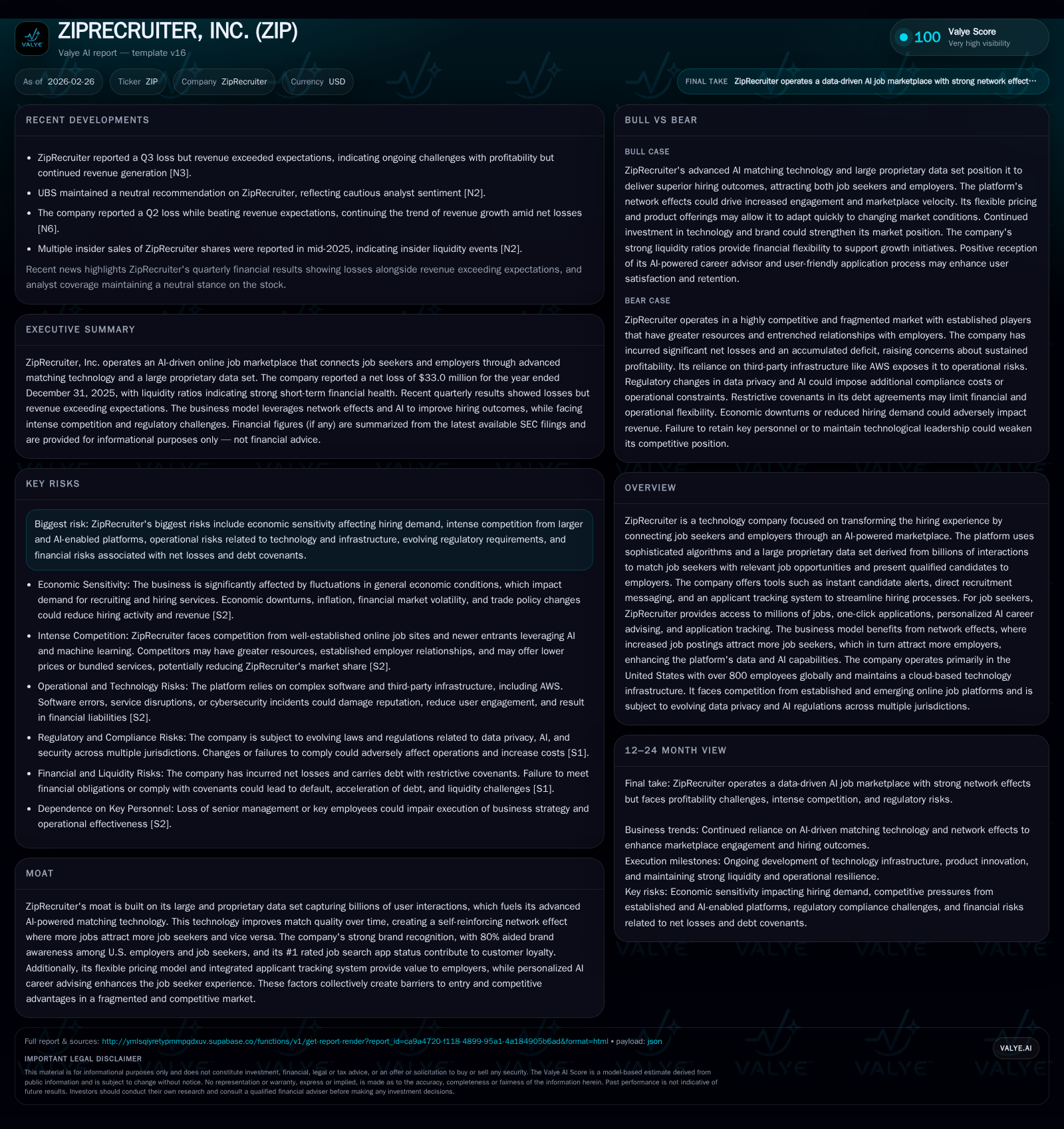
ZipRecruiter leverages an extensive proprietary dataset and advanced AI to optimize job matching, resulting in powerful network effects and leading brand awareness in the U.S. market. However, fiscal 2025 marked a pronounced profit contraction, with operating income plunging by over 1600% year-over-year and net losses widening despite positive operating cash flow. Economic uncertainties and industry competition intensify pressures on demand and pricing, while the company continues aggressive share repurchases amid tightening debt covenants. Going forward, ZipRecruiter must balance innovation-driven growth against macroeconomic sensitivities and regulatory risks that could cap expansion.
Innovating the Hiring Marketplace: How ZipRecruiter’s AI Creates Competitive Advantage
ZipRecruiter’s value proposition centers on transforming what has traditionally been a manual, time-consuming recruitment process into an intelligent, streamlined digital marketplace. The company operates a two-sided platform that links millions of employers posting jobs with a broad pool of diverse job seekers. Uniquely, this marketplace harnesses a proprietary dataset derived from billions of interactions across its platform—tracking nuanced candidate behaviors such as clicks, applications, employer responses, and hiring signals [S1], [S24].
At the heart of this ecosystem is advanced AI technology leveraging deep learning-based natural language processing (NLP). This allows the platform to comprehend complex intent behind job descriptions and candidate profiles far beyond static keywords. Such sophisticated marketplace optimization enables ZipRecruiter to significantly increase match precision over time as data accumulates [S1], [S23]. Deep learning models dynamically adjust recommendations for both sides—alerting employers instantly when high-fit candidates enter the system while guiding job seekers towards personalized suitable opportunities.
These capabilities generate powerful network externalities: more posted jobs attract more qualified seekers; increased seeker engagement boosts employer confidence; this creates a self-reinforcing cycle refining data quality further fueling AI improvements [S1], [S23]. Marketplaces like ZipRecruiter benefit disproportionately from these feedback loops compared to traditional job boards or aggregators lacking integrated matching intelligence.
The company's flexible pricing approach adapts swiftly to employer needs—from flat-rate plans spanning short durations to performance-based pricing for recruitment marketing campaigns—enabling responsiveness amid changing macroeconomic conditions [S24]. Additionally, ZipRecruiter integrates an applicant tracking system (ATS), simplifying workflow by centralizing candidate vetting processes inside one interface or syncing with existing enterprise ATS tools, enhancing employer productivity [S24].
Beyond employers, ZipRecruiter's product suite supports job seekers through a #1 rated mobile app augmented by "Phil," an AI career advisor providing customized job recommendations and application status updates—a rare feature directly addressing common grievances about opacity in digital hiring [S20]. This dual-sided focus on experience turns functional technologies into tangible competitive advantages built on brand awareness (80% aided among U.S. users) [S20].
From Growth to Contraction: Analyzing Recent Financial Performance and Year-on-Year Changes
Examining ZipRecruiter's financial trajectory reveals a sharp inflection from previous profitability into fiscal 2025 losses—a shift signaling material stress on its business model driven by external factors. Operating income dropped precipitously from a positive $1.26 million in FY2024 to a loss of $19.36 million in FY2025—a staggering -1633.9% year-over-year change [F1]. Correspondingly, net income swung from a negative $12.85 million loss in FY2024 to a substantially deeper loss of $32.99 million in FY2025 (-156.7% YoY) [F1]. These results mark a dramatic contraction following several years of solid earnings.
Operating cash flow mirrored this weakness with a 76% year-over-year decline—down from $45.74 million in FY2024 to just under $11.0 million in FY2025—but remained positive indicating ongoing core business liquidity albeit at reduced magnitude [F1]. Capital expenditures edged up modestly (+16.9% YoY) to approximately $1.08 million reflecting targeted investments rather than aggressive expansion [F1]. Free cash flow therefore stayed positive at roughly $9.88 million despite profit erosion.
This financial stress coincides directly with broader economic uncertainty compressing hiring demand across sectors—the company’s top-line revenue details were unavailable here but inferred contraction aligns with softer labor markets cited in risk disclosures ([S1], [S2]). The disproportionate operating income slide suggests rising cost pressures or inefficiencies increasing faster than revenues can absorb.
Historical performance (annual)
| FY | Net ($mm) | CFO ($mm) | OpInc ($mm) | Capex ($mm) | Net YoY |
|---|---|---|---|---|---|
| 2025 | -33 | 11 | -19 | 1 | -156.7% |
| 2024 | -13 | 46 | 1 | 1 | -126.2% |
| 2023 | 49 | 103 | 79 | 1 | -20.2% |
| 2022 | 61 | 129 | 97 | 3 |
Source: SEC companyfacts cache [F1].
Capital returns and efficiency (annual)
| FY | Buybacks ($mm) | FCF ($mm) | ROE% |
|---|---|---|---|
| 2025 | 102 | 10 | 42.7 |
| 2024 | 40 | 45 | -95.7 |
| 2023 | 148 | 102 | 586.9 |
| 2022 | 339 | 126 | 214.9 |
Source: SEC companyfacts cache [F1].
Table: Annual financial performance highlighting abrupt shift into losses in FY2025
Navigating Economic Sensitivities and Competitive Pressures in Talent Acquisition Tech
ZipRecruiter explicitly calls out volatility in global macroeconomic conditions as a principal operational risk [S1], [S2], [S14]. Labor demand—the lifeblood of recruiting marketplaces—is notably cyclical: downturns result not only in fewer roles but also induce pricing compression as employers rationalize recruitment spend amid uncertainty.
Recent triggers include banking sector instability impacting key employer budgets (notably financial institutions), inflationary wage pressures escalating overall costs for businesses alongside interest rate volatility dampening capital availability. Geopolitical conflicts amplify global trade uncertainties influencing hiring confidence unevenly across regions where ZipRecruiter operates [S1]. The inherent unpredictability means rebounds may appear localized or delayed even after general macro improvements.
Competitive dynamics heighten this pressure cooker environment: incumbents like LinkedIn leverage massive user bases supplemented by Microsoft investments; Google Jobs integrates search engine real estate; Indeed commands scale; emerging AI-native platforms promise smarter matching powered by crowd-sourced insights or conversational interfaces [S20], [S23]. ZipRecruiter's moat rests heavily on its integrated data-driven AI ecosystem plus brand recognition but requires ongoing R&D investment to maintain differentiation.
Flexibility helps mitigate some risks: variable sales & marketing spend enables agile scaling back when ROI weakens while preserving runway if rapid hiring demand recovers [S20]. Still regulatory landscapes introduce additional compliance burdens particularly around communications laws such as Telephone Consumer Protection Act enforcement risks ([S19]), which complicate direct messaging strategies critical for engagement effectiveness.
Capital Strategy and Returns: Share Repurchases, Cash Flows, and Leverage Dynamics
Despite mounting losses through FY2025’s turbulent period,[F1] reveals ZipRecruiter's continued commitment to capital returns via substantial share repurchases totaling approximately $102.1 million—nearly triple its buybacks in the prior year [$40.3M FY2024] and part of an expanded authorization currently capped at $750 million by year-end December 2025 [S12], [S13], [S16], [S18].
This aggressive buyback stance points to management's confidence in intrinsic valuation or strategic efforts to stabilize equity value amidst margin contraction but conversely depletes liquidity reserves deployed otherwise toward innovation or buffering debt exposure.
Financially the company carried robust cash & equivalents of $188 million against comparatively low current liabilities (~$71 million), yielding a strong current ratio above six times—a comfortable liquidity cushion for near-term obligations including covenant compliance [F1], [S4], [S25]. Nonetheless negative equity stood at roughly -$77 million indicating accumulated deficits eroding shareholders’ residual claim netted against assets implying stressed retained earnings from consecutive losses reducing ROE clarity though a crude ratio approximates near +43% if considered naively given negative equity mechanics ([F1]).
Debt covenants embedded within revolving credit facilities (~$290M secured line) plus senior unsecured notes ($550M issued Jan ‘22) enforce limits on leverage ratios restricting asset sale proceeds usage and distributions to shareholders thereby limiting capital structure flexibility should adverse conditions persist or worsen ([S4], [S5], [S6], [S7], [S8],[S9],[S10],[S25],[S27]). Default implications include acceleration risk triggering forced asset liquidation jeopardizing operational continuity.
Overall capital allocation reveals tension between shareholder-friendly repurchases versus prudence given looming uncertainties emphasizing measured stewardship necessary as balancing acts evolve.
Forward-Looking Considerations: Market Drivers and Risks on the Horizon
Explicit near-term earnings guidance remains sparse although recent disclosures acknowledge uncertain timing for labor market normalization impacting demand recovery trajectory ([N1],[S3],[S14]). Technological roadmap objectives appear focused on advancing AI feature sets such as enhancing "Phil" career advising personalization plus deeper integration within ATS workflows which could boost user stickiness and incremental value proposition gains.
Potential regulatory shifts around data privacy or communication statutes present wildcards capable of disrupting current marketplace dynamics necessitating pre-emptive adaptation strategies ([S14],[S19]). Increasing competitive intensity mandates sustained innovation pace alongside marketing agility to retain employer loyalty challenged by large tech platforms extending recruiting footprints ([S20],[S23]).
Analysts should monitor indicators including job posting volumes relative to macro benchmarks; customer retention/composition trends; marginal improvements in matching precision metrics; incremental adoption rates of AI advisory tools; legal/regulatory developments affecting operation scope; meanwhile watch capital deployment choices for signs of conservatism vis-à-vis opportunism.
Anticipated milestones likely revolve around reclaiming operating profitability thresholds post-economic stabilization paired with measured topline reacceleration reflecting revitalized marketplace engagement.
Key Metrics Table: Historical Financial Performance Overview
| FY | OpInc (USD) | OpInc YoY % | Net Inc (USD) | Net Inc YoY % | CFO (USD) | CFO YoY % | Capex (USD) | Capex YoY % |
|---|---|---|---|---|---|---|---|---|
| 2025 | -19,358,000 | -1633.9% | -32,994,000 | -156.7% | 10,958,000 | -76% | 1,078,000 | +16.9% |
| 2024 | +1,262,000 | N/A | -12,854,000 | N/A | 45,735,000 | N/A | 922,000 | N/A |
| 2023 | +79,437,000 | N/A | +49,098,000 | N/A | >103192000 | N/A | >918000 | >N/A |
| 2022 | +97_228_000_ | N/A_____ | +61_494_000____ | N/A_______ | 128_808_000__ | N/A_________ | 2_692_000___ | N/A_________ |
This summary underscores the pronounced profitability disruption entering FY2025 contrasting recent years' healthy operating margins alongside consistent positive cash conversion dynamics.
Disclaimer: This analysis is provided solely for informational purposes based on publicly available filings and does not constitute investment advice nor endorse any securities or strategies referenced herein.
Disclaimer: This is research-only, informational analysis and not investment advice. It may include AI-generated interpretation and general industry context. Always verify important details using primary sources.

Comments