
Zai Lab Ltd Advancing Innovative Therapies with Expanding China Commercial Footprint
Assessing Zai Lab’s growth through exclusive partnerships, Greater China commercialization, and financial performance amid ongoing operational losses.
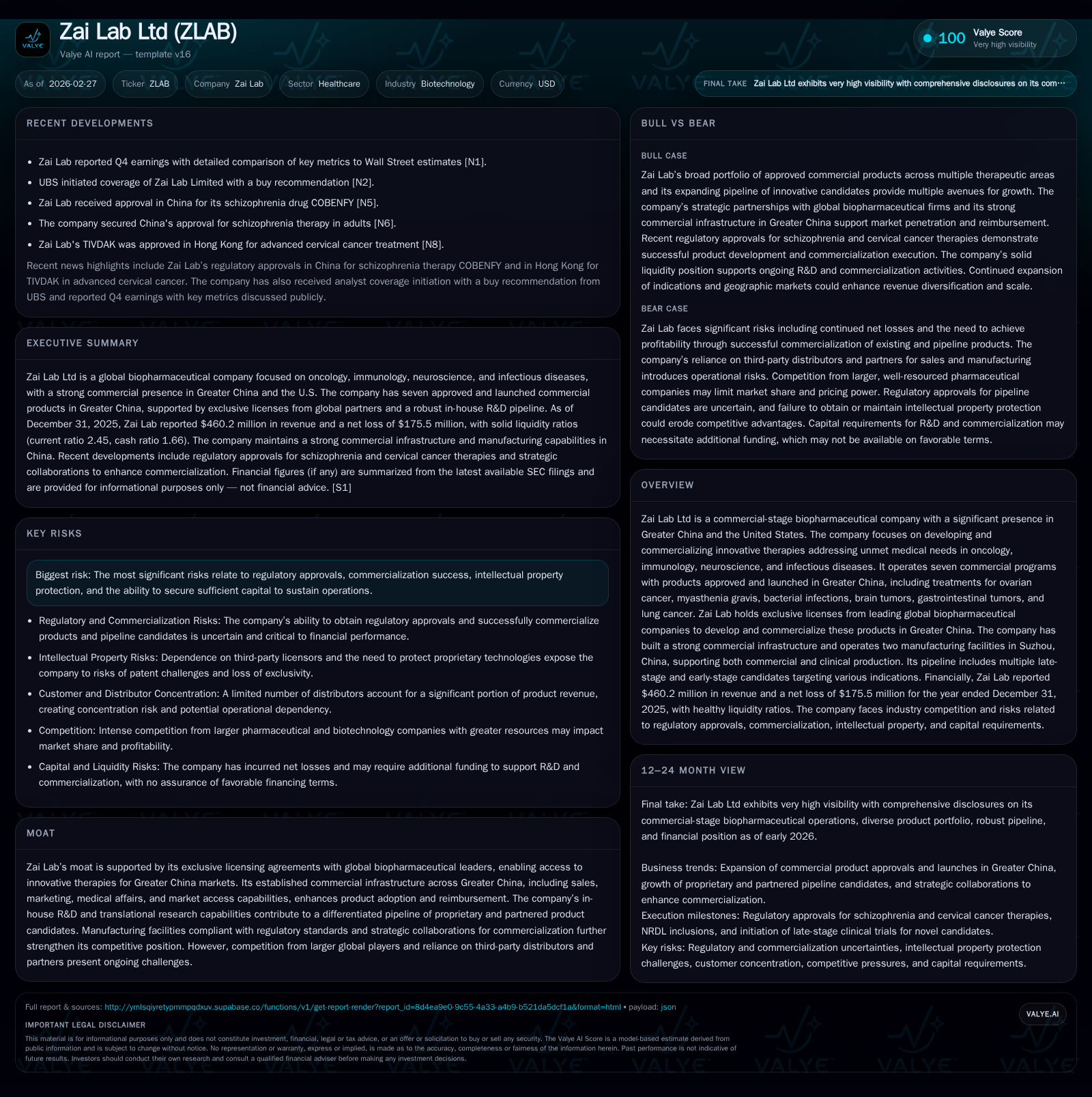
Zai Lab Ltd operates as a commercial-stage biopharmaceutical firm with a dual presence in Greater China and the United States. Its growth has been fueled by exclusive licensing agreements that provide differentiated access to innovative oncology and immunology therapies, supported by a strong commercial infrastructure across Greater China. Despite robust revenue growth exceeding 15% in 2025, the company continues to grapple with operating losses driven by intensive R&D investments and commercialization expenses. Future growth hinges on late-stage pipeline progress, regulatory approvals, and effective scaling of its commercial programs within a complex regulatory and geopolitical environment.
Growth Drivers Behind Recent Revenue Acceleration
Zai Lab Ltd's revenue trajectory reflects successful execution of its commercial strategy focused on Greater China markets. Revenues expanded from $215 million in FY2022 to $460 million in FY2025 — a compounded increase driven primarily by product launches under seven active commercial programs covering high-need areas such as ovarian cancer maintenance, myasthenia gravis (gMG), bacterial infections (CABP, ABSSSI), brain tumors (GBM), gastrointestinal stromal tumors (GIST), and lung cancers characterized by ROS1+ NSCLC and NTRK+ solid tumors [F1], [S7], [N1]. This 15.3% year-on-year jump from FY2024 to FY2025 underscores Zai Lab's ability to leverage exclusive in-licensing partnerships to access novel therapies from global biopharma leaders.
The company deploys third-party distributors strategically selected based on coverage capabilities aligned with hospital networks throughout mainland China — a common pharmaceutical industry practice ensuring tailored regional marketing effectiveness while mitigating inventory risk [S4], [S6]. Its strong salesforce complements this network with expertise sourced from previous roles at multinational pharma organizations such as AstraZeneca and Roche [S7]. The lifecycle ramp for biologics and specialty drugs typically involves growing physician adoption through medical affairs education paired with market access efforts aimed at inclusion on national reimbursement drug lists (NRDL) or supplemental insurance programs — critical for enhancing patient affordability in China’s tiered healthcare system.
Historical performance (annual)
| FY | Rev ($mm) | Net ($mm) | CFO ($mm) | OpInc ($mm) | Rev YoY | Net YoY |
|---|---|---|---|---|---|---|
| 2025 | 460 | -176 | -151 | -229 | +15.3% | +31.7% |
| 2024 | 399 | -257 | -215 | -282 | +49.6% | +23.2% |
| 2023 | 267 | -335 | -198 | -367 | +24.0% | +24.5% |
| 2022 | 215 | -443 | -368 | -404 |
Source: SEC companyfacts cache [F1].
Capital returns and efficiency (annual)
| FY | FCF ($mm) | ROE% |
|---|---|---|
| 2025 | -159 | -24.5 |
| 2024 | -221 | -30.6 |
| 2023 | -205 | -42.0 |
| 2022 | -392 | -42.4 |
Source: SEC companyfacts cache [F1].
Note: All figures sourced from SEC filings [F1].
Shifts in Profitability and Operating Cash Flows: A Closer Look
Despite topline gains, Zai Lab remains unprofitable, reflecting typical characteristics of commercial-stage biopharmaceutical firms investing heavily in R&D pipelines and market expansion [F1]. Operating loss improved by approximately $53 million (18.7%) from FY2024 but persisted at $229 million in FY2025 due largely to sustained clinical development costs coupled with scale-up expenses related to product launches [F1], [N1]. The net loss narrowed by an even larger margin (31.7%), indicating some reduction in non-operating expenses or potential tax effects.
Cash flow from operations has steadily improved but continues negative at $151 million — reflecting the burn associated with clinical trials, inventory build-up for new launches, and salesforce expansion [F1]. Capital expenditures remain modest around $8 million annually after a much higher spending burst in FY2022 likely linked to facility investments.
The approximate return on equity stands at negative 24.5%, directly driven by sustained net losses against shareholder equity base shrinking from capital allocations to fund operating deficits [F1]. This profile is typical for mid-size biotech developers transitioning toward profitability as pipeline assets mature.
Exclusive Licensing: Building a Defensible Market Moat
Zai Lab’s competitive advantage derives from exclusive licensing agreements with internationally recognized biopharma leaders that grant commercialization rights within Greater China — including mainland China, Hong Kong, Macau, and Taiwan [S7], [N1]. These arrangements provide early access to cutting-edge therapies without bearing full upfront discovery risks or global development costs.
In-licensing accelerates portfolio diversification rapidly while introducing dependencies on licensors for patent prosecution, manufacturing technology transfer quality, pharmacovigilance collaboration, and milestone payments [S7], [S25]. Integrating partner products into local reimbursement frameworks requires sophisticated market access expertise given diverse provincial regulations across Greater China.
Zai Lab's moat is reinforced by its integrated local commercial team experienced in navigating hospital formularies' fragmented landscape—crucial as Chinese top-tier hospitals often have autonomous procurement processes necessitating region-specific strategies [S4], [S6]. However, competition from larger multinational players bidding globally intensifies pressure post-launch.
Pipeline Expansion Strategy and Late-Stage Clinical Opportunities
Zai Lab maintains a balanced approach combining licensed late-stage clinical assets alongside internally developed candidates leveraging translational research strengths offered by its dedicated R&D teams in Suzhou and Cambridge [S7], [N1]. This dual-track strategy aims to create multiple future revenue inflection points beyond existing commercial portfolios.
Late-stage programs include oncology therapeutics targeting molecularly defined cancers (e.g., ROS1+, NTRK+) critical for capturing segments underserved by older chemotherapies or biologics [N1]. Proprietary discovery efforts reportedly focus on advancing innovative molecule classes addressing neurological disorders—a domain traditionally underresearched given CNS drug development complexities.
Phase III data readouts and regulatory submissions will be pivotal events shaping near-to mid-term valuations as successful registrations could extend shelf life significantly beyond marketed assets nearing patent cliffs or biosimilar competition onset.
Regulatory and Geopolitical Challenges Impacting Business Risks
Operating predominantly within mainland China exposes Zai Lab to multifaceted regulatory scrutiny encompassing drug approval timelines governed by NMPA standards harmonizing increasingly with FDA/EMA norms but still subject to local procedural delays [S4], [S22]. Enforcement intensification around anti-corruption laws combined with elevated Chinese health system audits heightens compliance costs for pharma sales activities including physician engagement practices fundamental for brand building [S4], [S11].
Further complicating factors include evolving data security laws restricting cross-border transfer of genetic or patient trial data requiring costly protocol adaptations [S5]. Good Manufacturing Practice (GMP) inspections historically pose challenges at domestic CDMO partners mandating remedial investments impacting supply chain reliability during scale-ups [S4].
Geopolitical tensions between the US and China add uncertainty around intellectual property protections especially for jointly developed assets where foreign collaborators retain partial rights potentially affecting freedom-to-operate post-launch or influencing capital market access dynamics for US-listed shares [S1], [S8].
Capital Allocation Strategy: Investment Priorities and Returns
As reflected in financials through year-end 2025, Zai Lab prioritizes reinvestment into R&D infrastructure and commercial expansion over shareholder returns, consistent with biotechnology sector norms where near-term profitability is subordinated to long-term pipeline maturation [F1], [S15]. Cash reserves stood robust at approximately $679 million providing necessary liquidity headroom amid ongoing operating deficits.
The company carries substantial RMB-denominated debt (~$317 million credit lines guaranteed by the holding entity) exposing it to interest rate variability risks inherent under variable-rate contracts common among Chinese financial institutions—potentially constraining discretionary spending if rates rise sharply without hedging strategies disclosed publicly yet [S16].
No dividends or share repurchases were recorded historically or projected given capital deployment towards upcoming phase transitions designed to pivot the business model toward sustainable profit generation once pipeline approvals mature sufficiently.
What to Monitor: Commercial Execution and Upcoming Milestones
Absent explicit forward earnings guidance or developmental timelines disclosed recently, investors should focus attention on several operational vectors:
- Regulatory approval progress updates for late-stage pipeline candidates especially those addressing niche unmet medical needs potentially opening new indications beyond currently approved territories;
- Commercial metrics like hospital penetration rates within various Chinese provinces reflecting effective salesforce utilization combined with distributor onboarding efficiency;
- Details regarding expanded licensor collaborations or newly secured strategic partnerships facilitating geographic or therapeutic area diversification;
- Compliance developments involving anti-corruption adjudications or GMP certifications signaling supply chain stability;
- Cash burn trends relative to milestone achievement avoiding unscheduled capital raises diluting shareholder value unnecessarily.
Monitoring these dynamics will provide clearer indicators regarding Zai Lab’s evolution from an innovation-driven bulk licensee toward an independent integrated biopharma entity capable of delivering consistent returns alongside sustained therapeutic breakthroughs.
This analysis is based exclusively on documented financial results from company filings as of February 26, 2026 ([F1],[S#]), supplemented by recent public reports ([N1]). It refrains from speculative projections beyond disclosed information.
Disclaimer: This is research-only, informational analysis and not investment advice. It may include AI-generated interpretation and general industry context. Always verify important details using primary sources.

Comments