
Zoom Communications Inc: Navigating AI-Driven Innovation Amid Competitive Pressures
Zoom continues to expand its unified communications platform leveraging AI investments while facing macroeconomic and competitive challenges.
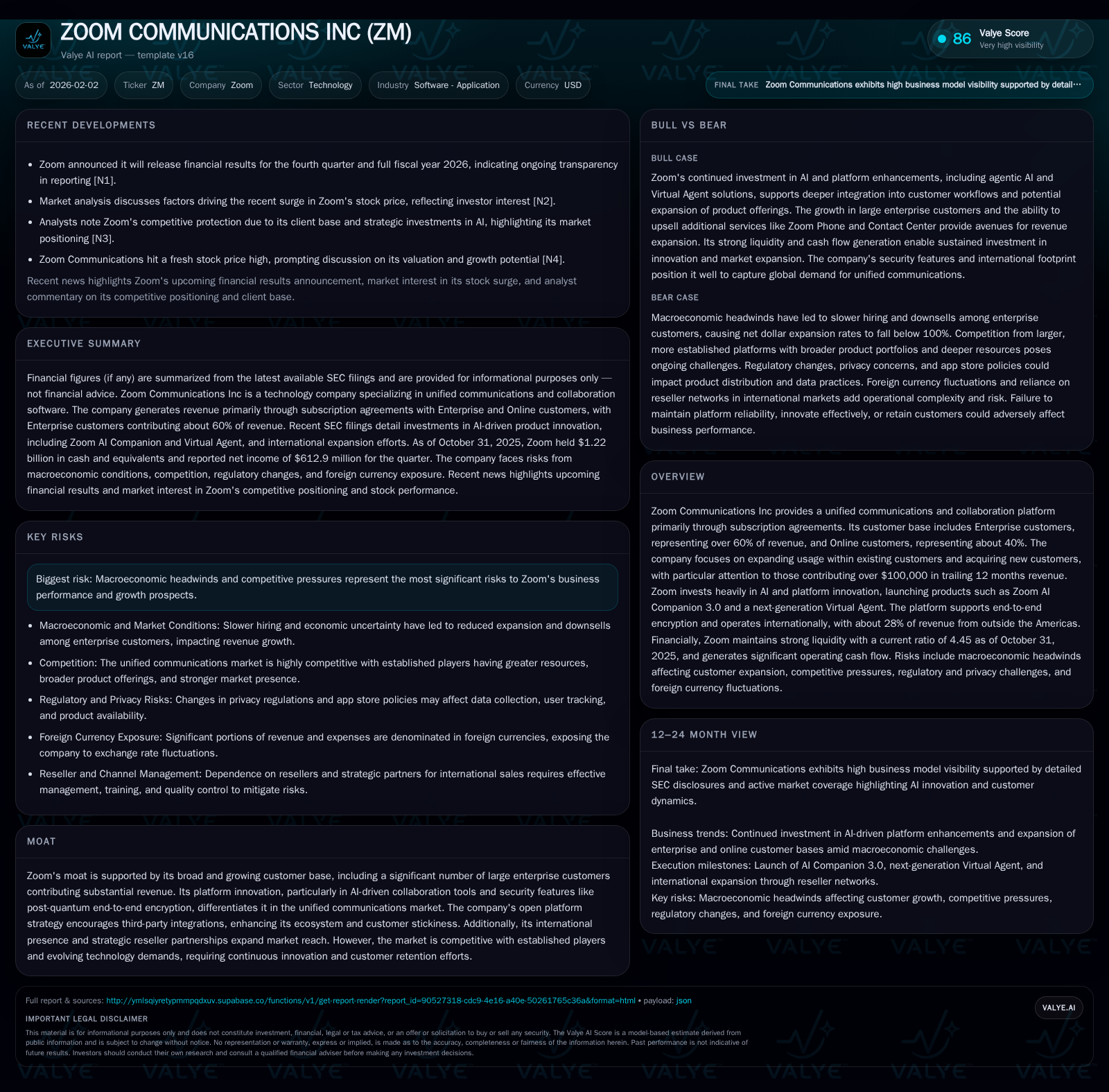
Zoom Communications remains a key player in the unified communications and collaboration space, driven by its broad enterprise customer base and ongoing AI innovation. Recent product launches such as Zoom AI Companion 3.0 and a next-generation Virtual Agent reinforce its platform strategy. However, growth dynamics are tempered by macroeconomic headwinds impacting customer expansion and price sensitivity. The company’s liquidity position is robust, supporting continued R&D and go-to-market investments. Competitive pressures from legacy and emerging players alongside evolving regulatory challenges require sustained innovation and operational discipline.
What Changed Recently
In the last 45 days, Zoom Communications announced its upcoming financial results for fiscal Q4 and full year 2026, coinciding with a notable stock surge driven by optimism around its AI investments and platform innovation [N1][N2]. Analysts highlighted Zoom’s strategic positioning as protected from competition due to deep client relationships and advancements in AI offerings such as the Zoom AI Companion 3.0 and next-generation Virtual Agent [N3][N4]. This renewed market enthusiasm reflects investor confidence in Zoom’s ability to leverage AI for productivity enhancement and customer engagement automation. However, some caution remains due to macroeconomic headwinds and competitive pressures highlighted in recent commentary [N5][N6].
Business Model as a System
Zoom operates a subscription-based unified communications platform serving two primary customer segments: Enterprise customers (approximately 60% of revenue) and Online customers (about 40%) [S1][S3][S4]. Enterprise customers are defined by engagement through direct sales, resellers, and partners, with a special focus on high-value accounts contributing more than $100,000 in trailing 12-month revenue, which represent about 32.2% of total revenue and number over 4,200 organizations [S5].
Subscription revenue is largely driven by the number of paid licenses and cross-product adoption, including Zoom Phone, Zoom Contact Center, Workvivo, and Zoom Meetings. The platform is designed for scalability and extensibility, with an open ecosystem that encourages third-party integrations to enhance customer value and stickiness [S2].
Zoom’s revenue recognition is aligned with subscription terms, with customers typically not taking possession of software but accessing services via the cloud. The online customer base shows stable retention dynamics, with an average monthly churn rate of 2.9%, supported by a substantial portion of long-tenured subscribers exceeding 16 months of continuous service [S1].
Investment priorities include ongoing R&D focused on AI, platform reliability, and global expansion, supported by a sales and marketing effort aimed at customer acquisition and expansion. Maintaining and growing the Zoom brand as a comprehensive communications platform beyond video conferencing remains a strategic imperative [S6].
Industry Map & Competitive Battlefield
The unified communications and collaboration market is highly competitive and rapidly evolving. Zoom competes with legacy vendors like Microsoft (Teams), Cisco (Webex), and Google Meet, all offering integrated suites combining video, voice, chat, and content sharing. Additionally, emerging AI-driven platforms and consumer-focused solutions add complexity to the competitive landscape [S19][S20].
Competitive advantages for Zoom include its extensive enterprise customer base, open platform enabling third-party integrations, and strong brand recognition. The company’s investment in AI-driven features aims to differentiate user experience and operational efficiency. However, competitors benefit from larger marketing budgets, broader product portfolios, and deeper integration into enterprise IT ecosystems.
Pricing sensitivity is a significant factor; competitors often use lower pricing or freemium models to capture market share, necessitating Zoom to balance value delivery with pricing discipline [S19]. The company also faces regulatory and privacy compliance challenges worldwide, with evolving standards increasing the cost and complexity of operations [S13][S14][S15].
Geopolitical factors, particularly U.S.-China relations, add risk related to data security perceptions and operational continuity given Zoom’s significant engineering presence in China [S17][S18].
Where the Economics Become Real
Zoom’s unit economics hinge on subscription growth, retention rates, and cross-selling success within its enterprise base. The company’s gross margin improved to 77.6% for Q3 2025, driven by reductions in stock-based compensation and hosting costs through cloud optimization and operational efficiencies [S7]. This margin expansion supports reinvestment in R&D and sales efforts.
Customer acquisition cost is influenced by sales and marketing investments, with ongoing hiring and productivity development crucial to expanding the enterprise customer base [S3]. Expansion within existing customers remains a key lever; however, net dollar expansion rates have dipped below 100% amid macroeconomic headwinds causing slower seat growth and some downsells [S3][S4]. Zoom aims to offset this by introducing new products and AI capabilities to deepen usage per customer.
Free cash flow remains strong, with over $970 million generated in the first half of fiscal 2025, underpinning financial flexibility [S8][S9]. The company has deployed capital for property and equipment, strategic investments, and share repurchases, reflecting confidence in its long-term model [S10][S12].
Risks to economics include potential churn from competitive pressures, regulatory costs, and adverse impacts from geopolitical tensions. Maintaining platform reliability and brand trust is essential to customer retention and pricing power [S6].
Diligence Questions / Disconfirming Signals
- How resilient is Zoom’s enterprise net dollar expansion rate given prolonged macroeconomic uncertainty and potential budget constraints at large customers?
- What is the sustainability of AI-driven product innovation in differentiating Zoom’s platform versus competitors investing heavily in similar capabilities?
- How effectively can Zoom manage increasing regulatory and privacy compliance costs globally without eroding margins or slowing innovation?
- To what extent does Zoom’s engineering and R&D presence in China expose it to operational risks amid escalating geopolitical tensions?
- Are the current churn rates and customer retention metrics stable across all geographies and customer segments, or are there pockets of vulnerability?
- How dependent is Zoom on third-party cloud providers and data centers, and what is the risk of cost inflation or service interruptions?
- How robust is Zoom’s pipeline for acquiring new large enterprise customers contributing over $100,000 in trailing revenue, and what are the barriers to scaling this segment faster?
- What impact could emerging competitors with bundled offerings or integrated ecosystems have on Zoom’s market share and pricing?
This analysis is based on publicly available information, including recent news and Zoom’s SEC filings, without access to proprietary data or forward-looking forecasts. It is intended to provide a comprehensive understanding of Zoom Communications’ business dynamics, competitive positioning, and operational challenges as of early 2026, without offering investment advice or recommendations.
Disclaimer: This is research-only, informational analysis and not investment advice. It may include AI-generated interpretation and general industry context. Always verify important details using primary sources.

Comments