
Zymeworks Advances Zanidatamab Commercialization While Managing Royalty Funding Risks
Zymeworks focuses on optimizing cash flow and advancing its flagship therapy Ziihera amid financial headwinds and strategic royalty monetization.
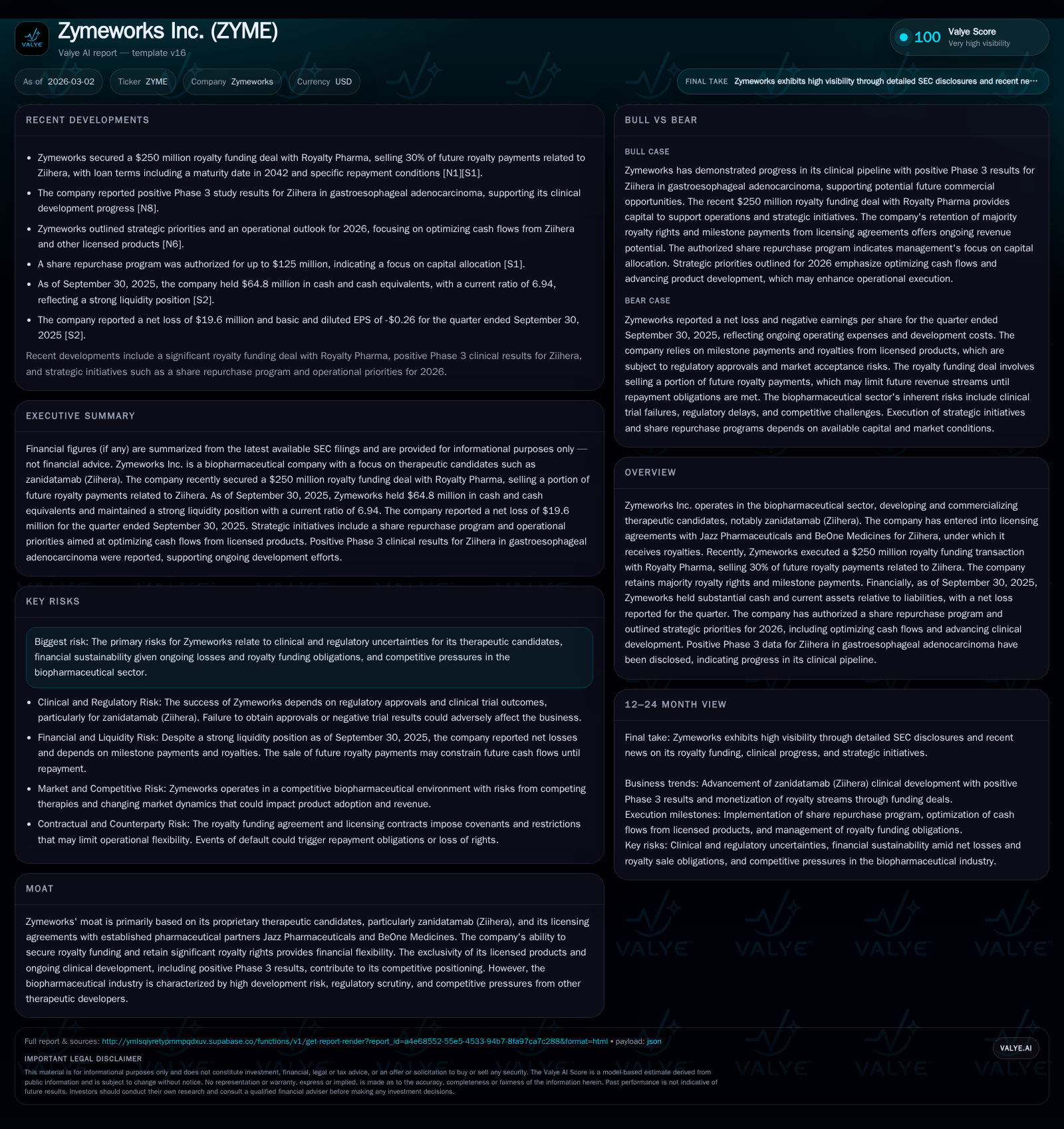
Zymeworks Inc. operates in the biopharmaceutical space with a core asset, zanidatamab (marketed as Ziihera), licensed to Jazz Pharmaceuticals and BeOne Medicines. The company has leveraged licensing royalties through a $250 million funding deal with Royalty Pharma, selling 30% of future royalties but retaining milestone payments and majority royalty rights. Despite operating losses and negative cash flow, Zymeworks’ balance sheet remains strong with a high current ratio supported by significant current assets. Positive phase 3 clinical data bolster growth prospects, though execution risks persist due to the inherent uncertainties in drug development and regulatory approvals. The company’s share repurchase program highlights confidence in capital allocation despite ongoing losses.
Company Overview and Business Model
Zymeworks Inc. develops therapeutic candidates in the biopharmaceutical arena with its most advanced commercial asset being zanidatamab (brand name Ziihera). This bispecific antibody targets specific cancer indications and is out-licensed to pharmaceutical partners Jazz Pharmaceuticals and BeOne Medicines for commercialization across various global territories [S1][N2]. The licensing framework provides Zymeworks with ongoing royalty income streams alongside milestone payments tied to regulatory approvals.
Financially, Zymeworks has engaged in innovative capital strategies to leverage these future revenue streams without relinquishing full control over its core assets. In March 2026, the company executed a $250 million royalty funding transaction with Royalty Pharma where it sold 30% of future royalties on Ziihera [N2][S3][S10]. This upfront capital infusion strengthens liquidity but transfers a portion of the future royalty upside until reimbursement caps are met. Notably, all milestone payments from the covered license agreements remain with Zymeworks.
Historical Financial Performance
Zymeworks' financial trajectory reflects the typical path of a biopharmaceutical enterprise progressing from R&D investment toward commercialization. Operating income remains negative but improved substantially from prior years, signaling controlled expense growth or early revenue impact.
Historical performance (annual)
| FY | Net ($mm) | CFO ($mm) | OpInc ($mm) | Capex ($mm) | Net YoY |
|---|---|---|---|---|---|
| 2025 | -81 | -33 | -93 | 2 | +33.9% |
| 2024 | -123 | -110 | -137 | 2 | -3.4% |
| 2023 | -119 | -118 | -138 | 2 | -195.4% |
| 2022 | 124 | 144 | 131 | 8 |
Source: SEC companyfacts cache [F1].
Capital returns and efficiency (annual)
| FY | Buybacks ($mm) | FCF ($mm) | ROE% |
|---|---|---|---|
| 2025 | 42 | -35 | -30.2 |
| 2024 | 30 | -112 | -36.2 |
| 2023 | -121 | -25.5 | |
| 2022 | 136 | 25.2 |
Source: SEC companyfacts cache [F1].
Operating income improved year-over-year by approximately one-third from FY2024 to FY2025 [F1]. Net losses narrowed similarly though remain significant as commercialization efforts ramp up.
Cash flow trends mirror operational results; negative operating cash flows have been steadily narrowing but still indicate ongoing investment needs for development and commercialization expansion [F1]. Capital expenditures have decreased by nearly one-quarter from FY2024 levels but remain modest relative to overall operations.
Equity declined over recent years reflecting accumulated losses but stood at about $268 million at the end of 2025 [F1]. Buyback activities intensified in FY2025 with $41.7 million invested back into share repurchases following an authorized $125 million program initiated in November 2025 [S8][S12][F1]. No dividends have been declared.
Liquidity and Capital Structure
At December 31, 2025, Zymeworks reported cash and equivalents of approximately $41 million along with total current assets near $249 million versus current liabilities around $42 million – yielding a robust current ratio of nearly 5.9x [F1]. This strong short-term liquidity position supports ongoing clinical programs and operational expenses despite negative cash flow.
The recently closed royalty sale brought significant upfront funding ($250 million) structured via a loan agreement maturing at end-2042 with fixed interest payments [S10][S13][N2]. Security interests cover subsidiary assets related to the royalty streams without direct recourse to parent company assets beyond equity interests.
Under this arrangement:
- Zymeworks retains 70% of Ziihera royalties until loan repayment is complete;
- All regulatory and commercial milestone payments under license agreements remain wholly owned by Zymeworks;
- Certain covenant restrictions apply primarily aimed at preserving value for Royalty Pharma while enabling operating flexibility.
This deal balances providing liquidity now while retaining long-term economic participation in successful commercialization outcomes.
Growth Prospects
The primary growth catalyst is successful market penetration of zanidatamab (Ziihera) across targeted oncology indications including gastroesophageal adenocarcinoma (GEA), where positive Phase 3 data have been recently reported [N2]. Approval milestones in major markets such as the U.S., Europe, Japan and China could drive significant milestone receipts along with escalating royalties tied to sales volumes beyond threshold levels.
Under existing licenses:
- Jazz Pharmaceuticals covers most global territories outside selected Asian markets;
- BeOne Medicines handles Asia (excluding Japan), Australia and New Zealand;
- Tiered royalties range broadly from single digits up to nearly 20% contingent on global sales volume bands [S10].
Continued clinical development programs aim to expand labeled indications which could further augment revenue potential and partner interest.
However:
- As typical in biopharma oncology development, clinical trial outcomes remain inherently uncertain,
- Regulatory approvals will shape timing and scale of commercialization,
- Competition both from established therapies and emerging biotech programs poses enduring pressure on market adoption and pricing,
- Execution risk around marketing infrastructure alignment with partners remains elevated given complex licensing geographies.
Strategic Priorities and Outlook
With an eye toward cash optimization announced in late 2025 [S8], management emphasizes steady progression of zanidatamab while managing expenses prudently amid broader macroeconomic pharmaceutical market dynamics.
Expectations include:
- Leveraging milestone payments from regulatory approvals as near-term inflection points for liquidity,
- Maximizing returns on collaboration agreements,
- Employing judicious capital allocation evidenced by active share buybacks that are funded alongside operational needs,
- Continuing pipeline advancement within focused therapeutic areas leveraging proprietary platforms.
Investors should monitor:
- Clinical readouts across ongoing trials,
- Regulatory announcement cadence globally,
- Royalty payment flows associated with partner sales performance,
- Any amendments or restructuring relating to the royalty sale arrangements,
- Cash burn trends relative to approved budgets.
Capital Allocation Review
Though currently loss-making at operating (-$92.5M) and net levels (-$81.1M), Zymeworks shows improvement versus prior years maintaining sufficient equity cushions ($268M) [F1]. The company’s FCF remains negative (-$34M), consistent with an R&D intensive stage requiring external capital support.
Noteworthy capital moves include:
- A material share repurchase program authorized up to $125M aiming to offset dilution effects or support valuation targets [S8][S12];
- Moderate capex expenditures reflective more of maintaining infrastructure than large-scale expansion;
- No dividend policy disclosed or paid highlighting retained earnings reinvestment strategy alongside partnership-based monetization deals.
Approximate calculated ROE stands negative (~-30%) reflecting net losses relative to equity at year-end; this is common for companies transitioning toward commercialization in biotech sectors [F1].
Industry Context Analysis
Despite Zanidatamab's promising clinical profile and strategic partnership model providing some level of risk mitigation through de-risked commercialization channels (Jazz Pharmaceuticals being a well-capitalized partner), biopharma companies focusing on oncology face rigorous challenges including approval timelines often extended by complex regulatory frameworks globally. Competitive dynamics often require sustained investment into differentiation technologies such as bispecific antibodies like those developed by Zymeworks — a niche becoming crowded by both large pharma incumbents and nimble biotech innovators.
Moreover, alliance management complexity rises when multiple regional licensors coexist within a single asset’s commercial ecosystem — mandating robust coordination across marketing authorization filings as well as post-launch sales tracking impacting royalty calculation accuracy.
Conclusion
Zymeworks Inc.’s business model centers on generating income from its lead asset zanidatamab via partnership royalty streams supplemented by milestone events tied closely to regulatory achievements across major oncology markets worldwide. Recent royalty monetization provides immediate capital relief enhancing liquidity yet creates financial obligations that limit near-term residual cash flow capture until loan repayment completes.
Operationally improving albeit still loss-making results underpin cautious optimism grounded on advancing pivotal clinical data sets for gastroesophageal adenocarcinoma indication coupled with strategic measures such as share repurchases illustrating proactive balance sheet management without triggering excessive dilution or distress financing events.
Continued surveillance of regulatory progressions paired with partner execution effectiveness will be critical markers signaling if projected growth can materialize against inherent developmental hazards endemic within oncology drug launch cycles.
This analysis summarizes publicly available information without offering buy or sell recommendations.
Disclaimer: This is research-only, informational analysis and not investment advice. It may include AI-generated interpretation and general industry context. Always verify important details using primary sources.

Comments