
AbCellera’s Strategic Pivot: From Antibody Discovery Platform to Proprietary Drug Development
AbCellera Biologics is transitioning from a partnership-driven antibody discovery model to building its own internal drug pipeline, introducing both new opportunities and heightened operational risk.
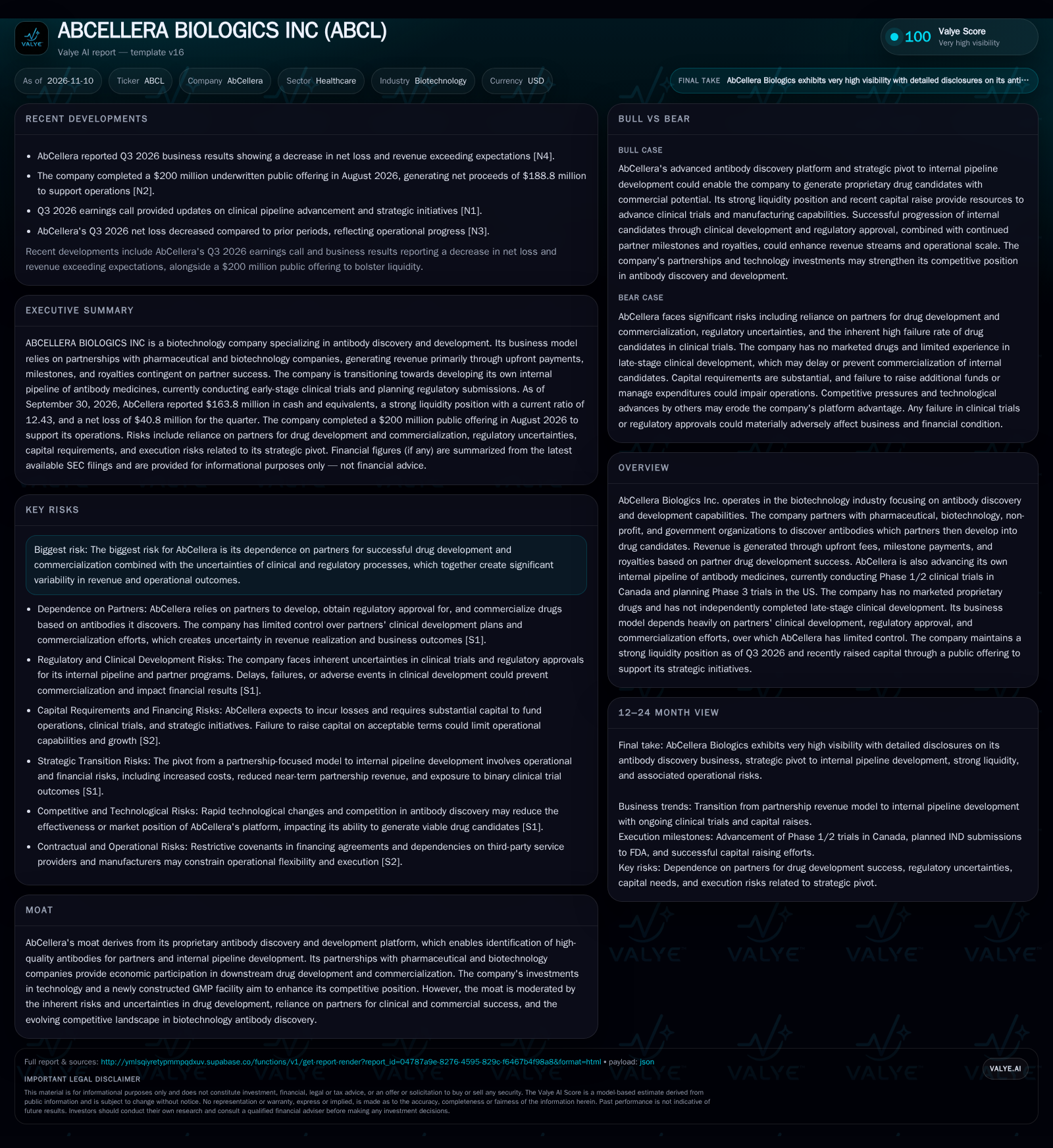
AbCellera Biologics is evolving from a third-party antibody discovery partner toward developing its own proprietary drugs, with early-stage trials underway but no late-stage or marketed assets yet. The transition, if successful, could unlock higher-margin revenue but carries significant uncertainty.
AbCellera Biologics stands at a critical inflection point, moving beyond its established role as a partner-driven antibody discovery company to pursue independent drug development. While the company continues to generate revenue from pharmaceutical and biotech partners, its future prospects increasingly rest on the success of its own pipeline—a move that could unlock greater value but brings much higher technical and financial risk.
Recent Progress and Strategic Redirection Define the Current State
AbCellera’s Q3 2026 results mark a period of transition and measured progress. The company reported a net loss of $40.8 million for the quarter, a decrease compared to previous periods, and revenue that exceeded expectations [S2] [N3] [N4].As of September 30, 2026, AbCellera held $163.8 million in cash and equivalents and posted a reported current ratio of 12.43 [S2]. The most significant development, however, is the company’s ongoing pivot from a pure partnership model to advancing its own internal antibody drug pipeline. Two candidates—ABCL635 and ABCL575—are in Phase 1/2 trials in Canada, with plans to submit IND applications for US Phase 3 trials [S1]. This marks AbCellera’s first substantial foray into independent drug development, a move that will require greater capital allocation and expose the company to new operational and regulatory risks.
How AbCellera’s Revenue Model and Cost Structure Are Evolving
Historically, AbCellera’s economics have hinged on a partnership-driven model, where upfront fees, milestone payments, and potential royalties are secured based on the downstream success of partner-developed drugs [S1]. This structure offers high operating leverage if partners deliver successful drugs, but leaves AbCellera with limited control over clinical timelines, regulatory outcomes, and commercialization. The revenue mix is inherently lumpy and unpredictable, as payments are tied to external events beyond AbCellera’s direct influence.
The company’s pivot to developing its own proprietary antibody therapies fundamentally changes its economic profile. Internal drug development entails substantial fixed costs—clinical trial expenses, regulatory submissions, and eventual commercial buildout—while pushing the company up the value chain. If successful, proprietary drugs could yield much higher margins and recurring revenue streams, but the path is capital-intensive and exposes AbCellera to the full spectrum of biotech R&D risk. The economics will thus shift from relatively low-risk, low-margin partnership fees to a higher-risk, higher-reward proprietary drug model.
Assessing Platform Differentiation and Emerging Competitive Pressures
AbCellera’s competitive edge to date has stemmed from its proprietary antibody discovery platform, which partners value for its speed and quality in identifying novel antibodies [S1]. The company’s technology investments and new GMP manufacturing facility could enhance this differentiation. However, the competitive landscape for antibody discovery is rapidly evolving, with numerous biotech firms, CROs, and large pharma players investing heavily in similar or adjacent capabilities. Advances in AI-driven discovery, alternative biologics platforms, and direct integration by large pharma could erode AbCellera’s partnership moat.
As AbCellera moves toward internal drug development, it enters a new arena dominated by established biotech and pharmaceutical companies with deep clinical, regulatory, and commercialization experience. Success will require not only scientific excellence but also the ability to execute complex, capital-intensive late-stage trials and eventually compete for payer, provider, and patient attention. The company’s lack of late-stage experience and the absence of marketed proprietary drugs highlight the steep learning curve and execution risk in this new competitive context.
What Success Looks Like: Internal Pipeline Delivers and Partnership Revenue Persists
The most favorable scenario for AbCellera is one in which its internal pipeline achieves strong clinical results, leading to regulatory approvals and eventual commercialization of proprietary antibody drugs. This would allow the company to capture much higher-margin revenue and establish itself as a vertically integrated biotech, reducing its dependence on unpredictable partner milestones. Simultaneously, a steady flow of partnership deals and partner-driven drug successes would provide a diversified revenue base, smoothing out the inherent volatility of internal R&D.
Confirmation of this scenario would come from positive Phase 2 and Phase 3 trial results for ABCL635 and ABCL575, timely regulatory submissions and approvals, and evidence of successful commercialization efforts. Continued announcements of new or expanded partnerships, as well as partners advancing AbCellera-discovered assets into late-stage development or commercialization, would further validate the hybrid model’s scalability. If AbCellera can demonstrate the ability to move multiple candidates through late-stage trials and into the market, it could justify a step-change in valuation and operational scale.
A Mixed Outcome: Progress Tempered by Execution Hurdles
The most plausible trajectory is a gradual evolution, with AbCellera making incremental progress in its internal pipeline but facing the common setbacks of biotech drug development. Some internal candidates may show promise in early-stage trials but encounter delays, regulatory challenges, or underwhelming efficacy in later phases. Partnership revenue continues but remains volatile, dependent on partner disclosures and development pace, limiting visibility and near-term revenue predictability.
This scenario would be confirmed by steady, but not transformative, pipeline advancement—such as positive but preliminary Phase 1/2 data, ongoing IND submissions, but a lack of late-stage or marketed assets. Partnership announcements may continue but with limited downstream royalty realization.
Where the Model Breaks: Clinical Setbacks and Erosion of Platform Relevance
In a negative scenario, AbCellera’s internal pipeline encounters major clinical setbacks—such as trial failures, regulatory holds, or safety concerns—leading to delays or discontinuation of key programs. Without successful proprietary assets, the company remains reliant on partner revenue, which itself is unpredictable and potentially declines if partners deprioritize AbCellera-sourced assets or competitors gain share in antibody discovery.
This downside is exacerbated if the broader market for antibody discovery platforms becomes commoditized due to technological advances or if key partners internalize capabilities. The company’s high fixed cost base from expanded R&D and manufacturing investments, combined with limited near-term revenue, could lead to accelerating losses and pressure to raise dilutive capital. Confirmation would come from negative or inconclusive clinical data, a lack of new partnerships or royalties, and persistent or widening net losses despite increased investment.
Milestones and External Triggers That Will Shape AbCellera’s Trajectory
Progression of ABCL635 and ABCL575 through Phase 1/2 trials and the timing and outcome of planned IND submissions for US Phase 3 trials; positive clinical data would be a major catalyst [S1].
Announcements of new or expanded partnerships, especially those involving downstream milestone or royalty potential, would provide evidence of continued platform relevance (if disclosed).
Evidence of partners advancing AbCellera-discovered antibodies into late-stage clinical development or commercialization, as this would directly impact royalty potential (if disclosed).
Updates on regulatory interactions, including any clinical holds, expedited designations, or guidance from Canadian and US regulators, which could impact trial timelines and success probability.
Any changes to restrictive covenants or financing terms that could impact operational flexibility and strategic choices [S2].
Competitive developments in antibody discovery, such as new platform technologies or high-profile deals by peers, which could affect AbCellera’s market position.
Disclaimer: This is research-only, informational analysis and not investment advice. It may include AI-generated interpretation and general industry context. Always verify important details using primary sources.

Comments