
InfuSystem Holdings: Operational Resilience Meets Transparency Risks in a Competitive Medical Equipment Rental Market
InfuSystem Holdings has demonstrated profitability and reported liquidity position through Q3 2026, but the recent postponement of its earnings release raises concerns about operational transparency. As the company navigates competitive pressures in the medical equipment rental sector, the durability of its business model will hinge on maintaining execution quality and addressing any emerging reporting challenges.
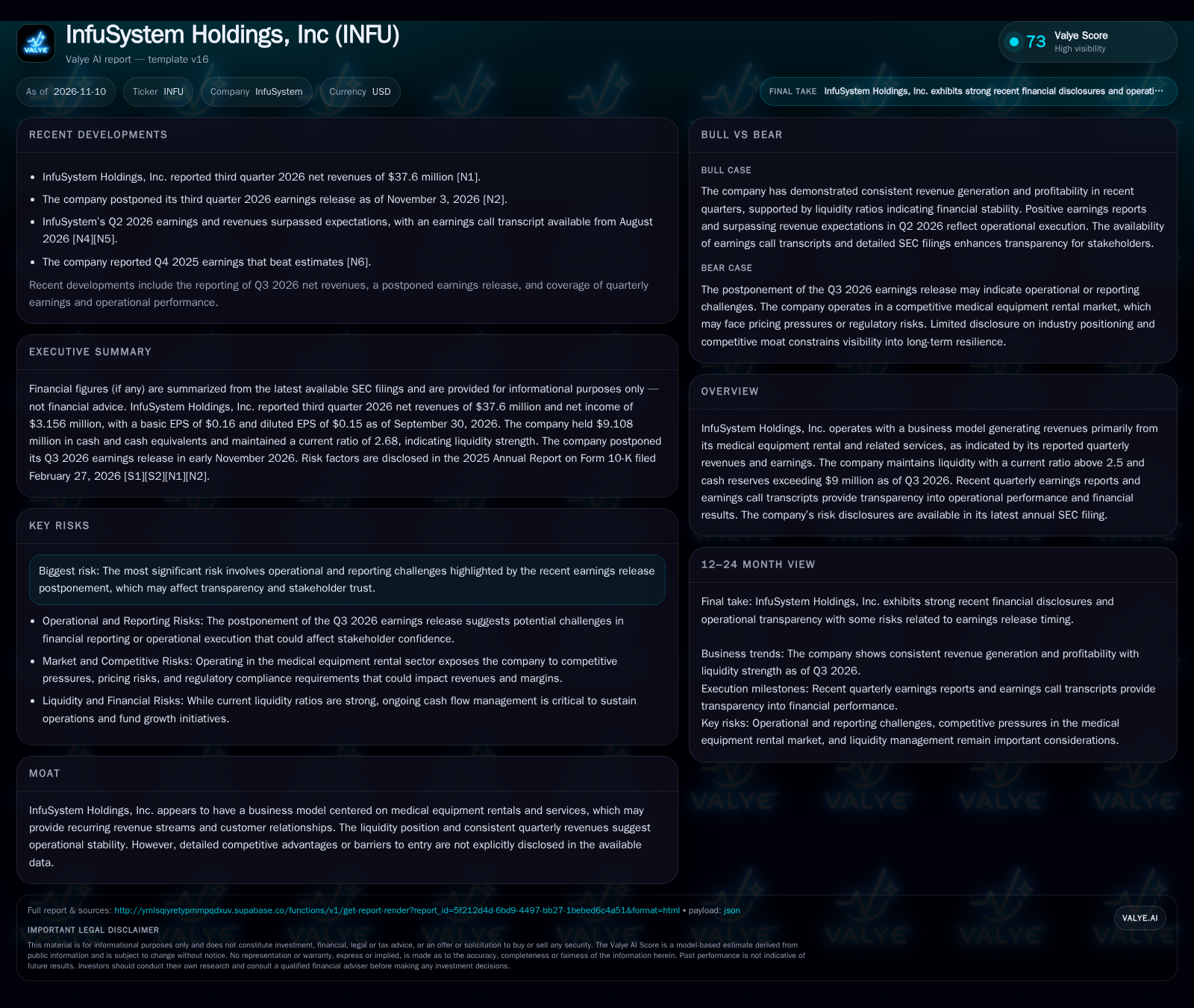
However, the company postponed its Q3 earnings release in early November 2026, introducing uncertainty around operational and reporting processes. The core question is whether InfuSystem can sustain its recent profitability and growth momentum while addressing transparency concerns and competitive pressures in the medical equipment rental market. [N1] [S2] [N2]
InfuSystem Holdings enters late 2026 with a track record of consistent revenue generation and profitability, evidenced by its Q3 net income and reported liquidity position. Yet the abrupt postponement of its third quarter earnings release injects a note of caution, suggesting potential operational or reporting headwinds that could weigh on stakeholder confidence. As the company operates within the competitive and regulated medical equipment rental sector, its ability to sustain financial momentum may hinge on both maintaining execution quality and restoring transparency.
Recent Performance and Transparency Concerns Shape Investor Focus
InfuSystem Holdings reported third quarter 2026 net revenues of $37.6 million and net income of $3.156 million, translating to $0.16 basic and $0.15 diluted EPS [N1] [S2]. This profitability, alongside a current ratio of 2.68 and cash reserves of $9.108 million as of September 30, 2026, signals a solid financial footing [S2]. However, the company postponed its Q3 2026 earnings release as of November 3, 2026, introducing uncertainty around operational or reporting processes [N2]. While recent quarters—including Q2 2026—showed revenue and earnings beats, the disruption in reporting cadence may impact stakeholder trust and raises questions about potential internal or market-facing issues [N4] [N5].
How InfuSystem’s Business Model Converts Equipment into Recurring Revenue
InfuSystem operates in the medical equipment rental sector, which typically features a mix of recurring rental income, consumables sales, and service contracts. The economics of such a model often hinge on fleet utilization rates, pricing discipline, and the ability to spread fixed costs (such as equipment procurement and maintenance infrastructure) across a growing revenue base. High gross margins are possible if equipment is kept in continuous use and if service offerings are bundled with rentals, but pricing pressure from competitors or group purchasing organizations can compress margins.
Operating leverage is attainable as incremental rental or service volume typically carries lower variable costs after fixed infrastructure is in place. However, the capital intensity of maintaining and upgrading a medical equipment fleet requires careful cash flow management. The company reported cash and liquidity metrics for the period; these figures do not by themselves establish operating runway, investment capacity, financial flexibility, or financing capacity. [S2]
A critical factor influencing InfuSystem’s business model resilience lies in the balance between capital expenditure cycles and revenue recognition patterns. Given the medical equipment rental industry’s capital intensity, timing mismatches between upfront equipment investments and subsequent rental income streams can create cash flow variability. Effective asset lifecycle management, including refurbishment and redeployment strategies, can enhance return on invested capital and mitigate depreciation risks. Additionally, the degree to which InfuSystem can leverage data analytics to optimize fleet utilization and predictive maintenance may further improve operational efficiency and customer satisfaction, thereby strengthening recurring revenue predictability.
Another dimension to consider is the contractual structure underpinning rental and service agreements. Longer-term contracts with embedded service components can create revenue visibility and reduce volatility, but may also limit pricing flexibility in a rapidly evolving competitive landscape. Conversely, shorter-term or more transactional arrangements might afford agility but increase exposure to customer churn and pricing pressures. Understanding how InfuSystem manages this trade-off, including its approach to contract renewal incentives and penalty clauses, would provide insight into the sustainability of its revenue base and margin stability.
Competitive Dynamics and Substitution Threats in Medical Equipment Rental
InfuSystem’s core market is characterized by both established national providers and regional players competing on price, service reliability, and breadth of product offerings. Barriers to entry are moderate, as capital is needed for equipment acquisition and regulatory compliance, but product commoditization can erode pricing power. The company’s recurring revenue streams may provide some insulation, but customer retention is often vulnerable to aggressive pricing or superior service from rivals.
Technology substitution—such as hospitals or clinics purchasing their own equipment or adopting new clinical modalities—could also threaten the traditional rental model. Additionally, reimbursement pressures and regulatory compliance costs could further squeeze margins. InfuSystem’s ability to differentiate on service quality, integration with clinical workflows, or exclusive product access could be key to defending share, though the report does not provide detail on unique competitive advantages.
Competitive positioning in this sector can also be influenced by the company’s ability to navigate regulatory complexities and compliance costs, which vary by geography and product category. Firms that invest proactively in compliance infrastructure may incur higher short-term costs but benefit from reduced regulatory risk and enhanced customer trust over time. Moreover, the potential for consolidation among smaller regional providers could alter competitive dynamics, possibly enabling InfuSystem to expand market share if it can execute effective integration strategies. However, such consolidation might also intensify competition if larger rivals pursue aggressive pricing or invest in differentiated service capabilities.
The threat of technology substitution extends beyond outright equipment ownership by healthcare providers to include emerging care delivery models such as home infusion therapies or telehealth-enabled monitoring, which may reduce dependency on traditional rental equipment. InfuSystem’s strategic response to these trends—whether through innovation partnerships, diversification of service offerings, or investment in complementary technologies—will be pivotal. The company’s agility in adapting its business model to evolving clinical workflows and reimbursement frameworks could determine its ability to maintain relevance and pricing power amid shifting market fundamentals.
Sustained Execution and Market Expansion Drive Above-Expectations Growth
If InfuSystem continues to deliver consistent revenue growth and profitability, leveraging its existing customer relationships and expanding into adjacent service lines or new geographies, the business could realize significant operating leverage. Evidence confirming this scenario would include ongoing revenue and earnings beats, expansion of gross margins, and disclosure of new multi-year customer agreements or service contracts.
Additional upside could come from successful integration of new technologies, enhanced service offerings, or exclusive distribution partnerships that could increase switching costs and improve retention. Confirmation would require clear communication on strategic wins and detailed competitive differentiation in future disclosures. Falsification would be signaled by margin compression, loss of major customers, or stagnating top-line growth despite sector tailwinds.
Stable Operations with Moderate Growth Amid Competitive Pressures
The most plausible outcome is that InfuSystem maintains steady revenue growth and profitability, but faces ongoing competitive and pricing pressures that limit margin expansion.
Confirmation of this scenario would involve a resumption of timely and transparent reporting, stable gross and operating margins, and continued positive net income. Falsification would be seen if reporting delays recur, if regulatory or operational disruptions emerge, or if competitive pressures result in sustained revenue or margin declines.
Operational or Reporting Setbacks Undermine Stakeholder Confidence
Should the issues underlying the Q3 earnings postponement reflect deeper operational or financial control weaknesses, InfuSystem could face an erosion of stakeholder trust, increased scrutiny from regulators, or even restatements of prior results. In this scenario, revenue momentum could stall as customers and partners seek more transparent or stable providers, and the company might need to devote resources to remediation efforts rather than growth.
Downside confirmation would include additional reporting delays, adverse audit findings, negative changes in credit terms, or customer attrition. Falsification of this scenario would be a rapid return to regular reporting cadence with no subsequent disclosures of material weaknesses or operational disruptions.
What Will Prove InfuSystem’s Ability to Navigate Uncertainty?
The timing and transparency of the next scheduled earnings release and whether the reporting cadence returns to normal.
Gross and operating margin trends in subsequent quarters, especially if disclosed in context of pricing or cost pressures.
Disclosure of any material weaknesses in internal controls or restatements arising from the Q3 earnings postponement.
Customer retention rates, contract renewal activity, or major new customer wins—if disclosed.
Revenue growth relative to industry benchmarks and evidence of expansion into new service lines or geographies.
Changes in cash flow from operations and capital expenditures, indicating the company’s ability to self-fund growth.
Updates on competitive positioning, such as service differentiation or integration partnerships, that could support pricing power or retention.
Disclaimer: This is research-only, informational analysis and not investment advice. It may include AI-generated interpretation and general industry context. Always verify important details using primary sources.

Comments