
JBS N.V.: Scale, Regulation, and the Economic Stakes of Global Meat Processing
JBS N.V., one of the world's largest meat processors, posts substantial revenue and profit but faces regulatory, climate, and governance headwinds. Recent earnings softness and rising compliance costs highlight the delicate balance between operational scale and mounting external pressures.
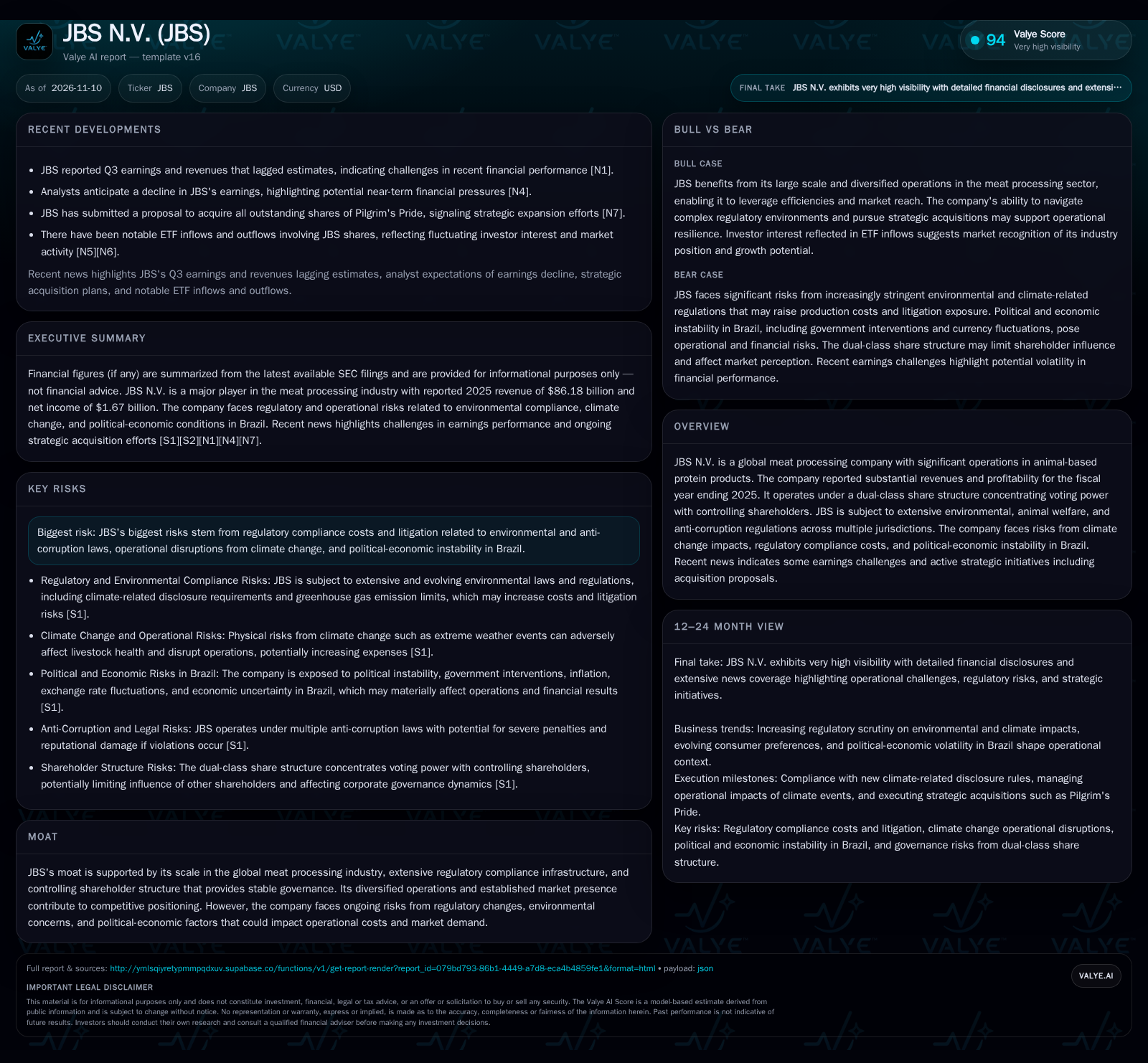
JBS reported $86.18 billion in 2025 revenue and $1.67 billion in net income, but recent quarters have lagged expectations as regulatory and climate risks rise. The company’s dual-class structure and exposure to Brazil add complexity, while its global scale remains a potential buffer. The key question: Can JBS offset intensifying cost and risk pressures through efficiency, diversification, and strategic moves before external forces erode its core economics? [S1] [N1] [N4]
JBS N.V. stands at the crossroads of global food demand and intensifying regulatory, environmental, and political risks. With $86.18 billion in 2025 revenue and a sprawling international footprint, JBS’s scale offers both resilience and exposure. Recent earnings softness and analyst caution point to mounting cost and margin pressures, while new climate disclosure rules and Brazil’s volatile macro environment threaten to reshape the company’s risk-reward profile. The fundamental question for investors and stakeholders is whether JBS can leverage its operational advantages to offset these mounting headwinds—or whether external forces will erode the core economics of industrial meat processing.
Recent Financial Performance and Shifting Risk Landscape
JBS reported revenue of $86.18 billion and net income of $1.67 billion for the full year 2025, maintaining its status as a global meat processing heavyweight [S1]. However, Q3 2026 results lagged analyst estimates, and consensus anticipates a further earnings decline, suggesting recent operational and margin headwinds [N1] [N4]. The company’s regulatory exposure is intensifying: new SEC climate disclosure rules and other environmental mandates are expected to drive up compliance costs and increase litigation risk [S1]. JBS’s dual-class share structure continues to concentrate voting power with controlling shareholders, limiting the influence of minority investors [S1]. Additionally, the company’s significant operations and exposure in Brazil bring ongoing risks related to political instability, inflation, and currency volatility [S1].
How the Industrial Meat Model Drives—and Constrains—Profitability
JBS’s economic engine is built on high-volume, low-margin processing of animal proteins, with profitability hinging on throughput, operational efficiency, and commodity price management. The business is capital-intensive: large-scale slaughterhouses, logistics networks, and compliance with food safety, animal welfare, and environmental standards all require significant ongoing investment. Fixed costs are high, but scale can drive operating leverage if volumes remain robust and input costs are contained.
Pricing power is limited by intense global competition and consumer price sensitivity, while revenue mix is heavily weighted toward beef—typically the highest-margin but also the most climate- and regulation-exposed product line. Variable costs, particularly feed and livestock, are volatile and can quickly compress margins. Downcycle risks are pronounced: when commodity or regulatory costs spike, or when demand falters, profitability can erode rapidly.
The company reported cash and liquidity metrics for the period; these figures do not by themselves establish operating runway, investment capacity, financial flexibility, or financing capacity. [S1]
Scale Advantages and the Limits of Defensive Moats
JBS’s global footprint and vertical integration offer tangible scale advantages: procurement leverage, diversified sourcing, and the ability to spread regulatory and compliance costs across multiple jurisdictions. This can deter smaller competitors and create efficiencies in logistics, procurement, and risk management. The company’s broad customer base—including retailers, foodservice, and export channels—further insulates against demand shocks in any single market.
However, these advantages are increasingly offset by counterforces. Regulatory scrutiny is disproportionately high for industry leaders, and scale does not shield JBS from the direct operating impacts of extreme weather, disease outbreaks, or geopolitical disruptions. Alternative proteins (plant-based and cultivated meat) continue to threaten long-term demand for traditional animal products, particularly in developed markets. Meanwhile, the company’s dual-class share structure may be a double-edged sword: it supports stable governance but can alienate institutional investors and constrain access to capital.
Leveraging Efficiency and Diversification to Outpace Rising Costs
The most favorable scenario for JBS is one in which operational efficiencies, strategic acquisitions, and product diversification outstrip the rising tide of regulatory and input costs. If the company can successfully implement automation, optimize supply chains, and expand into higher-margin or less-regulated protein segments, margin resilience could improve despite external pressures.
Success would be confirmed by stabilization or expansion of operating margins, cash flow growth even as compliance costs rise, and evidence of continued market share gains in both traditional and alternative protein categories. Strategic acquisitions that enhance scale or access to new markets—if executed without overleveraging—would add further upside.
This scenario could be falsified by persistent margin compression, inability to pass through costs, or failure to gain traction in new product lines, as well as regulatory or legal setbacks that trigger outsized fines or operational restrictions.
Managing Through Margin Squeeze and Regulatory Drag
The most plausible pathway for JBS over the next 12-24 months is a period of margin compression as compliance, environmental, and input costs rise faster than efficiency gains or price increases. The company is likely to maintain its revenue scale, but net income may stagnate or decline modestly under regulatory and macroeconomic pressure.
Confirmation would come from sequentially flat or slightly declining operating margins, continued high capital expenditures, and muted net income growth despite revenue stability. Regulatory filings showing increased compliance and legal expenditures—and management commentary focusing on cost control and risk mitigation—would further support this view.
This scenario would be challenged if JBS delivers a notable rebound in profitability, demonstrates successful cost pass-through to customers, or if regulatory headwinds prove less onerous than anticipated.
Regulatory, Climate, and Political Shocks Trigger Disproportionate Earnings Decline
A more adverse scenario unfolds if JBS faces a convergence of negative forces: major climate-related production disruptions, sharply higher compliance or litigation costs, and acute political or currency instability in Brazil. In this case, the company’s fixed cost base and exposure to volatile commodity and regulatory risks could drive a rapid contraction in earnings and cash flow.
Indicators would include a sharp drop in net income, negative free cash flow, rising leverage, and potential asset impairments or restructuring charges. Regulatory or legal actions resulting in material fines or operational restrictions would further aggravate downside risk. Prolonged political or macro instability in Brazil could exacerbate these pressures by disrupting supply chains, inflating costs, or limiting access to capital.
This scenario would be falsified by resilience in earnings and cash flow even in the face of negative external events, or by rapid adaptation to new regulatory requirements without outsized cost increases.
What Will Test JBS’s Ability to Sustain Its Industrial Meat Economics?
Quarterly and annual trends in operating margin and net income: Persistent declines would signal cost pressures are outpacing efficiency gains.
Disclosure and quantification of climate-related compliance and litigation costs: Rising figures would confirm regulatory drag.
Progress and execution on strategic acquisitions and diversification into alternative proteins or higher-margin segments, if disclosed.
Capital expenditure levels and allocation: Shifts toward automation, sustainability, or new geographies would indicate strategic response.
Trends in feed and livestock input costs versus realized pricing: Compression here would test the company’s ability to pass through costs.
Impact of currency and inflation volatility in Brazil on consolidated financials: Persistent headwinds would raise risk.
Changes in the shareholder base or governance structure: Movement away from the dual-class model, or increased activism, could alter capital access and oversight.
Any disclosed legal or regulatory settlements, fines, or restrictions: These could have immediate financial and reputational impacts.
Disclaimer: This is research-only, informational analysis and not investment advice. It may include AI-generated interpretation and general industry context. Always verify important details using primary sources.

Comments