
Select Water Solutions: Building Permian-Scale Water Infrastructure in a Volatile Energy Cycle
With a recycling-first network, long-term contracts, and capital-intensive assets, Select Water Solutions seeks to anchor its economics in the growing need for sustainable water management across U.S. oil and gas basins. The company’s 2026 results highlight the opportunities and constraints of tying infrastructure investments to the volatile capital spending of its energy customers.
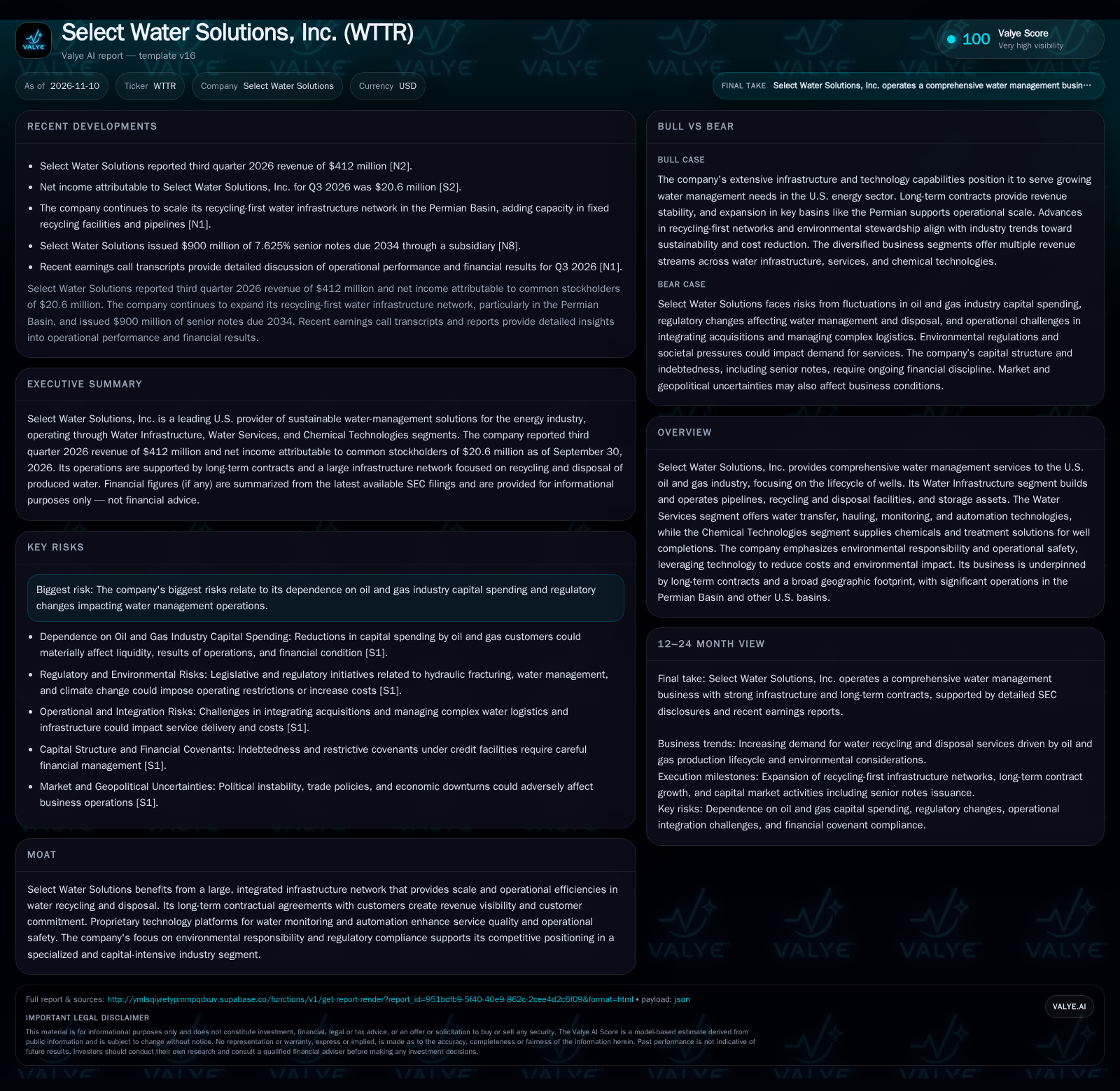
Select Water Solutions delivered $412 million in Q3 2026 revenue and $20.6 million in net income, underpinned by a vast water infrastructure network and long-term contracts. Its ongoing expansion in the Permian Basin and its recent $900 million senior notes issuance signal bets on scale and recurring demand for water recycling and disposal. However, the business remains exposed to energy industry cycles, regulatory shifts, and integration complexities, all of which could reshape its risk/reward profile in the next phase.
Select Water Solutions stands at the intersection of infrastructure, technology, and energy services, providing mission-critical water management for U.S. oil and gas producers. Its Q3 2026 results show a business balancing scale—via a vast network of recycling and disposal assets—with the inherent cyclicality and regulatory scrutiny of the energy sector. As the industry transitions toward more sustainable practices, Select’s long-term contracts and recycling-first strategy may offer both resilience and upside, but the company’s reliance on debt-funded growth and exposure to external shocks remain central to its risk profile.
2026 Snapshot: Revenue Growth, Infrastructure Expansion, and Capital Structure Moves
Select Water Solutions reported $412 million in revenue and $20.6 million in net income for the third quarter of 2026, signaling strong demand for its water management services in the U.S. oil and gas sector [N2] [S2]. This performance is rooted in a broad infrastructure footprint, including 2.4 million barrels per day of recycling capacity and 2.3 million barrels per day of disposal capacity as of December 2025 [S1]. The company continues to ramp up recycling-first assets in the Permian Basin, responding to customer needs for both cost efficiency and environmental compliance [N1] [S1].
The company reported a current ratio of 1.61 for the period. [N8] [S2]
How Scale, Contracts, and Recurring Volumes Drive Economics—And Where the Leverage Lies
Select Water Solutions’ business model is anchored in long-lived, capital-intensive assets—pipelines, recycling plants, and disposal wells—that aim to generate recurring revenue from oil and gas producers. The economics hinge on high upfront capital deployment, followed by multi-year revenue streams secured by acreage dedications, minimum volume commitments, and rights of first refusal [S1]. This structure can yield operating leverage: once infrastructure is in place, incremental volume tends to carry higher margins, as fixed costs are spread over more throughput.
Pricing is typically influenced by local competition, basin-specific supply-demand for water management, and regulatory factors. The company’s Water Infrastructure segment likely benefits from higher margins and contract-driven revenue visibility, while Water Services and Chemical Technologies are more volume-sensitive and exposed to day-rate or transactional pricing. The shift from truck-based to pipeline-based produced water transport may further reduce variable costs and environmental risks, enhancing margin structure over time.
However, the debt-financed nature of recent expansions raises the stakes: interest costs on the new $900 million notes will be a significant fixed charge, so asset utilization and contract enforcement become critical to maintaining profitability. If oil and gas activity stalls, the company’s fixed cost base could weigh on returns, and covenant compliance may become a constraint.
Infrastructure Density, Contractual Lock-In, and Technology: Can Select Defend Its Turf?
Select Water Solutions’ competitive positioning rests on three pillars: infrastructure density, long-term customer contracts, and proprietary technology. The scale of its recycling and disposal network—especially in the Permian—gives it a logistical and cost advantage, making it harder for new entrants to replicate its footprint without substantial capital outlays [S1]. Long-term agreements such as acreage and wellbore dedications create customer stickiness, reducing churn and providing revenue visibility.
Technology platforms like AquaView® for monitoring and automation further differentiate Select’s service offering, potentially lowering customers’ total cost of water management and improving regulatory compliance. However, competition remains intense from both large diversified oilfield service providers and regional water specialists, some of whom may pursue price competition or invest in their own infrastructure. The risk of technology or regulatory substitution—such as new water treatment or recycling techniques—could also erode the moat over time if Select’s solutions do not keep pace.
Leveraging Permian Growth and Sustainability Mandates for Margin Expansion
A favorable scenario unfolds if U.S. oil and gas activity remains robust and environmental regulations increasingly mandate water recycling and lower emissions. In this world, Select’s fixed recycling and disposal assets operate near capacity, while long-term contracts anchor pricing and minimize customer turnover. The company’s pipeline infrastructure displaces truck hauling, driving both cost and emissions savings for customers—potentially justifying premium pricing.
Upside would be confirmed by a sustained increase in contracted recycling volumes, successful expansion of large-diameter pipelines in the Permian, and additional long-term agreements with major operators. Improving margins in the Water Infrastructure segment and rising share of revenue from recycling versus disposal would further validate this scenario. Evidence of customers extending contract duration or expanding dedications would suggest Select is viewed as a strategic, rather than merely transactional, partner.
Recurring Revenue, Cyclical Exposure, and the Push-Pull of Industry Spending
The most plausible outcome is a business benefitting from stable, contract-driven infrastructure revenues, but with ongoing sensitivity to oil and gas capital spending cycles. Recurring volumes from long-term agreements provide a floor under revenues, while Water Services and Chemical Technologies revenues remain more variable, tracking drilling and completion activity.
Moderate growth in recycling volumes is likely as environmental pressures mount, but price competition and regulatory friction may cap margin expansion. The company’s leverage from recent note issuance is manageable so long as utilization remains high and the oil and gas sector avoids a sharp contraction. The base case would be confirmed by steady infrastructure segment utilization rates, stable or modestly rising EBITDA margins, and no material covenant or liquidity stress.
When Energy Cycles Turn: Fixed Costs, Debt, and Regulatory Shocks
A negative outcome could unfold if oil and gas capital spending declines due to commodity price drops, regulatory changes, or geopolitical shocks. In this scenario, Water Services and Chemical Technologies see sharp volume contractions, while even infrastructure segment revenues come under pressure if minimum volume commitments are not enforced or renegotiated.
The capital-intensive, debt-supported model becomes a liability if asset utilization drops: fixed costs and interest payments erode profitability, and liquidity tightens. Regulatory or environmental setbacks—such as new restrictions on disposal wells or stricter recycling mandates—could force new investment or curtail operations. Confirmation of this scenario would include falling contract volumes, margin compression, missed debt covenants, or a need to raise additional capital under adverse terms.
What Will Determine Select Water Solutions’ Trajectory in the Next Phase?
Trends in contracted recycling and disposal volumes, especially in the Permian Basin, would help test the durability of infrastructure utilization and recurring revenue.
Disclosure of new or expanded long-term customer agreements—particularly acreage or wellbore dedications—would indicate ongoing customer lock-in and future revenue visibility.
Infrastructure segment EBITDA margin trends (if disclosed) would provide insight into operating leverage and pricing power.
Actual versus minimum volume commitments under existing contracts: are customers consistently meeting or exceeding their obligations?
Changes in regulatory environment—especially new rules affecting water disposal wells or recycling mandates—could materially alter capital requirements and revenue mix.
Covenant compliance and net leverage ratios following the $900 million notes issuance: look for early signs of financial constraint if industry conditions soften.
Adoption or expansion of proprietary technology platforms (e.g., AquaView®) among key customers: does this translate into improved retention or pricing?
Evidence of operational or integration issues, particularly if the company pursues further acquisitions or rapid infrastructure build-out.
Disclaimer: This is research-only, informational analysis and not investment advice. It may include AI-generated interpretation and general industry context. Always verify important details using primary sources.

Comments