
Tecnoglass: Can Vertical Integration and U.S. Expansion Sustain Margin Strength as Industry Cycles Shift?
Tecnoglass’s cost-advantaged, vertically integrated model has enabled rapid U.S. growth and strong margins, but the next phase of value creation hinges on execution outside Florida, resilience to construction cycles, and the durability of its cost and quality edge.
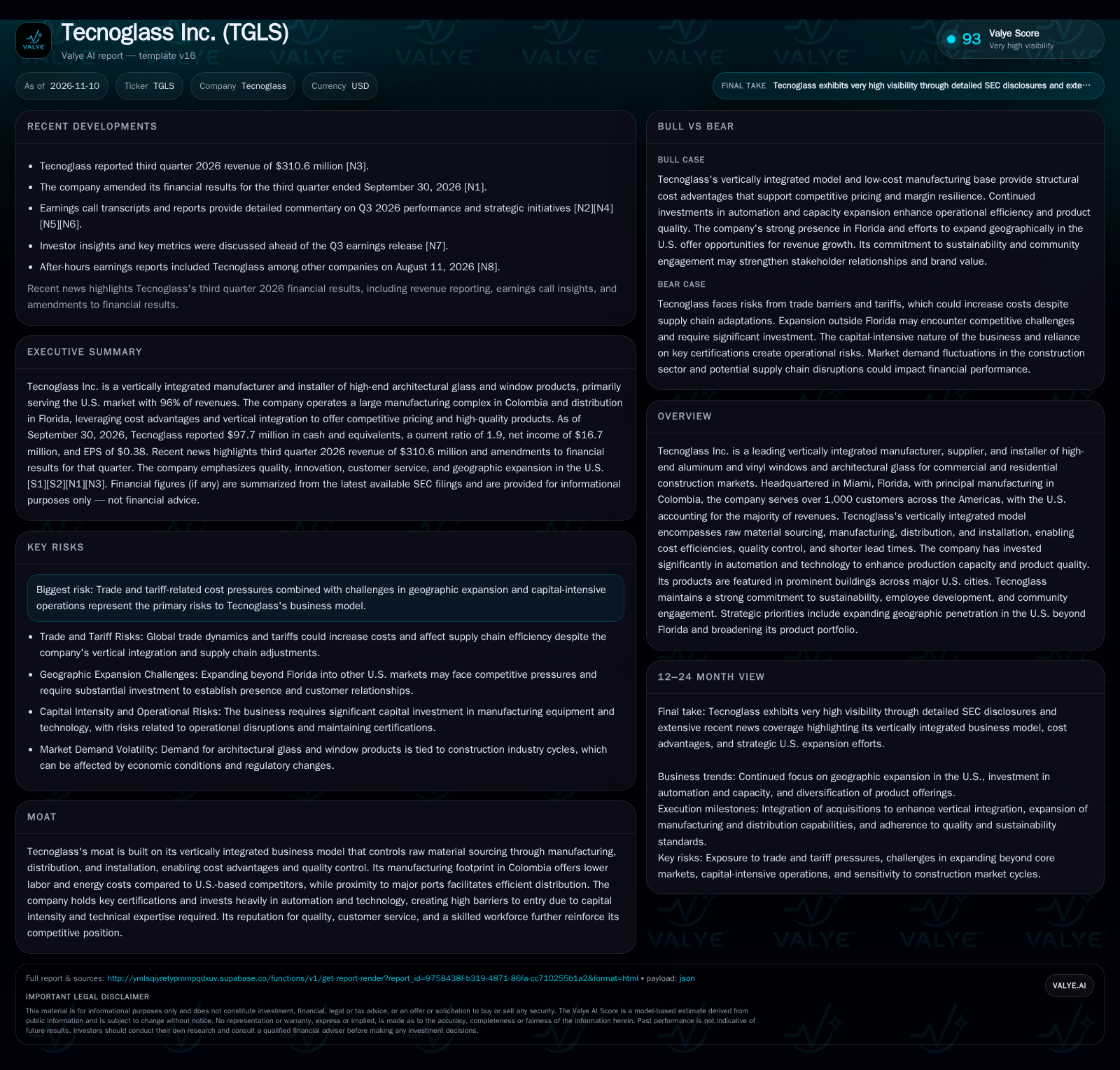
Tecnoglass reported Q3 2026 revenue of $310.6 million and continues to derive 96% of sales from the U.S., leveraging its Colombian manufacturing base for significant cost advantages. The company’s vertical integration, recent $230 million investment in automation and expansion, and focus on quality and customer service underpin its market share gains. However, future growth depends on successful geographic diversification, effective management of capital intensity, and the ability to withstand construction market volatility and potential trade/tariff headwinds. Barriers to entry remain high, but the company’s margin resilience and pricing power will be tested as it moves further into new U.S. regions and broader product categories. [S1] [S2] [N1] [N3]
Tecnoglass Inc. has built a business with enviable operating leverage by marrying a low-cost Colombian manufacturing hub with deep vertical integration, serving the U.S. construction market with high-end glass and window systems. Its ability to deliver quality at scale, underpinned by $230 million in recent automation and capacity investments, has driven strong revenue and margin performance—culminating in $310.6 million of Q3 2026 revenue and a net income of $16.7 million. Yet, as the company seeks growth beyond its Florida stronghold, the focus shifts to whether its cost, quality, and service advantages are portable and sustainable amid a maturing U.S. construction cycle, intensifying competition, and persistent trade/tariff uncertainties. [S1] [S2] [N3]
Recent Financials Highlight Growth and the Stakes of U.S. Market Dependence
Tecnoglass reported Q3 2026 revenue of $310.6 million, with 96% of its sales coming from the United States—a testament to its concentration in the U.S. construction sector. Net income for the quarter was $16.7 million, translating to basic and diluted EPS of $0.38. The company’s financial position as of September 30, 2026, included $97.7 million in cash and equivalents, a current ratio of 1.9, and a cash ratio of 0.26. Notably, Tecnoglass amended its third quarter financial results, underlining the importance of data integrity and transparency as the company attracts greater investor scrutiny. The company has also invested approximately $230 million since 2023 in automation, technology, and capacity expansion, positioning itself for operational efficiency and product quality improvements. [S1] [S2] [N1] [N3]
Dissecting the Economics of Vertical Integration and Cost Advantage
Tecnoglass’s core economic proposition rests on its vertically integrated approach, which spans raw material sourcing, manufacturing, distribution, and installation. This structure helps capture more value per project and reduces reliance on third-party suppliers, which, combined with its Colombian manufacturing base, yields lower labor and energy costs compared to U.S.-based competitors. The company’s ownership stake in Vidrio Andino Holdings S.A.S. further secures raw glass supply, mitigating some input price risks.
Revenue is generated primarily through sales of high-end architectural glass and window systems to commercial and residential customers, with product mix and project scale influencing gross margins. The capital intensity is substantial—recent $230 million investments in automation and expansion illustrate the ongoing need for large-scale capital allocations to maintain efficiency and capacity. Fixed costs are significant but provide strong operating leverage as volumes rise, especially when paired with high asset utilization.
Pricing power is potentially supported by technical certifications, quality reputation, and the ability to meet demanding lead times, but it is ultimately tested by market cycles and competitive bids. As Tecnoglass moves beyond Florida and into broader U.S. geographies and residential segments, the mix of contract size, margin profile, and customer acquisition costs may shift, making the efficiency of its vertically integrated, cost-advantaged model a critical determinant of future profitability.
How Tecnoglass’s Moat Is Tested by U.S. Expansion and Industry Headwinds
The company’s moat is derived from a combination of vertical integration, technical certifications, and a cost structure that U.S.-based competitors find difficult to replicate. Its manufacturing scale and automation investments create high barriers to entry, while its reputation for quality and customer service provides a further buffer against commoditization.
However, expansion into new U.S. markets exposes Tecnoglass to entrenched regional players, who may have deeper local relationships, established distribution, and brand familiarity. Additionally, the U.S. construction materials market is fragmented, with both large national suppliers and regional specialists competing aggressively on price and service. Potential substitutes include domestic glass manufacturers, alternative window systems, and pre-fabricated solutions.
Trade and tariff risks could erode the Colombian cost advantage, while fluctuations in construction activity and regulatory requirements (such as new building codes or sustainability mandates) could shift customer priorities. The question is whether Tecnoglass’s integration, quality, and cost position can continue to deliver above-peer returns as it broadens its geographic footprint and faces more direct competition.
What Sustained Share Gains Would Require: Margin Durability and Market Expansion
A favorable scenario for Tecnoglass would see the company successfully replicating its Florida playbook in additional U.S. markets, leveraging its cost structure and integrated model to win market share while maintaining or expanding margins. This would likely require continued operational execution—on-time delivery, service reliability, and product innovation—combined with effective local sales and installation partnerships.
Confirmation would come from consistent revenue growth outside Florida, stable or improving gross margins despite higher logistics and customer acquisition costs, and evidence that pricing discipline is maintained even as the company scales. Expansion of the product portfolio, especially into residential and retrofit segments, would further support top-line growth and diversify end-market exposure.
Sustained margin strength in the face of construction cycle volatility and any new tariffs would also signal that Tecnoglass’s structural advantages remain intact. Additional evidence would include customer wins in high-profile projects outside its historical core, and successful integration of technology and automation investments into scalable, repeatable delivery processes.
Growth Continues but Margins Normalize as Expansion Costs Rise
The most plausible trajectory is that Tecnoglass continues to grow revenues, particularly through incremental gains in new U.S. regions, but faces some margin compression as the cost of geographic expansion rises. Increased logistics complexity, local marketing and sales costs, and the need to meet varying regulatory and building code requirements may weigh on profitability, even as scale efficiencies partially offset these pressures.
Gross margins could gradually revert toward industry norms as the company absorbs higher transportation costs and encounters more price-sensitive regional competitors. However, the company’s automation investments and ongoing process improvements may enable it to preserve a cost edge relative to less-integrated peers. Revenue growth would likely remain above construction sector averages if Tecnoglass can maintain service and quality standards while broadening its footprint.
Evidence for this scenario would include steady but moderating growth rates, stable revenue contribution from Florida, and incremental gains in new territories, with some quarter-to-quarter volatility in margins as the company adjusts to broader geographic operations.
Margin Compression and Volatility if Cost Advantages Erode or Market Cycles Turn
In a less favorable scenario, Tecnoglass’s cost advantages are diminished by new trade barriers, rising Colombian input costs, or inefficiencies as it expands into less familiar U.S. regions. If construction activity slows in the U.S.—particularly in key Sunbelt markets—the company’s high fixed costs and capital intensity could magnify profit declines.
Margin pressure could intensify if competitors respond aggressively on price or if Tecnoglass is forced to absorb higher logistics and compliance costs to win new business. Operational missteps, supply chain disruptions, or failure to secure required technical certifications for new markets would further undermine profitability.
Confirmation of this scenario would include declining gross margins, negative operating leverage, a drop in order backlog (if disclosed), or slower cash conversion cycles. A significant reduction in U.S. construction activity, or company disclosures of project delays and cost overruns, would also be red flags.
Factors That Will Determine Whether Tecnoglass’s Expansion Thesis Holds
Revenue growth rates in U.S. regions outside Florida—disclosure of state or regional sales mix would help test the scalability of the model.
Gross margin trends as the company expands geographically—persistent margin strength would support the competitive advantage thesis.
Project backlog or order book (if disclosed)—would provide visibility into forward demand and resilience to construction cycle swings.
Updates on trade/tariff policy or input cost inflation—evidence of cost pass-through and sustained sourcing advantages.
Customer concentration metrics—greater diversification would reduce risk as the company moves beyond its Florida base.
Evidence of successful execution in high-profile projects outside historical core markets.
Progress in integration of automation and capacity investments—impact on operating efficiency and delivery times.
Any recurring amendments or restatements of financial results, which could signal internal controls or data integrity issues.
Disclaimer: This is research-only, informational analysis and not investment advice. It may include AI-generated interpretation and general industry context. Always verify important details using primary sources.

Comments