
Trevi Therapeutics and the Stakes of Late-Stage Respiratory Drug Development
Trevi Therapeutics is advancing Haduvio through pivotal Phase 3 trials for chronic cough in IPF and other interstitial lung diseases, leveraging a cash-rich balance sheet to navigate a highly competitive landscape. The company's near-term trajectory hinges on clinical outcomes, regulatory clarity, and its ability to differentiate in a market crowded with both established and emerging players.
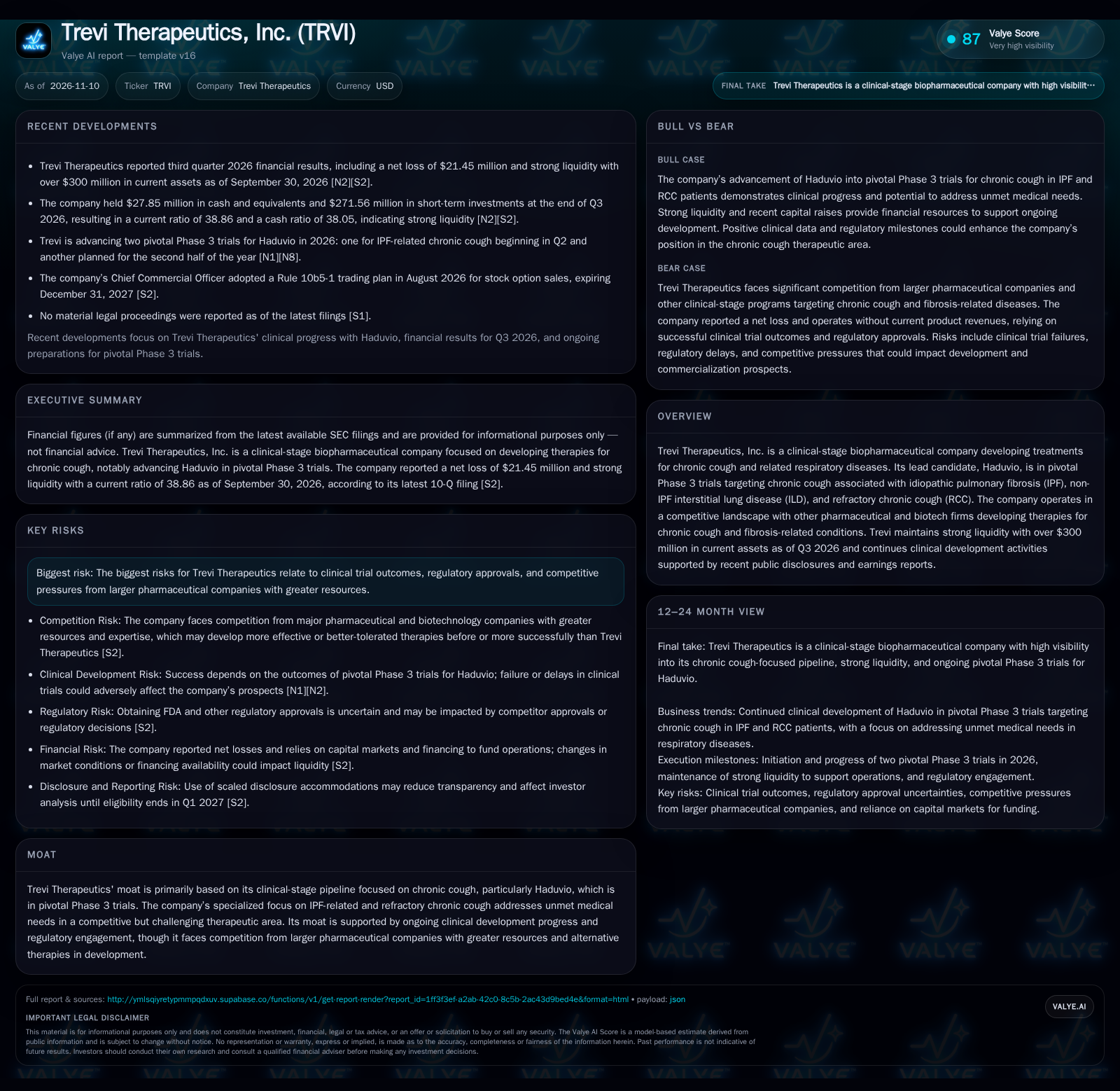
Trevi Therapeutics holds over $300 million in current assets and is progressing two pivotal Phase 3 trials for Haduvio in chronic cough related to IPF and non-IPF ILD. The company faces intense competition from larger pharmaceutical players and other clinical-stage programs targeting similar indications. Its financial strength provides a buffer for ongoing R&D, but future value depends on clinical and regulatory milestones as well as commercial positioning. [S2] [N1] [N8]
Trevi Therapeutics is at a critical inflection point as it advances Haduvio, its lead candidate for chronic cough in idiopathic pulmonary fibrosis (IPF) and related conditions, into late-stage clinical trials.With over $300 million in current assets and an reported current ratio, Trevi is better capitalized than many clinical-stage peers, positioning it to weather the uncertainties of drug development. Yet, the company’s future is far from assured, as it faces well-funded competitors and the inherent risks of clinical and regulatory setbacks. The next 12-24 months will likely determine whether Trevi can convert its financial strength and clinical momentum into a sustainable commercial franchise—or become another cautionary tale of biotech volatility.
Trevi’s Late-Stage Pipeline and Financial Position Define Its Near-Term Stakes
Trevi Therapeutics reported $305.8 million in current assets—including $27.85 million in cash and $271.56 million in short-term investments—against just $7.87 million in current liabilities as of September 30, 2026, giving it a current ratio of 38.86 and a cash ratio of 38.05. The company reported cash and liquidity metrics for the period; these figures do not by themselves establish operating runway, investment capacity, financial flexibility, or financing capacity. [S2] [N2]
The company is advancing two pivotal Phase 3 trials for Haduvio: one targeting chronic cough in IPF patients, which began in Q2 2026, and another for non-IPF interstitial lung disease planned for the second half of the year. [N1] [N8]
Despite this progress, Trevi reported a net loss of $21.45 million for Q3 2026, which underscores the high costs associated with late-stage clinical programs and the absence of commercial revenue at this stage. [S2] [N2]
No material legal proceedings or adverse regulatory disclosures have emerged as of the latest filings, and the company’s Chief Commercial Officer adopted a 10b5-1 trading plan for stock option sales in August 2026. [S2]
How Trevi’s Model Could Capture Value—If Clinical Success Is Achieved
Trevi’s economic model is predicated on the successful development and eventual commercialization of Haduvio for chronic cough in IPF and non-IPF ILD. In the absence of current product revenue, the company’s cash burn is driven primarily by R&D and clinical trial expenses, which are typically front-loaded in late-stage development.
If Haduvio demonstrates efficacy and safety in its pivotal trials and secures regulatory approval, Trevi could monetize the asset through direct commercialization, partnerships, or out-licensing. Chronic cough in IPF is a high unmet-need market, and pricing power could be meaningful if Haduvio can differentiate on clinical outcomes, tolerability, or dosing convenience. However, payer adoption and formulary access will depend on comparative effectiveness versus existing and emerging competitors.
Operating leverage could materialize if Haduvio achieves penetration in both IPF-related and broader cough indications, but the fixed-cost base would need to be scaled carefully to avoid margin compression in the event of slower-than-expected uptake.
Navigating a Crowded Field: P2X3 Antagonists and the Search for Differentiation
Trevi is operating in a therapeutic area that has attracted significant attention from both large pharmaceutical firms and other clinical-stage biotech companies. The chronic cough market, especially for IPF and related diseases, has seen the development of several P2X3 antagonists and other mechanistically distinct candidates. Some competitors have already secured regulatory approvals or are in advanced stages of development.
The key competitive challenge for Trevi is to demonstrate superior efficacy, safety, or patient convenience compared to existing therapies. Larger competitors may have advantages in commercialization, market access, and physician education. If Haduvio’s clinical data are undifferentiated or only marginally better than alternatives, Trevi could struggle to gain traction, especially if competitors are able to bundle or discount their offerings.
Switching costs in this market are typically modest, as prescribers and patients may be willing to try new therapies if supported by robust data and payer coverage. However, specialist prescribing patterns and established relationships with larger pharma sales forces could create additional hurdles for a new entrant like Trevi.
Breakthrough Clinical Data and Approval Could Catalyze a Commercial Inflection
The most favorable outcome for Trevi would involve Haduvio delivering compelling efficacy and safety data in its ongoing Phase 3 trials, leading to regulatory approvals in both IPF-related and non-IPF ILD chronic cough. Positive top-line data could set the stage for rapid regulatory filings and potentially expedited review if the therapy addresses a clear unmet need.
In this scenario, Trevi’s substantial liquidity would enable it to invest aggressively in commercialization or negotiate favorable partnership terms with a larger company, unlocking near-term non-dilutive capital and accelerating market entry. Early adoption by key opinion leaders and inclusion in treatment guidelines could drive rapid uptake, especially if Haduvio demonstrates advantages over P2X3 antagonists or fills a gap for patients not responding to existing therapies.
Confirmation of this scenario would require clear, statistically significant improvements in primary and secondary endpoints, favorable safety/tolerability profiles, and positive regulator feedback. Early commercial traction and payer reimbursement would further validate the upside thesis.
Clinical Progress Amid Intense Competition Likely Yields a Gradual Path to Value
The most likely scenario is that Trevi advances Haduvio through Phase 3 with mixed but acceptable results—enough to support regulatory filings, but without transformative differentiation versus competitors. Approval may be achieved, but commercial uptake could be moderate as payers and prescribers weigh its profile against established and emerging alternatives.
In this case, Trevi’s financial strength allows it to continue development and possibly launch Haduvio, but the company may need to pursue partnerships to achieve sufficient scale in commercialization. Margins could be pressured by higher-than-anticipated commercial spend and slower revenue ramp, especially if payer reimbursement is conservative or competitors respond with price competition.
Evidence supporting this scenario would include primary endpoint achievement with only incremental benefit, cautious regulator commentary, and initial sales or partnership structures that reflect risk-sharing rather than blockbuster potential.
Clinical or Regulatory Setbacks Could Trigger Strategic Reset
The principal risk to Trevi’s thesis is a failure to achieve positive or differentiating clinical data in pivotal trials. Safety signals, lackluster efficacy, or unanticipated adverse events could derail regulatory filings or result in a narrower label than anticipated. Regulatory delay or a complete response letter would further postpone potential commercialization.
The loss of scaled disclosure accommodations after Q1 2027 could also increase cost and complexity in reporting, though this is secondary to clinical outcomes.
Confirmation would come from trial readouts that miss primary endpoints, negative regulatory feedback, or abrupt restructuring announcements. A prolonged delay in clinical progress, with no new pipeline catalysts, would also support the downside case.
Milestones That Will Shape Trevi’s Clinical and Commercial Trajectory
Top-line data readouts from the ongoing and planned Phase 3 trials of Haduvio for IPF-related and non-IPF ILD chronic cough—timing, primary endpoint achievement, and safety/tolerability signals.
Regulatory submission and feedback timelines from FDA and other agencies, including acceptance for review and any requests for additional data or analysis.
Evidence of payer engagement and initial steps toward formulary inclusion or reimbursement, if disclosed.
Updates on partnership discussions, licensing interest, or co-commercialization agreements—especially with larger pharma players.
Cash burn rate and updated guidance on financial runway as trial expenses ramp and reporting accommodations phase out.
Details on commercialization strategy and infrastructure buildout, if Haduvio approaches approval.
Competitive landscape developments—regulatory approvals, trial results, or commercial launches by rival P2X3 antagonists and other chronic cough therapies.
Disclaimer: This is research-only, informational analysis and not investment advice. It may include AI-generated interpretation and general industry context. Always verify important details using primary sources.

Comments