
Octave Specialty Group: Specialty Insurance Scale, Distribution Expansion, and the Stakes of Market Cyclicality
Octave Specialty Group is advancing a multi-pronged specialty insurance and distribution strategy, leveraging acquisitions and technology-led efficiencies, while confronting the persistent risks of market cycles, catastrophe volatility, and regulatory constraints.
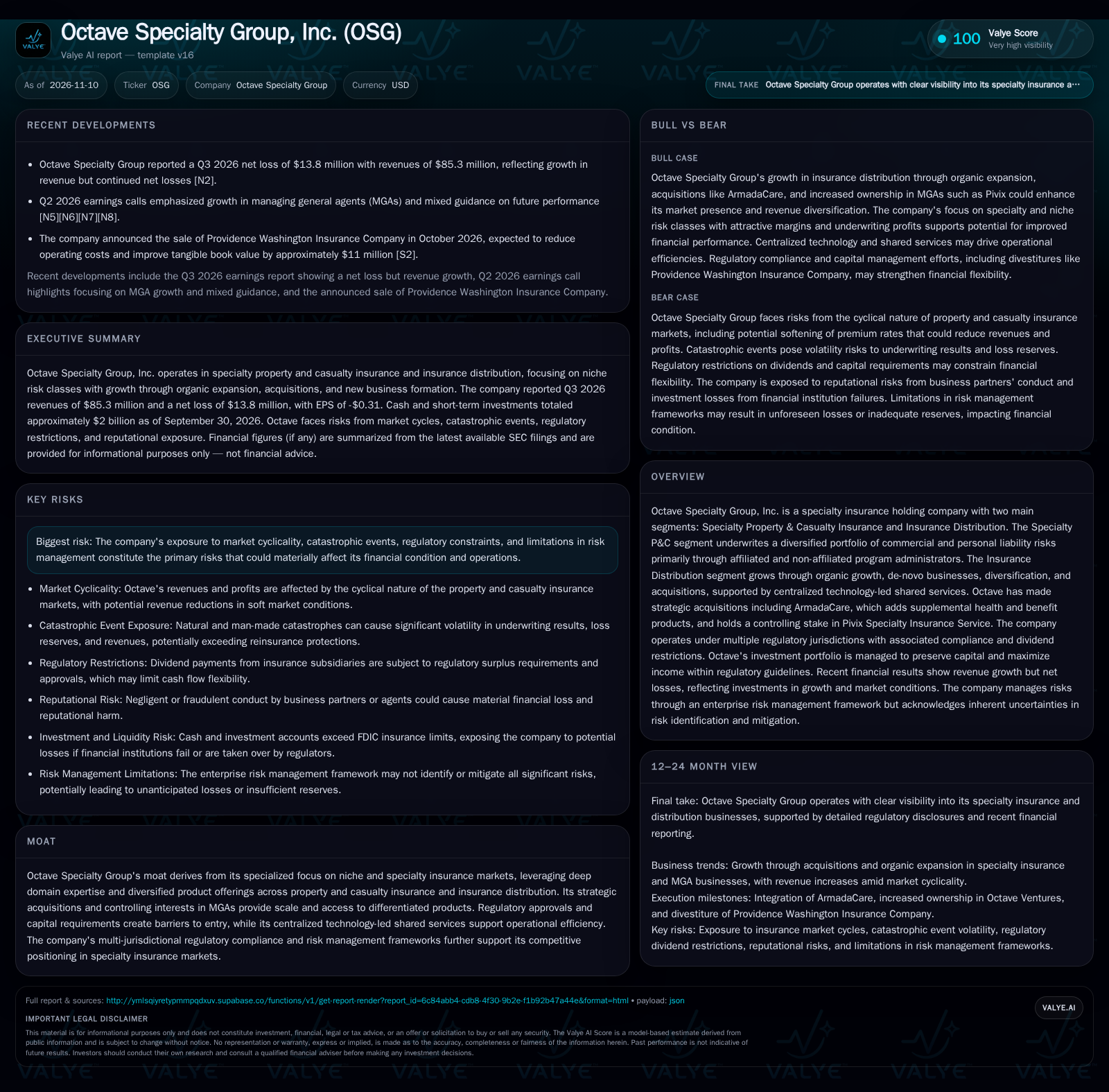
Octave Specialty Group is scaling its specialty property & casualty and insurance distribution businesses through program administrator partnerships, targeted acquisitions like ArmadaCare, and a growing MGA footprint. Recent divestitures aim to streamline the portfolio and improve tangible book value, but the company remains exposed to underwriting cyclicality, catastrophe event risk, and regulatory dividend restrictions. The core question is whether Octave can sustain margin discipline and profitable growth amid volatile insurance markets and integration challenges. [S2]
Octave Specialty Group, Inc. is executing a specialty insurance holding company strategy that relies on underwriting niche risk classes, expanding insurance distribution channels, and acquiring program administrators and MGAs to achieve scale and margin diversity. Recent moves—including the acquisition of ArmadaCare and the divestiture of Providence Washington Insurance Company—signal a drive for product breadth and operational efficiency. However, as Octave navigates the cyclical property & casualty market, catastrophe risk, and regulatory capital constraints, its ability to translate scale into consistent profitability and cash flow will be tested. The company's mix of organic and acquisition-driven growth, coupled with a significant capital base, sets the stage for further expansion, but exposes the business to integration and market turbulence.
Recent Portfolio Moves and Financial Position Shape Octave’s Strategic Flexibility
As of September 30, 2026, Octave Specialty Group reported $98.8 million in gross premiums written for Q3, with net premiums earned at $25.8 million, underscoring the company’s reliance on risk-sharing mechanisms such as reinsurance and the fee-based economics of its MGA-centric distribution model. The October 2026 sale of Providence Washington Insurance Company is expected to reduce operating costs and improve tangible book value by approximately $11 million, indicating a continued focus on optimizing the business portfolio. Program fees—primarily ceding commissions and minimum fees from affiliated MGAs—remained flat year-over-year, while net investment income showed modest declines, reflecting both the impact of recent acquisitions and changes in asset allocation. [S2]
How Octave’s Specialty Insurance and Distribution Model Drives Earnings Potential
Octave’s core earnings engine is a blend of specialty property & casualty underwriting and fee-based income from insurance distribution, particularly through MGAs and program administrators. The company’s approach to underwriting—focusing on niche and specialty risks—seeks to capture higher margins than standard commercial lines, but this comes with higher volatility and the need for disciplined risk selection. The heavy use of reinsurance, as evidenced by the low ratio of net to gross premiums, allows Octave to limit retained risk and capital consumption, while generating steady program fees from ceding commissions and administrative services.
The Insurance Distribution segment, driven by both organic expansion and acquisitions such as ArmadaCare, is designed to scale fee income and broaden product offerings. Centralized technology-led shared services could create operating leverage, but actual margin improvement depends on successful integration and cost discipline. The business is capital-intensive, as regulatory requirements in multiple jurisdictions set minimum surplus and liquidity thresholds, constraining capital allocation flexibility. Investment income remains a secondary but important contributor, with the portfolio managed for preservation and yield—though this exposes Octave to interest rate and credit risk, particularly given balances above FDIC insurance limits.
Operating leverage is plausible if Octave can grow distribution revenues faster than fixed costs, but flat program fees in recent periods suggest that the scaling of fee-based economics is not automatic and may lag premium growth or depend on new program launches and acquisitions.
Specialty Focus, MGA Scale, and Regulatory Barriers: Octave’s Competitive Landscape
Octave’s competitive advantage rests on its ability to source and underwrite niche risks, its growing network of MGAs and program administrators, and its regulatory positioning in multiple jurisdictions. The company’s acquisition of ArmadaCare and controlling stake in Pivix Specialty Insurance Service diversify its product mix and extend its reach into supplemental health, executive benefits, and excess & surplus lines—segments traditionally less dominated by large multiline carriers and with higher barriers to entry.
In specialty insurance, expertise in risk selection, claims management, and regulatory compliance are critical differentiators. Octave’s centralized technology and shared services may offer cost and process efficiencies, but similar strategies are being adopted across the specialty and program insurance sector, including by insurtechs and established managing general agency platforms. The Lloyd’s managing agent subsidiary (Statera Managing Agency Limited) extends Octave’s access to global risk pools and specialty markets, but also intensifies regulatory scrutiny and capital requirements.
Counterforces include the cyclical nature of specialty insurance pricing, increased competition from digital-native MGAs, and the risk that reinsurance capacity could tighten or become more expensive following catastrophic events. Regulatory capital requirements and dividend restrictions also create hurdles for aggressive expansion or capital returns.
If Octave Achieves Integration and Margin Expansion, Shareholder Value Could Re-Rate
A favorable scenario would see Octave successfully integrating ArmadaCare and other recent acquisitions, achieving both cost and revenue synergies via technology-led shared services. If Octave’s MGA network continues to grow—either organically or through further selective acquisitions—fee-based income could outpace flat or cyclical premium growth, leading to higher and more stable operating margins. Divestitures such as Providence Washington Insurance Company could lower the cost base and improve capital efficiency, freeing resources for higher-return opportunities.
Confirmation of this scenario would include sustained increases in program fees, improvement in combined ratios (if disclosed), and a rising contribution from distribution segment earnings. Evidence of successful integration—such as lower expense ratios, increased cross-sell of specialty products, or new program launches—would also support the thesis.
Most Likely Outcome: Mixed Growth with Episodic Volatility and Integration Friction
The most plausible trajectory is that Octave continues to grow through a combination of organic expansion and targeted acquisitions, but faces episodic volatility from insurance market cycles, catastrophe losses, and integration challenges. Program fees and distribution earnings may grow incrementally, but are likely to be offset at times by flat premium growth, reinsurance cost spikes, or regulatory capital constraints.
This scenario would be confirmed by continued, but uneven, growth in gross and net premiums written, relatively stable (but not rapidly accelerating) program fee income, and periodic expense spikes associated with integration or restructuring. If Octave maintains underwriting discipline and avoids major catastrophe losses, overall profitability could trend upward, but with significant quarter-to-quarter or year-to-year noise.
Adverse Sequence: Catastrophe Losses, Margin Compression, and Regulatory Friction
In a negative scenario, Octave could experience a combination of large catastrophic losses, a sharp downturn in specialty premium pricing, and integration setbacks from recent acquisitions. Such events could drive up loss ratios, compress underwriting margins, and expose weaknesses in the risk management framework. If reinsurance becomes more expensive or less available, Octave’s retained risk could rise, amplifying earnings volatility.
Regulatory capital or dividend restrictions could further constrain the company’s flexibility to deploy capital or return cash to shareholders. Confirmation of this scenario would include a spike in loss and expense ratios (if disclosed), negative surprises in reserve adequacy, declining investment income, or evidence of regulatory intervention in subsidiary capital flows. Failure to realize expected operating cost reductions from divestitures or integration would also signal downside risk.
Milestones That Will Shape Octave’s Specialty Insurance Trajectory
Sustained growth or acceleration in program fees and distribution segment earnings—especially if outpacing premium growth—would indicate successful scaling of the MGA model.
Expense ratios and operating cost trends following the Providence Washington Insurance Company divestiture would help test whether cost reductions and tangible book value improvement are realized.
Disclosure of combined and loss ratios for the specialty P&C segment (if disclosed) would clarify underwriting discipline and exposure to catastrophe volatility.
Evidence of successful integration and cross-selling between ArmadaCare, Pivix, and legacy businesses—such as new bundled products or joint distribution initiatives—would support the synergy thesis.
Any regulatory developments affecting capital requirements, dividend flows, or MGA licensing in key jurisdictions would directly impact Octave’s potential financial flexibility.
Material changes in reinsurance pricing or capacity would influence Octave’s risk retention strategy and margin outlook.
Trends in investment income and asset allocation—particularly in the context of prevailing interest rates and credit risk—would affect non-underwriting earnings stability.
Employee turnover rates and retention of key talent, particularly in newly acquired subsidiaries, could signal integration health and cultural alignment.
Disclaimer: This is research-only, informational analysis and not investment advice. It may include AI-generated interpretation and general industry context. Always verify important details using primary sources.

Comments