
Amneal’s Complex Generics and Biosimilars: Expansion Momentum Meets Integration and Leverage Stakes
Amneal Pharmaceuticals is scaling its presence in high-barrier generic and biosimilar markets, leveraging recent FDA approvals and a diversified pipeline. However, the company’s persistent net losses, material debt load, and integration risks from acquisitions like Kashiv Biosciences raise questions about operational leverage and resilience in a competitive, price-sensitive sector.
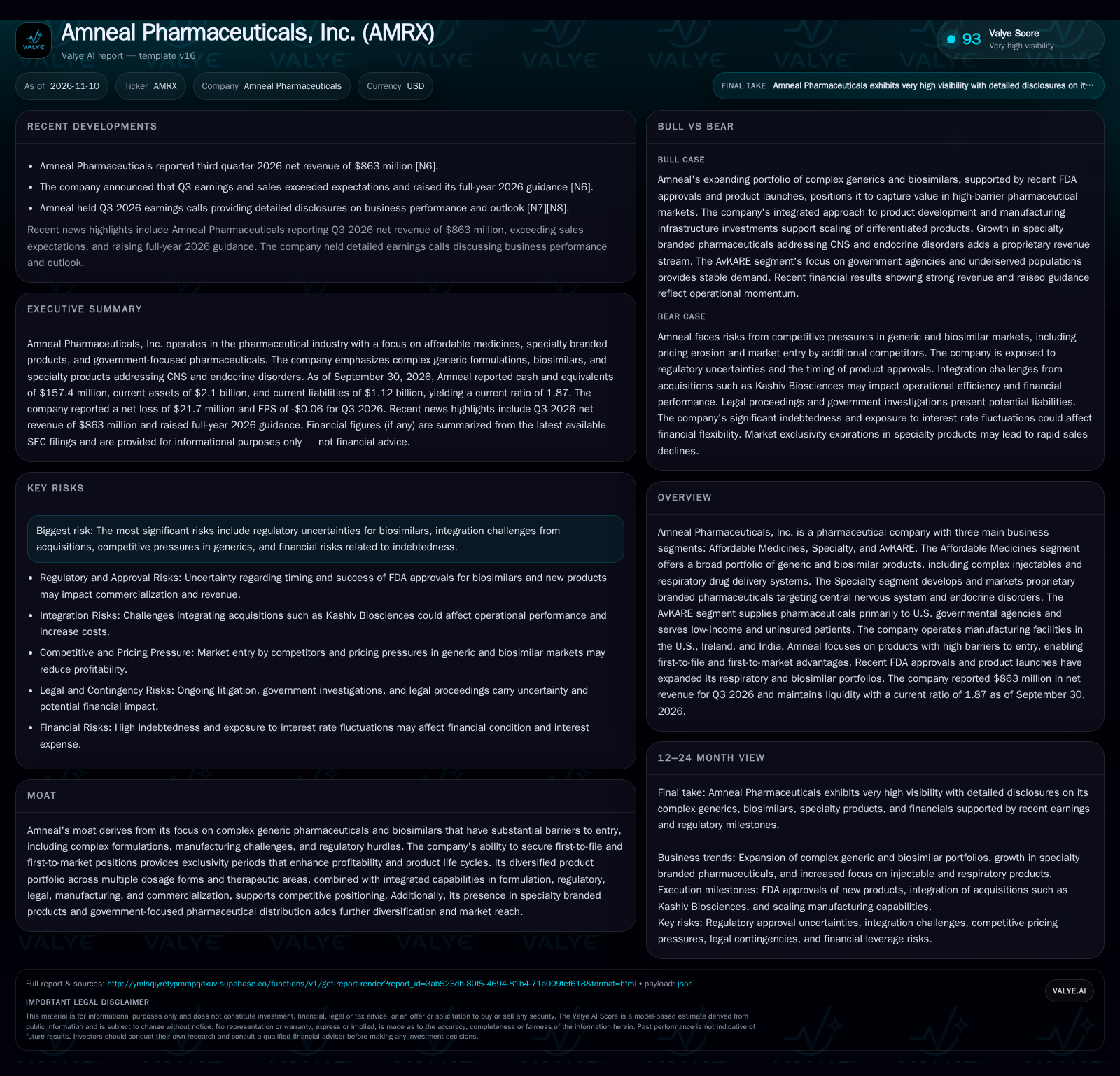
Amneal Pharmaceuticals is executing on a strategy centered around complex generics, biosimilars, and specialty drugs, with recent FDA approvals supporting portfolio expansion. The company’s raised 2026 guidance and expanding respiratory and injectable offerings signal operational momentum, but ongoing net losses, a high debt burden, and integration risks from recent acquisitions temper the outlook. Competitive pricing pressure and regulatory uncertainties remain central risks to sustained margin expansion and cash flow improvement. [S1] [S2] [N6]
Amneal Pharmaceuticals is pursuing scale and differentiation by targeting complex generics and biosimilars, backed by recent FDA approvals and portfolio expansion in high-barrier drug classes. The company’s raised guidance and product launches in respiratory and specialty markets reflect operational progress, yet continued net losses and a substantial debt burden highlight the pressure to translate innovation and regulatory wins into sustainable cash flow. As Amneal integrates recent acquisitions and ramps new manufacturing capabilities, its ability to manage competitive pricing, regulatory hurdles, and financial leverage will be critical to long-term value creation.
Recent FDA Approvals and Portfolio Expansion Drive Momentum but Losses Persist
Amneal’s Q3 2026 performance saw net losses of $21.7 million, offset by sales and earnings that exceeded market expectations, prompting management to raise full-year 2026 guidance. This operational momentum coincides with the launch of new FDA-approved inhalation and biosimilar products, including beclomethasone dipropionate HFA and albuterol sulfate aerosols, as well as five biosimilars now commercialized in the U.S. [S1] [S2] [N6].
Despite the raised outlook, the company’s balance sheet reflects $157.4 million in cash and cash equivalents against current liabilities of $1.12 billion and long-term debt of approximately $2.7 billion, producing a current ratio of 1.87 but a reported cash ratio of 0.14. This financial structure underscores the urgency of converting recent product wins into durable cash flow and margin expansion. [S1] [S2].
Integration of Kashiv Biosciences and scaling of new manufacturing capabilities introduce both operational upside and risk, as the company seeks to leverage its expanded pipeline and infrastructure amid persistent sector pricing and regulatory challenges. [S1]
Portfolio Breadth, Margin Dynamics, and the Economics of High-Barrier Generics
Amneal’s revenue model is anchored in a mix of high-barrier generic pharmaceuticals, biosimilars, and specialty branded drugs. The Affordable Medicines segment, with over 280 product families, targets complex formulations—such as injectables and inhalation products—where first-to-file (FTF) and first-to-market (FTM) status can confer temporary exclusivity and premium pricing. This strategy is designed to capture higher margins versus commodity generics, but requires ongoing investment in R&D, manufacturing technology, and regulatory compliance. [S1]
Biosimilars, while offering the prospect of multi-year revenue streams, carry high upfront development and legal costs, and face uncertain market uptake due to payer dynamics and entrenched reference biologics. The Specialty segment contributes proprietary revenue from branded CNS and endocrine products, which can command premium prices but are vulnerable to rapid decline upon loss of exclusivity.
The AvKARE division’s focus on government contracts and underserved populations provides volume stability but typically at lower margins, reflecting the price sensitivity of public payers. Operating leverage may increase as new complex products scale, but the company’s significant fixed costs—including debt service and manufacturing overhead—create a high bar for cash flow inflection.
Amneal’s ability to drive profitability hinges on balancing portfolio mix (complex generics, biosimilars, specialty), scaling volumes in high-barrier categories, and containing operating costs amid ongoing R&D and integration expenses.
Barriers to Entry, Regulatory Hurdles, and the Shifting Terrain of Generic Competition
Amneal’s competitive positioning depends on its ability to develop and commercialize complex generics and biosimilars faster than peers, leveraging regulatory expertise (ANDAs, exclusivities) and manufacturing scale. The company’s recent FDA approvals and first-to-market launches illustrate its capacity to navigate regulatory complexities, but these advantages are often temporary, as exclusivity periods expire and additional entrants compress pricing.
Competition in U.S. generics is fierce, with incumbent players, multinational pharmaceutical firms, and new entrants all seeking to capitalize on patent cliffs and biosimilar opportunities. Amneal’s breadth across oral solids, injectables, inhalation, and biosimilars offers some diversification, but its exposure to pricing pressure—especially in commoditized or multi-source categories—remains significant.
The Specialty segment’s branded products provide differentiation, but face threats from generic/biosimilar entry once exclusivity lapses. AvKARE’s government focus is relatively insulated from direct consumer competition, but subject to procurement cycles and reimbursement risk.
Amneal’s moat lies in its technical capabilities and regulatory execution, but the durability of competitive advantage depends on a steady pipeline of complex launches and the company’s ability to defend market share as barriers erode.
Margin Expansion If Complex Launches and Biosimilars Achieve Scale
A favorable scenario for Amneal would see rapid uptake of recently launched biosimilars and inhalation products, with limited competitive entry during initial exclusivity windows. This, combined with successful integration of Kashiv Biosciences and smooth scale-up of new manufacturing capabilities, could drive operating leverage and margin expansion.
Further FDA approvals from the company’s robust pipeline (61 pending ANDAs, 43 in development) would feed a stream of high-barrier launches, supporting both volume growth and pricing power in select categories. If the Specialty segment’s branded products—such as Brekiya—capture share in target indications, proprietary revenue could offset generic price erosion.
Evidence of this scenario would include sustained revenue growth outpacing R&D and SG&A expense increases, gross margin improvement, declining net losses (or a pivot to profitability), and measurable reduction in leverage through organic cash flow. Market share gains in recently approved biosimilars and inhalation products, accompanied by favorable payer adoption, would further validate the upside case.
Incremental Progress Amid Persistent Margin Pressure and Competitive Headwinds
The most plausible medium-term trajectory is one of incremental revenue growth driven by new product launches and portfolio expansion, offset by ongoing pricing pressure and elevated operating costs. Amneal may continue to post modest net losses or low single-digit margins as it absorbs acquisition integration costs and interest expense from its sizable debt load.
Revenue visibility from government contracts (AvKARE) and a diversified product base across generics, biosimilars, and specialty drugs provides some stability, but margin recovery may be gradual unless uptake of complex products accelerates and cost discipline improves. Regulatory and legal risks—such as delays in FDA approvals or adverse litigation outcomes—could periodically disrupt momentum.
Confirmation of this scenario would be evidenced by sequential revenue growth, stable or slightly improved gross margins, and net losses that narrow but do not fully resolve. Ongoing product launches and a steady pipeline would support the outlook, while persistent leverage and integration drag would define the primary constraints.
Pressure Intensifies: Delays, Pricing Erosion, and Integration Missteps
A more adverse scenario could materialize if Amneal experiences significant delays in FDA approvals, disappointing uptake or payer resistance for new biosimilars and inhalation products, and intensifying price competition in core generic categories. Integration difficulties with Kashiv Biosciences—such as cost overruns, manufacturing disruptions, or cultural friction—could further erode margins.
Legal liabilities, government investigations, or unfavorable litigation outcomes could introduce material one-time costs or restrict future product launches. The company’s high fixed costs and $2.7 billion debt burden would amplify the impact of operational shortfalls, potentially triggering liquidity pressures or the need to refinance on unfavorable terms.
Evidence for this scenario would include stagnant or declining revenues, worsening net losses, deteriorating gross margins, rising SG&A or integration expenses, and negative operating cash flow. Missed or delayed product launches, regulatory setbacks, or adverse legal developments would further undermine the outlook.
Milestones and Metrics That Will Clarify Amneal’s Margin and Growth Trajectory
Sequential quarterly gross margin progression, particularly as new biosimilars and complex inhalation products ramp, would help test the thesis on margin expansion.
Disclosure of biosimilar and new inhalation product market share or uptake rates, if provided, would clarify the commercial impact of recent launches.
Trends in R&D and SG&A expenses relative to revenue growth: improving operating leverage would support a path toward profitability.
Updates on integration costs, synergies, and operational milestones related to Kashiv Biosciences would inform execution risk.
Net debt and interest coverage ratios, along with any refinancing activity, will reveal the sustainability of Amneal’s capital structure.
Pipeline progress: number and profile of FDA approvals, ANDA submissions, and launches in complex/high-barrier categories.
Any adverse legal, regulatory, or government investigation disclosures that could materially impact cash flow or product pipeline.
Volume and pricing trends in the AvKARE segment, as shifts here could signal changes in government demand or reimbursement landscape.
Disclaimer: This is research-only, informational analysis and not investment advice. It may include AI-generated interpretation and general industry context. Always verify important details using primary sources.

Comments