
Lineage, Inc.: Scale, Automation, and the Stakes of Global Cold Chain Dominance
As the world’s largest temperature-controlled warehouse REIT, Lineage, Inc. commands an unparalleled global cold storage network and invests heavily in automation and technology. The company’s strategic locations, diversified customer base, and long-term relationships provide resilience, but margin pressure from energy, labor, and competitive supply remains a persistent risk. The next phase hinges on throughput optimization, pricing discipline, and the return on automation as new supply and cost volatility test the durability of its moat.
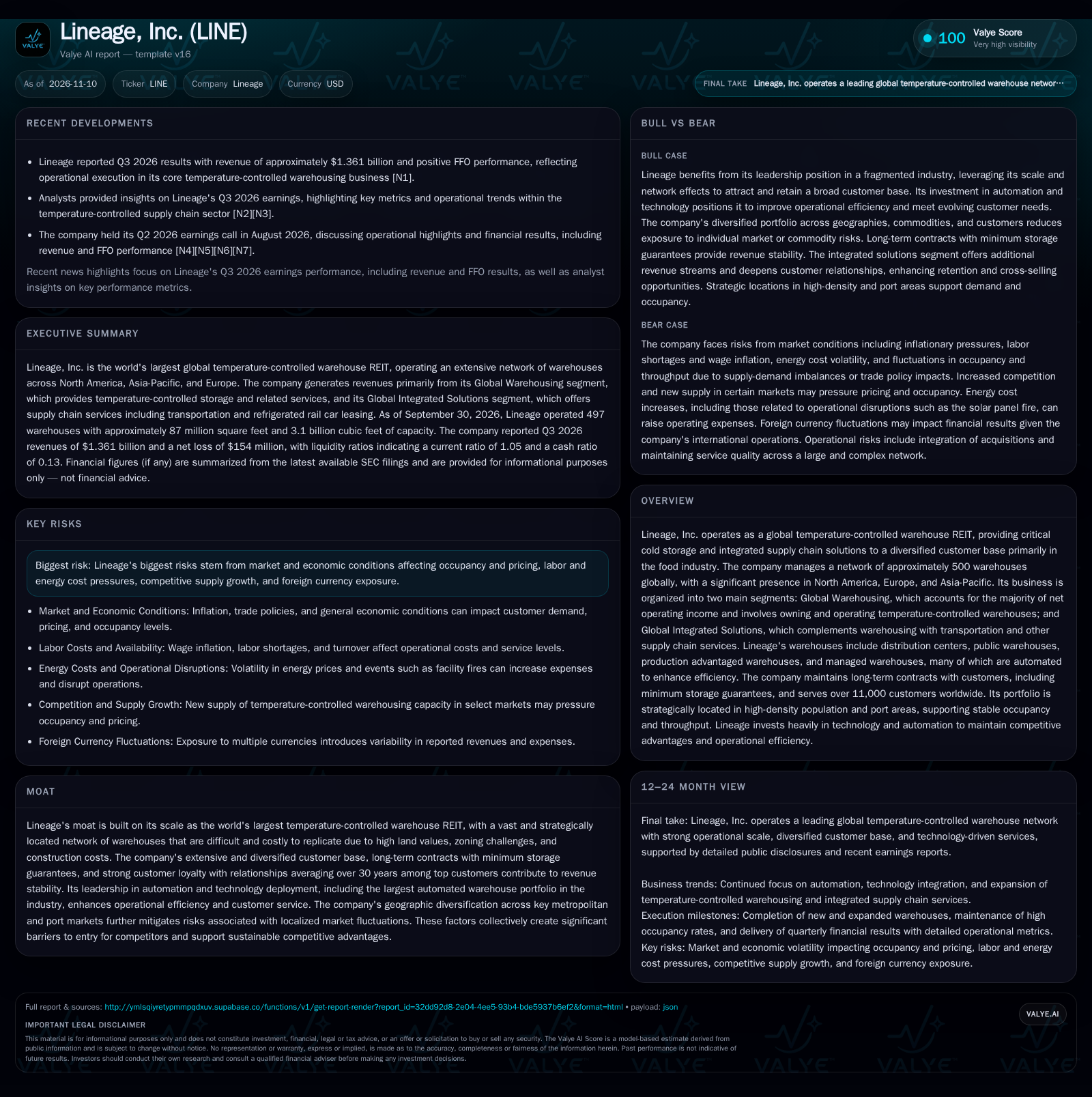
Lineage, Inc. operates nearly 500 temperature-controlled warehouses globally, serving over 11,000 food industry customers with a network anchored in high-density and port locations. The company’s leadership in automation and long-term customer relationships support revenue stability, but recent results show a net loss despite strong revenues, highlighting ongoing margin compression from operating costs and competitive supply. The central question is whether Lineage’s scale and technology investments will deliver sustainable earnings growth amid rising costs and market fragmentation. [S2] [N2] [N3]
Lineage, Inc. sits at the center of the global cold chain, operating the world’s largest network of temperature-controlled warehouses and supply chain solutions. Its reach, automation investments, and deeply entrenched customer relationships offer significant competitive advantages in a fragmented sector where scale and reliability are paramount. However, the company’s recent net loss despite robust revenues underscores the challenge of converting scale and technology into durable profits, especially as energy, labor, and competitive pressures intensify. The next chapter for Lineage will test whether its automation strategy and integrated model can defend margins and deliver sustainable growth as the cold storage landscape evolves. [S2] [N2] [N3]
Recent Results Highlight Scale and Margin Pressure
As of September 30, 2026, Lineage, Inc. operated 497 warehouses with approximately 87 million square feet and 3.1 billion cubic feet of capacity, securing its status as the world’s largest temperature-controlled warehouse REIT. The company reported Q3 2026 revenues of $1.361 billion, but also a net loss of $154 million, underscoring the persistent challenge of maintaining profitability in the face of rising operating expenses. Lineage’s customer base remains highly diversified, with no single customer accounting for more than 3.6% of revenues and long-standing relationships averaging over 30 years among the top 25 customers. The portfolio includes 83 automated warehouses, the largest such footprint in the industry, which is central to its operational strategy. The company reported cash and liquidity metrics for the period; these figures do not by themselves establish operating runway, investment capacity, financial flexibility, or financing capacity. [S2] [N2] [N3]
How Lineage’s Integrated Cold Chain Model Generates (and Spends) Cash
Lineage’s economics are driven by its dual-segment model. The Global Warehousing segment (86% of NOI) monetizes temperature-controlled storage, typically through a mix of fixed and variable contract structures—such as minimum storage guarantees, throughput-based charges, and service fees. This structure enables a degree of revenue visibility while still exposing the company to volume and occupancy fluctuations. The Global Integrated Solutions segment (14% of NOI) offers transportation, refrigerated rail car leasing, and ancillary logistics services, providing cross-selling opportunities but generally at lower margins than pure storage.
The business model is capital-intensive: owning approximately 80% of its warehouses, Lineage bears the full brunt of real estate, construction, and automation investments. Automation—now deployed across 83 warehouses—offers the promise of lower variable labor costs and higher throughput, but also requires significant upfront capital and ongoing maintenance. Operating leverage is structurally high: incremental revenue in high-occupancy, highly automated warehouses can flow through at attractive rates, but fixed costs (depreciation, energy, taxes) create downside risk when occupancy or throughput drops.
Pricing power is uneven. While Lineage’s locations in dense urban and port markets could support premium pricing and customer stickiness, competition and new supply in select regions can pressure rates. The use of minimum storage guarantees and long-term agreements helps mitigate short-term volatility but does not fully insulate against broader market or cost shocks. Energy and labor are the most volatile cost drivers, and their recent inflation has squeezed margins even as top-line growth persists.
Defending the Cold Chain: Barriers, Substitutes, and Evolving Rivals
Lineage’s moat is anchored in its global scale, strategic locations, and deep customer relationships. The company’s network spans high-density population centers and key port markets, where land scarcity, zoning hurdles, and construction costs make replication by new entrants difficult. Its diversified customer base and long-term contracts, often with minimum guarantees, provide a buffer against single-customer risk and could increase switching friction.
Automation and proprietary technology are increasingly central to Lineage’s competitive edge. With the largest automated warehouse footprint in the industry, Lineage can offer higher reliability, faster throughput, and potentially lower labor costs compared to less automated peers. However, rivals—including other large global cold storage providers, regional REITs, and vertically integrated food distributors—are investing in automation and digital integration, narrowing the technology gap. The threat of new supply, especially in high-growth regions, remains real and could pressure occupancy and pricing.
Substitutes are limited—cold storage is essential for perishable food supply chains—but customers can shift volume to competing facilities if service or pricing falters. Integrated logistics providers and large food retailers may also seek to insource or vertically integrate cold storage, particularly if third-party pricing rises or reliability falters. Lineage’s challenge is to keep its operational edge while maintaining pricing discipline in a market where new capacity can quickly commoditize incremental demand.
When Automation Pays Off: The Case for Margin Recovery and Network Effects
The bullish scenario for Lineage centers on successful execution of its automation and technology strategy, driving sustained margin expansion and improved cash conversion. If automation delivers on its promise—reducing labor intensity, increasing throughput, and lowering unit energy costs—incremental revenue in high-occupancy warehouses could flow through at strong incremental margins. Continued migration to proprietary software and cloud infrastructure may also enable better dynamic pricing, inventory optimization, and customer service, deepening customer relationships and reducing churn.
Revenue stability would be reinforced if Lineage can maintain or increase minimum storage guarantees and throughput commitments in customer contracts, especially in markets with high demand and limited new supply. If new supply is absorbed without significant pricing erosion, and if energy and labor cost inflation moderates, the company could return to consistent profitability and positive FFO growth. Evidence for this scenario would include sustained occupancy above 90%, improving operating margins, and visible growth in automated warehouse throughput. Confirmation would also come from increased contract wins tied to automation capabilities, and customer retention rates holding at or above historical averages.
Navigating Cost Inflation and Competitive Supply: A Mixed Operating Environment
The most plausible path for Lineage is a gradual improvement in margins as automation projects mature, offset by persistent cost pressures and regional pricing competition. The company’s scale and customer diversification are likely to support stable occupancy and moderate revenue growth, but margin expansion could be limited by continued inflation in energy and labor costs. New warehouse supply in certain markets may force selective pricing concessions or increased incentives to retain key accounts.
Lineage’s differentiated locations and long-term relationships should provide some insulation, but not immunity, to cyclical swings in demand or cost shocks. The integrated solutions segment may continue to grow, but likely at lower incremental margins than core warehousing. In this scenario, FFO and net income could remain volatile, with improvement contingent on cost containment, successful renegotiation of storage guarantees, and continued investment in automation.
Evidence for the base scenario would include occupancy levels in the mid-to-high 80s percent range, modest improvement in operating margins, and stable customer retention. Early signs of margin improvement from automation would support the outlook, but persistent net losses or further compression of FFO would challenge it.
If Cost Shocks and New Supply Overwhelm Scale Advantages
The bear case for Lineage materializes if labor and energy cost inflation outpace the benefits of automation, or if new supply in key markets drives a sustained decline in occupancy and pricing. In this scenario, fixed costs—including debt service, property taxes, and depreciation—would magnify the impact of revenue shortfalls, potentially leading to persistent net losses and pressure on the company’s balance sheet.
Customer churn could increase if large food retailers or manufacturers shift volume to competitors or insource their own cold storage capacity, especially if Lineage is forced to raise prices or cut service levels to offset cost inflation. Currency volatility could further erode reported results, particularly if international operations underperform. Evidence supporting this scenario would include a sustained drop in occupancy below 80%, major contract losses, or further widening of net losses and negative FFO.
Testing the Automation Thesis and Margin Recovery for Lineage
Quarterly occupancy rates by warehouse type and region—if disclosed—would clarify the impact of new supply and demand trends.
Operating margin trends, particularly in the automated warehouse portfolio, would help validate whether automation is driving efficiency gains.
Average duration and renewal rates of customer contracts, especially those with minimum storage guarantees, would indicate revenue visibility and customer retention.
Energy and labor cost per cubic foot stored—if disclosed—would reveal the trajectory of the company’s most volatile expenses.
Growth in throughput and service revenue from the Global Integrated Solutions segment would show whether cross-selling is gaining traction.
Net cash provided by operating activities and FFO trends, rather than just headline net income, would offer a clearer view of underlying cash generation.
Changes in the competitive landscape, such as announced expansions by regional or global cold storage peers, could signal increased pricing or occupancy pressure.
Disclaimer: This is research-only, informational analysis and not investment advice. It may include AI-generated interpretation and general industry context. Always verify important details using primary sources.

Comments