
Cannae Holdings: Portfolio Strategy, Governance Streamlining, and the Stakes of Persistent Losses
Cannae Holdings, Inc. enters late 2026 with a diversified portfolio strategy, a streamlined board, and the challenge of persistent net losses. The company’s ability to translate investment expertise and sector breadth into sustainable profitability remains the central question as transparency gaps and portfolio company performance drive future outcomes.
Recent governance changes could sharpen decision-making, but persistent profitability challenges and limited segment-level disclosure cloud the outlook. The company’s fate will hinge on execution within its underlying holdings and improvements in segment transparency and capital allocation.
Cannae Holdings, Inc. (NYSE: CNNE) presents a classic holding company conundrum in late 2026: a diversified portfolio spanning multiple sectors, a board comprised of financial heavyweights, and a liquidity profile that appears robust on the surface. Yet, beneath this structure, the company continues to report net losses, and recent earnings have lagged expectations. With a recent board size reduction aimed at governance efficiency, attention now turns to whether Cannae can convert its investment breadth and managerial pedigree into enduring, portfolio-driven value creation—or whether persistent profitability challenges and limited segment transparency will undermine its strategic ambitions.
Recent Financial and Governance Developments: What’s Changed for Cannae Holdings
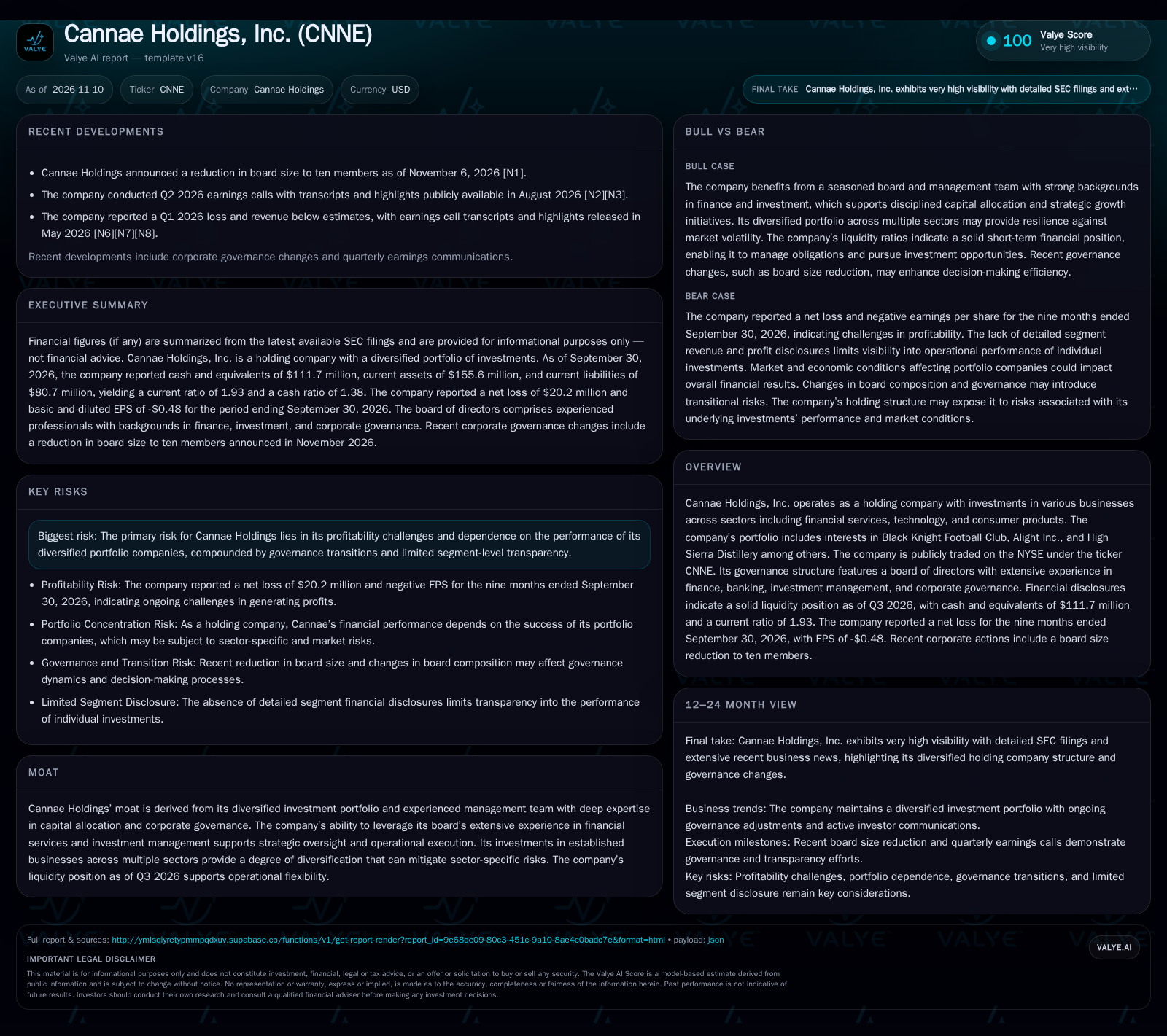
Cannae Holdings reported a net loss of $20.2 million for the period ending September 30, 2026, with basic and diluted EPS of -$0.48, continuing a trend of persistent losses [S2]. Liquidity remains notable, with $111.7 million in cash and equivalents and a current ratio of 1.93 as of Q3 2026 [S2]. In November 2026, the company reduced its board size to ten members, an action that could signal a push for more agile governance or cost-saving measures [N1]. Recent quarters have seen revenue underperformance relative to estimates, with Q1 2026 results lagging expectations [N8]. The company’s portfolio remains broad, covering investments in Black Knight Football Club, Alight Inc., and High Sierra Distillery, among others [S1]. These developments together raise questions about capital allocation discipline, the efficacy of governance changes, and the ability to drive sustainable profitability.
How Cannae’s Holding Company Model Shapes Value Creation and Capital Needs
As a holding company, Cannae’s economics are fundamentally tied to the performance and monetization of its portfolio companies. Revenue is a composite of subsidiary performance, investment income, and occasional asset sales or mark-to-market gains. The company’s fixed cost base is largely determined by corporate overhead, board and management compensation, and governance expenses, while variable costs depend on portfolio company dynamics and transaction activity.
Operating leverage in this model is limited unless portfolio companies scale rapidly or Cannae realizes outsized returns from investment exits. The company reported cash and liquidity metrics for the period; these figures do not by themselves establish operating runway, investment capacity, financial flexibility, or financing capacity. [S2] Capital needs are episodic and linked to investment opportunities or portfolio support, rather than recurring operational outlays. The lack of detailed segment disclosure limits outside assessment of which investments are contributing or detracting from overall returns, making it difficult to gauge where the company’s capital is most productively deployed.
Portfolio Breadth vs. Transparency: Where Cannae Stands Among Diversified Holdcos
Cannae’s competitive positioning is anchored in its diversified sector exposure and the financial acumen of its board, which includes veterans with deep experience in finance, investment management, and corporate governance [S1]. This breadth theoretically reduces the risk of any single investment derailing the overall entity and gives Cannae flexibility to pivot as sector conditions change.
However, in the holding company peer set, transparency and capital allocation track record are critical differentiators. The limited segment-level disclosure at Cannae makes it difficult for investors to assess the quality and trajectory of individual holdings, which can undermine the market’s willingness to assign a premium valuation. Competitors that provide clearer segment economics or have demonstrated consistent returns from portfolio rebalancing may enjoy a lower cost of capital or stronger investor support. Additionally, the presence of alternative asset managers and private equity-style firms as substitutes means Cannae must continually demonstrate that its governance, access, and execution add value not easily replicated by passive investment vehicles or direct investors.
Unlocking Value Through Portfolio Monetization and Governance Streamlining
A favorable outcome for Cannae would involve successful monetization or operational improvements at one or more key holdings, driving both realized gains and improved recurring income. [S2] [N1]
The upside scenario would be confirmed by announcements of successful exits or partial sales of major holdings at premiums to book value, improved profitability at the portfolio company level, or new investments that quickly demonstrate accretive economics. Clearer segment-level disclosures would further validate the thesis by allowing investors to track the performance of core assets and capital allocation decisions. Falsification of this scenario would be signaled by continued net losses without asset sales, stagnation in portfolio value, or governance changes that fail to translate into strategic clarity or improved performance.
Diversification Offsets Volatility, but Transparency and Profitability Remain Elusive
The most plausible trajectory for Cannae is one in which portfolio diversification cushions the impact of individual asset underperformance, but ongoing profitability remains out of reach. The company may continue to report modest losses or break-even results, with occasional gains from asset sales or mark-to-market improvements offset by holding company expenses and underperforming investments.
Confirmation of this scenario would come from continued liquidity stability, incremental governance enhancements, and sporadic—but not transformative—portfolio activity. The absence of granular segment reporting and persistent net losses would reinforce the perception that Cannae’s value is capped by its transparency gap and challenged capital allocation outcomes. A shift in this scenario would be indicated by either a material improvement in segment disclosure or a meaningful change in the earnings trajectory, such as a pivot to sustained profitability or a large-scale portfolio restructuring.
Persistent Losses, Portfolio Write-Downs, and Erosion of Investor Confidence
A bearish scenario unfolds if Cannae’s portfolio companies continue to underperform, resulting in further net losses and potential asset write-downs. If the company’s liquidity is gradually depleted by ongoing losses and the absence of profitable exits, Cannae could be forced to sell assets at discounted valuations or seek dilutive financing.
This outcome would be confirmed by a sustained pattern of revenue and earnings misses, negative news from major portfolio holdings, or disclosures of impairments and distressed asset sales. Erosion of investor confidence could be exacerbated by continued opacity around segment performance, governance instability, or board turnover that signals strategic drift rather than renewed focus. Falsification of the downside would require a demonstrable turnaround in portfolio company performance or a major asset sale at an attractive valuation that restores capital and market confidence.
Milestones and Disclosures That Will Determine Cannae’s Thesis Over the Next Year
Quarterly net income and EPS trends: Persistent losses would reinforce bear concerns, while a move to sustained profitability would support the bull case.
Announcements of major asset sales, acquisitions, or portfolio rebalancing: Evidence of successful monetization or capital redeployment would test the upside scenario.
Segment-level financial disclosure (if disclosed): Any increase in transparency around the performance of key holdings would help clarify capital allocation effectiveness.
Board composition and governance developments: Tracking the impact of recent and future changes on decision-making efficiency and strategic clarity.
Performance updates from core portfolio companies such as Alight Inc. or Black Knight Football Club: Positive or negative developments here could drive outsized impacts on consolidated results.
Earnings call commentary on capital allocation priorities and investment pipeline: Management’s articulation of strategy and pipeline visibility would help assess the company’s forward-looking discipline.
Evidence of write-downs, impairments, or distressed asset sales: These would indicate portfolio stress and could accelerate downside risks.
Disclaimer: This is research-only, informational analysis and not investment advice. It may include AI-generated interpretation and general industry context. Always verify important details using primary sources.

Comments