
Tidewater’s Expansion Gambit: Fleet Scale, Brazilian Entry, and the Cyclical Stakes of Offshore Energy
Tidewater Inc. is executing a major acquisition in Brazil, leveraging its large, diversified vessel fleet and new financial structure to capture demand across oil, gas, and renewables. The company’s fortunes remain tightly linked to volatile offshore activity and integration risks, as it seeks to convert scale and geographic breadth into durable profitability.
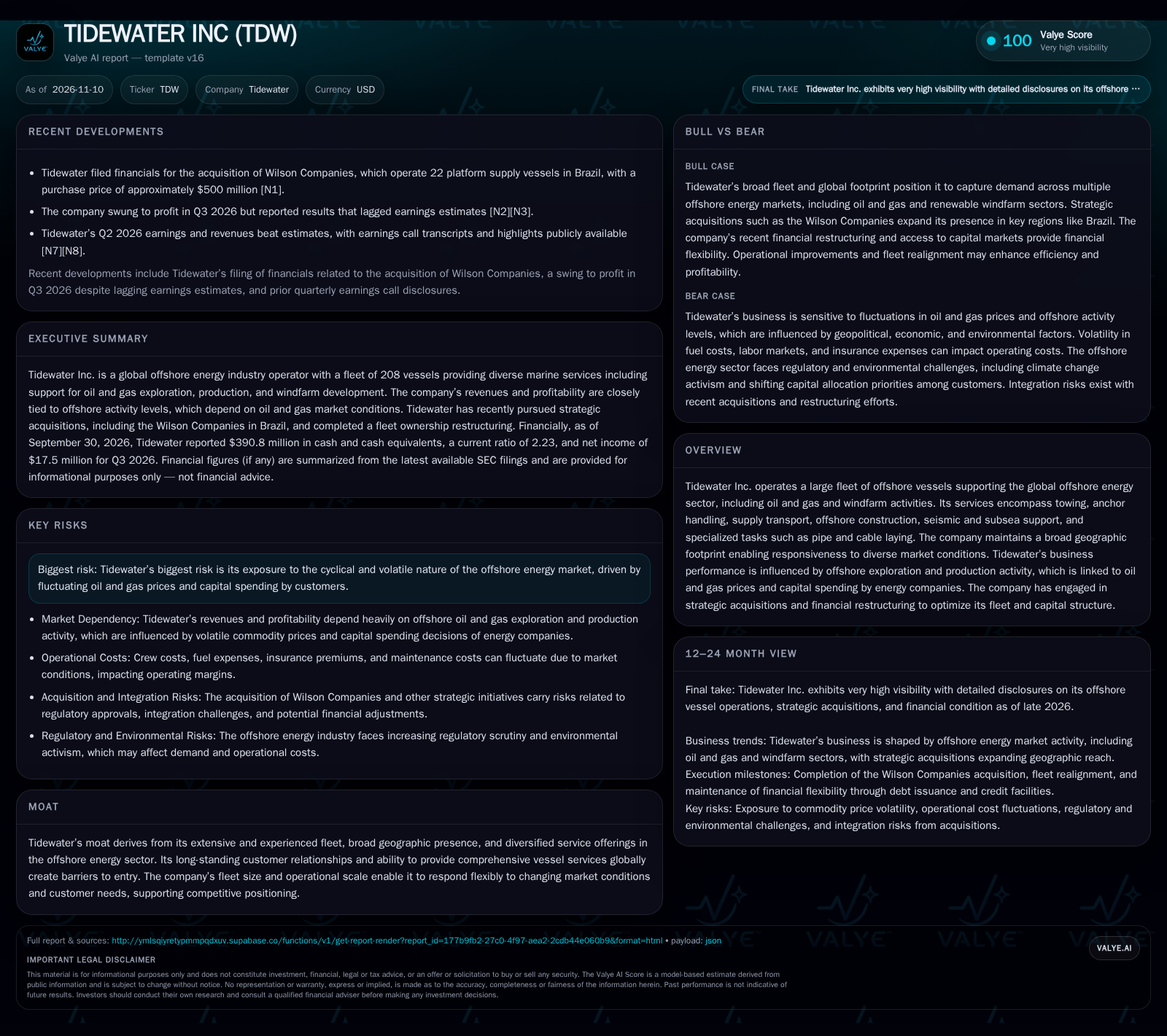
Tidewater Inc. (TDW) is expanding its global footprint with the $500 million acquisition of Wilson Companies’ Brazilian platform supply fleet, aiming to deepen exposure in a key offshore market. The company’s Q3 2026 swing to profit follows a major fleet restructuring and new capital raises, but earnings lagged estimates, highlighting the still-volatile offshore cycle. Tidewater’s business model is highly sensitive to oil and gas activity, labor and fuel cost swings, and integration execution, with future upside hinging on successful acquisition absorption and stable offshore demand.
Tidewater Inc. is at a strategic crossroads: fresh off a swing to profitability and a major fleet restructuring, the company is betting big on Brazil with a $500 million acquisition that could reshape its operating footprint. With 208 vessels supporting oil, gas, and windfarm projects worldwide, Tidewater is leveraging scale and geographic reach to target growth—but remains exposed to the inherent cyclicality of offshore energy markets. The company’s ability to integrate new assets, manage labor and fuel costs, and sustain earnings through commodity swings will determine whether its recent moves deliver lasting value or amplify volatility.
Brazilian Expansion, Fleet Realignment, and a Profitable Quarter: What’s Changing Now
Tidewater is advancing a $500 million acquisition of Wilson Sons Ultratug Participações S.A. and its affiliate, which collectively operate 22 platform supply vessels in Brazil. This deal, expected to close in late Q2 2026 pending regulatory and lender approvals, marks a significant expansion into a core offshore market [S1] [N1]. The move builds on Tidewater’s already sizable global fleet of 208 vessels as of year-end 2025, which supports a range of oil, gas, and windfarm activities [S1].
The company recently completed a strategic internal restructuring, consolidating much of its fleet into a single U.S. entity and recognizing a substantial non-cash deferred tax benefit [S1]. Financially, Tidewater reported $390.8 million in cash and a current ratio of 2.23 as of September 30, 2026 [S2]. Q3 2026 saw a return to profitability, with net income of $17.5 million, but results lagged analyst expectations [S2] [N2] [N3].
These developments matter because they signal an aggressive push for market share and operational efficiency at a moment when offshore activity is recovering but remains unpredictable. The Brazilian acquisition, if integrated well, could deepen Tidewater’s exposure to a key growth market—though it also introduces new operational and integration risks.
Fleet Scale, Cost Structure, and the Economics of Offshore Vessel Operations
Tidewater’s revenue model is fundamentally volume-driven: vessel utilization and day rates are dictated by the pace of offshore energy activity, which is in turn highly sensitive to global oil and gas prices and customer capital spending cycles. The company’s diversified service mix—towing, anchor handling, supply, subsea, and windfarm support—creates some buffer against single-segment downturns, but the bulk of demand remains linked to oil and gas exploration and development [S1].
Operating leverage is significant: fixed costs such as vessel depreciation and insurance are high, while variable costs (crew, repair, fuel) can swing sharply with labor markets and vessel deployment patterns. Crew expenses are a major line item and are influenced by both fleet size and geography, with tight labor markets in some regions potentially pressuring margins [S1].
Fuel costs are generally passed through to customers when vessels are on-hire, but when vessels are idle or in drydock, Tidewater absorbs these costs directly [S1]. This structure means that utilization is a critical economic lever—rising off-hire time quickly erodes margins, while high utilization amplifies operating leverage. The ability to flex the fleet and match capacity to demand is thus central to Tidewater’s profitability.
The recent $650 million bond issuance and expanded $250 million credit facility, both completed in 2025, provide financial tools for growth and working capital management, but also introduce higher fixed interest obligations that must be serviced through the cycle [S1].
Can Tidewater’s Scale and Global Reach Outpace Offshore Rivals?
Tidewater’s competitive position rests on fleet size, service breadth, and global footprint. With 208 vessels and operations spanning oil, gas, and renewables, the company is positioned to serve both supermajors and regional operators, with the flexibility to follow activity to high-demand basins [S1]. This geographic diversification can mitigate local market slumps, but also requires complex logistics and exposes the business to a patchwork of regulatory and labor regimes.
Barriers to entry in offshore vessel markets are significant: capital intensity, long asset lives, and the need for established customer relationships all favor incumbents. Tidewater’s long operating history and ability to provide end-to-end vessel services create switching frictions for major customers, particularly when reliability and safety are paramount.
However, the industry is notoriously cyclical and fragmented, with pricing power often limited by excess capacity and aggressive discounting during downturns. Newer, more fuel-efficient vessels and specialized assets for windfarm and deepwater projects can command premium rates, but commoditized supply vessels face margin pressure when supply exceeds demand.
The Wilson Companies acquisition, if closed and integrated effectively, could improve Tidewater’s position in the competitive Brazilian offshore market, where local content rules and relationships are critical. The question is whether the added scale will translate into higher utilization and pricing, or whether integration friction and market saturation will dilute returns.
How Acquisition Synergies and Offshore Recovery Could Unlock Margin Expansion
A favorable scenario for Tidewater unfolds if global offshore activity continues to rebound, driven by stable or rising oil prices and renewed capital spending by energy majors. In this environment, vessel utilization rates climb, day rates firm, and Tidewater’s operating leverage magnifies incremental revenue into outsized profit gains. The addition of 22 Brazilian vessels through the Wilson Companies deal could allow Tidewater to capture share in a high-growth region, especially if Brazilian pre-salt and deepwater projects accelerate.
If the company successfully integrates the new assets, achieves cost synergies, and leverages its expanded scale to negotiate better terms with customers and suppliers, margins could expand meaningfully. Demonstrable improvement in utilization, day rates, and operating cash flow from the combined fleet would confirm this thesis.
Evidence to watch for: faster-than-expected revenue and profit growth post-acquisition, sustained high utilization and day rates in core markets, and clear disclosure of realized cost synergies and integration milestones.
Integration Execution and Offshore Cyclicality Define the Plausible Mid-Term Outcome
The most likely path is a mixed environment: offshore activity trends upward but remains volatile, with periods of regional strength offset by pauses in new project approvals or temporary commodity price dips. In this scenario, Tidewater’s fleet remains broadly utilized but with some idle capacity, and day rates recover only gradually as older vessels compete with newbuilds and specialized assets.
The Wilson Companies integration proceeds but encounters typical challenges—cultural alignment, system harmonization, and customer retention in a competitive Brazilian market. Cost synergies materialize, but not to their theoretical maximum, and incremental operating costs from new vessels partially offset revenue gains.
Financially, Tidewater remains profitable but with earnings volatility tied to offshore cycles, labor cost swings, and episodic downtime.
Evidence that would confirm this scenario: post-acquisition financials showing steady but not dramatic improvement in utilization and margins, periodic earnings volatility tied to market swings, and integration updates acknowledging both early wins and ongoing challenges.
If Offshore Activity Stalls or Integration Falters, Margin Compression and Asset Write-downs Loom
A negative outcome could emerge if oil and gas prices fall sharply or if global offshore project sanctioning slows, leading to a glut of idle vessels and eroding day rates. In such a scenario, Tidewater’s expanded fleet—now including the newly acquired Brazilian vessels—would face utilization declines, with fixed crew and maintenance costs compressing margins or pushing the business back into losses.
Integration risks are elevated: if Tidewater cannot harmonize operations, retain key Brazilian customers, or realize cost synergies, the acquisition could dilute earnings and force restructuring or asset write-downs. Labor disputes, regulatory hurdles, or unexpected vessel downtime in Brazil could compound these pressures.
Confirmation would come from declining utilization rates, falling day rates, negative operating cash flow, and disclosures of integration setbacks or impairment charges in future filings.
Milestones That Will Reveal Whether Tidewater’s Expansion Delivers Lasting Value
Closing and regulatory approval of the Wilson Companies acquisition in Brazil, including any updates on timeline or deal terms.
Utilization rates and average day rates for the combined fleet post-acquisition, with regional breakdowns if disclosed.
Integration progress metrics: cost synergies realized, system harmonization, and retention of key Brazilian customer contracts (if disclosed).
Trends in crew and labor costs, particularly in tight labor markets or regions with new regulatory requirements.
Debt service coverage ratios and cash flow from operations, especially as new interest obligations come due.
Any major shifts in offshore project sanctioning activity or capital spending by key oil, gas, and windfarm customers.
Disclosure of vessel idle time, drydock days, or asset impairment charges that may signal operational or market stress.
Insurance costs and claims experience, especially in light of rising cybersecurity or environmental risk exposures.
Disclaimer: This is research-only, informational analysis and not investment advice. It may include AI-generated interpretation and general industry context. Always verify important details using primary sources.

Comments