
Quantum’s AI-Era Storage Ambitions: Scale, Margin Mechanics, and the Stakes of Financial Resilience
The company’s future will be shaped by its ability to scale differentiated object storage platforms, deepen service attachment, and defend its niche against enterprise giants and cloud-native disruptors.
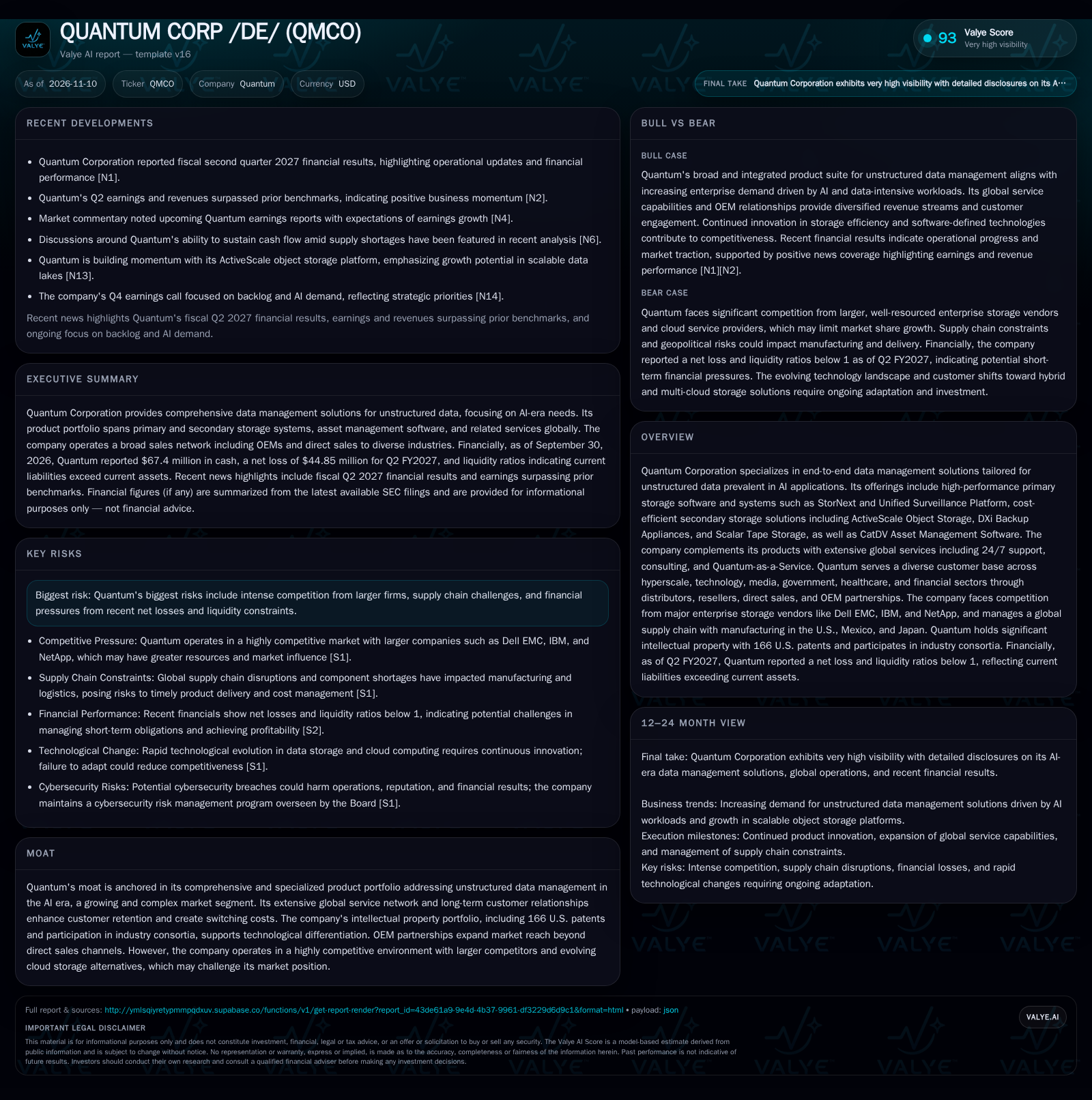
Quantum’s Q2 FY2027 results show improved earnings and revenue momentum, yet material net losses and a sub-1 current ratio underscore ongoing financial pressures. The company’s value lies in its deep portfolio for unstructured data and global service reach, but intense competition and supply chain sensitivities persist. The critical question is whether Quantum can convert AI-driven data growth into sustainable, higher-margin recurring revenue before funding constraints force strategic retrenchment. [S1] [S2] [N2]
Quantum Corporation is at a crossroads: its specialized portfolio for unstructured data management—spanning AI-era workloads, video, and large-scale object storage—aligns with secular data growth, yet persistent net losses and liquidity ratios below 1 as of Q2 FY2027 highlight real financial vulnerability. As hyperscalers and enterprise incumbents intensify competition, Quantum’s ability to scale its ActiveScale platform, deepen service revenue, and navigate supply chain and funding pressures will determine whether it can turn technical differentiation into durable economic value. The next year will test whether operational momentum can outpace the mounting demands of capital and competition. [S1] [S2] [N2]
Recent Financial Performance and Strategic Positioning: Signals from Q2 FY2027
The company reported cash and liquidity metrics for the period; these figures do not by themselves establish operating runway, investment capacity, financial flexibility, or financing capacity. While recent headlines note that Q2 earnings and revenue surpassed prior benchmarks, the company’s balance sheet continues to reflect material financial stress. [S2] [N2]
Quantum’s top five customers accounted for 27% of fiscal 2026 revenue, underscoring some customer concentration risk despite a diversified industry footprint across hyperscale, media, government, and life sciences. Recent commentary also points to ongoing supply chain constraints, though with signs of improvement, which could influence both cost structure and delivery velocity in the near term. [S1] [N6]
How Quantum’s Storage and Service Model Could Unlock Operating Leverage
Quantum’s economics are built on a mix of hardware sales (primary and secondary storage systems), software (asset management, workflow orchestration), and high-margin services (support, consulting, Quantum-as-a-Service). In theory, the company’s end-to-end approach—spanning on-premises, hybrid, and cloud-enabling solutions—should enable differentiated pricing and cross-sell opportunities, especially as unstructured data volumes surge in AI and video-centric industries.
However, hardware remains a margin-challenged business, especially in the face of supply chain volatility and price-based competition from larger incumbents. Software and recurring service contracts—such as Quantum-as-a-Service and MyQuantum AIOps analytics—could drive higher gross margins and stickier revenue if penetration increases, but the extent, duration, and renewal mechanics of these contracts are not disclosed. The company’s global service delivery, covering over 100 countries, offers leverage for support and consulting attachment, but also requires ongoing investment in headcount, logistics, and infrastructure.
Quantum’s capital needs remain acute: scaling object storage, investing in R&D for new software-defined platforms, and supporting global operations all demand cash at a time when net losses persist. The question is whether incremental gross profit from new object storage deployments and expanded service revenue can outpace fixed cost growth and offset hardware margin pressure before funding constraints force retrenchment or strategic pivots.
Competing for Relevance: Quantum Versus Enterprise Giants and Cloud-Native Entrants
Quantum operates in a brutally competitive landscape. For primary storage, it faces entrenched enterprise vendors such as Dell EMC, IBM, and NetApp, who benefit from scale, broad portfolios, and deep customer relationships. In secondary storage and backup, Quantum’s tape and disk appliances compete with IBM, Hewlett Packard Enterprise, and Veritas, all of whom can bundle offerings or leverage broader sales networks.
Cloud-native storage providers and hyperscalers represent a different class of threat: as more enterprises adopt hybrid or multi-cloud architectures, the value proposition of on-premises or hybrid object storage must be compelling on both cost and integration. Quantum’s participation in industry consortia and its 166 U.S. patents offer some technological differentiation, but the durability of these advantages depends on continued innovation and the company’s ability to keep pace with rapid software-defined and cloud-native advances.
OEM partnerships and service breadth expand Quantum’s reach, but customer concentration and lack of lock-in in hardware-centric deals could weaken retention if better-capitalized competitors undercut on price or bundle cloud storage with analytics and AI tools.
If AI-Driven Data Growth Converts to Recurring Revenue: What a Winning Chain Looks Like
The bull thesis rests on Quantum’s ability to capture a disproportionate share of unstructured data growth driven by AI, video, and scientific workloads—segments where its platforms (notably ActiveScale object storage and StorNext) are well aligned. If Quantum can successfully transition new and existing customers to higher-margin software and service offerings (Quantum-as-a-Service, CatDV asset management, AIOps), recurring revenue could rise as a share of the mix, boosting gross margins and reducing exposure to hardware volatility.
Signs that would confirm this scenario include: sustained double-digit revenue growth in object storage and services, rising gross margin, and disclosure of multi-year recurring revenue contracts or renewal rates. A declining reliance on top-five customers and evidence of new logo wins in hyperscale or AI-centric verticals would further validate the thesis. If Quantum can leverage its global service network to drive high service attachment rates and upsell analytics or workflow automation, operating leverage could improve, supporting a path to break-even or positive free cash flow even as R&D and service investments continue.
Mixed Progress: Incremental Gains Offset by Margin Pressure and Balance Sheet Constraints
The most plausible outcome is that Quantum continues to see moderate revenue growth, particularly in object storage and services, but faces ongoing margin compression in hardware and persistent cost pressures from supply chain and global operations. Hardware sales may remain lumpy, and while software/service revenue could grow, it may not rise quickly enough to offset losses or materially improve profitability within the next year.
Financially, net losses and sub-1 liquidity ratios could persist, forcing management to prioritize cash conservation, delay some R&D or service investments, or pursue opportunistic capital raises at unattractive terms. Customer concentration remains a risk: a loss or slowdown from a top customer could dent revenue visibility. Absent a step-change in recurring revenue mix or a sharp improvement in margins, Quantum may tread water—preserving relevance but not breaking out as a clear winner.
Evidence confirming this scenario would include steady but unspectacular top-line growth, gross margins that remain below those of leading software or cloud peers, and continued tight liquidity. Watch for incremental service wins, but also for signals of cost-cutting or deferred investment.
When Cash Burn Outpaces Momentum: How Financial Strain Could Force Tough Choices
The bear case is that Quantum’s net losses and liquidity constraints become acute before its new platforms reach scale. If hardware sales falter—due to competitive pricing, supply chain setbacks, or customer delays—while recurring revenue remains a small share of the mix, the company could face a cash crunch that forces it to cut R&D, reduce service footprint, or sell non-core assets to preserve solvency.
In this scenario, customer concentration risk could crystallize: a top customer defecting or reducing spend would hit both revenue and working capital. Supply chain disruptions or further cost inflation could exacerbate losses, while larger competitors might accelerate share gains by bundling cloud-native analytics or undercutting Quantum’s margins.
Evidence would include mounting quarterly losses, further deterioration in liquidity ratios, asset sales, layoffs, or disclosures of going-concern risk. A lack of new recurring revenue disclosures or failure to grow service attachment rates would further reinforce downside risk.
How to Judge Quantum’s Strategic Progress in the Next Year
Growth rate and revenue mix for object storage (ActiveScale) and Quantum-as-a-Service; a useful metric would be recurring revenue as a percentage of total if disclosed.
Gross margin trends by segment—especially software and services versus hardware; rising margins would support thesis momentum.
Service attachment rates and renewal/expansion activity for support, consulting, and analytics; higher rates would signal stickier customer relationships.
Customer concentration: percentage of revenue from top five customers; declining concentration would indicate broader market traction.
Quarterly cash burn and free cash flow; monitoring whether net losses narrow or widen will help gauge financial trajectory.
Supply chain cost and delivery updates; improvement would reduce risk of margin compression or delayed installations.
Disclosure of new multi-year contracts, major customer wins, or strategic OEM deals—especially in AI, hyperscale, or scientific verticals.
If available, churn/retention rates for recurring software and service contracts; improvement would validate higher switching costs and stickier revenue.
Disclaimer: This is research-only, informational analysis and not investment advice. It may include AI-generated interpretation and general industry context. Always verify important details using primary sources.

Comments