
Surrozen’s Ophthalmology Bet: Clinical Progress, Capital Cushion, and the Stakes of Wnt Pathway Innovation
Surrozen’s push into retinal disease therapies, anchored by its Wnt pathway platform and lead candidate SZN-8141, has reached key clinical and regulatory milestones. With reported liquidity position but no product revenues, the company’s future depends on clinical trial success, regulatory navigation, and capital discipline in a competitive ophthalmology landscape.
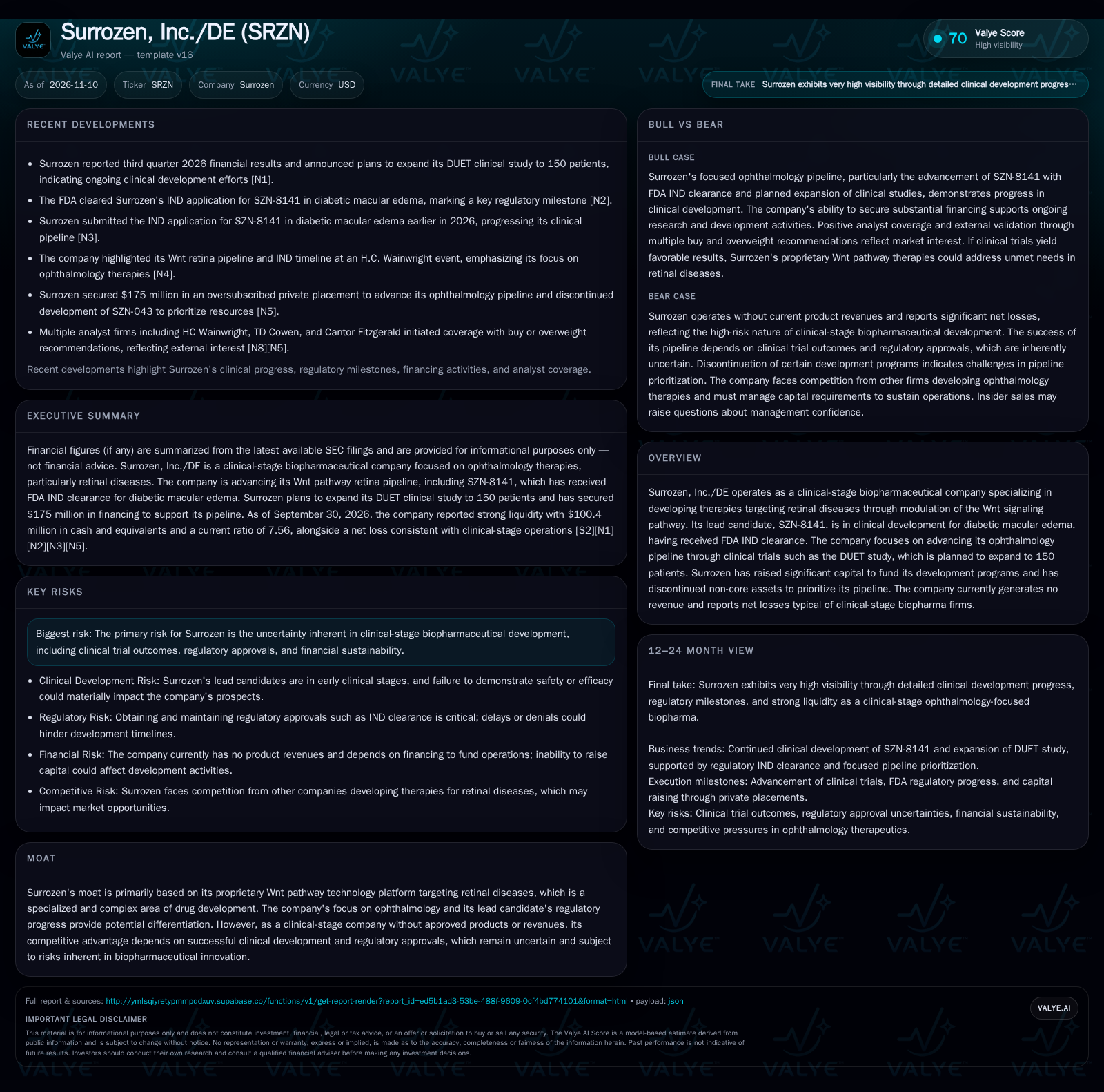
Surrozen, a clinical-stage biopharma, is advancing its Wnt pathway-based candidate SZN-8141 for diabetic macular edema, recently securing FDA IND clearance. With $100.4 million in cash and a planned expansion of its DUET clinical study, Surrozen exhibits reported liquidity position but remains pre-revenue and reliant on trial outcomes. The company’s near-term trajectory hinges on demonstrating clinical efficacy and maintaining potential financial flexibility amid competitive and regulatory pressures. [S2] [N1] [N2] [N3]
Surrozen, Inc. stands at a pivotal moment as it advances SZN-8141, its lead candidate targeting diabetic macular edema, through early clinical development. With FDA IND clearance in hand and a significant expansion of its DUET trial underway, Surrozen has both regulatory momentum and a financial buffer, holding over $100 million in cash. Yet, as a pre-revenue, clinical-stage company, its value proposition remains tightly linked to unproven science, trial outcomes, and the ability to translate Wnt pathway innovation into a viable ophthalmology franchise.
Recent Milestones Anchor Surrozen’s Strategic Position
Surrozen’s most material recent developments include FDA IND clearance for SZN-8141 in diabetic macular edema—a critical regulatory gateway that enables formal clinical evaluation of its lead asset [N2] [N3]. The company is moving to expand its DUET clinical study to 150 patients, signaling both confidence in its trial design and commitment to generating robust data [N1]. [S2] Importantly, Surrozen remains pre-revenue, posting a net loss of $129.7 million for the quarter—a profile typical of clinical-stage biopharma firms [S2]. These facts collectively frame Surrozen’s near-term opportunity set: advancing its pipeline with sufficient capital, but under the pressure of delivering clinical proof and securing a viable commercial future.
How Surrozen’s Model Could Create Value—And Where the Economic Leverage Lies
Surrozen’s economics are classic for a clinical-stage biopharma: significant R&D outlays, no product revenue, and a reliance on external capital. Its value creation engine is the successful clinical and regulatory advancement of novel therapies—here, centered on SZN-8141 and the Wnt pathway for retinal diseases. If SZN-8141 demonstrates efficacy in diabetic macular edema and achieves regulatory approval, Surrozen could unlock a high-value specialty market with significant unmet need. Pricing for innovative retinal therapies is traditionally robust, particularly if clinical benefit is meaningful and competition is limited. However, fixed costs (clinical, regulatory, G&A) are high and variable costs remain low until commercialization. Once a therapy is approved, operating leverage can be substantial: incremental sales generate high gross margins, but only if the company can secure payer reimbursement and physician adoption. Funding needs remain acute until late-stage clinical readouts or a partnership/licensing event—a common path for pre-commercial biotechs. The company’s current capital base provides runway for near-term trial execution, but further financing or partnership would likely be needed for a commercial launch or expanded pipeline push.
The economic leverage inherent in Surrozen’s model is also closely tied to the scalability of its Wnt pathway platform beyond the initial indication. Should the company successfully validate the mechanism in diabetic macular edema, it may unlock opportunities for platform licensing or co-development agreements, which could provide alternative revenue streams and mitigate risk. Moreover, the timing of clinical milestones relative to capital deployment is critical; efficient trial management and adaptive study designs could reduce cash burn and extend the runway. Conversely, delays or clinical setbacks would amplify funding pressures, potentially diluting shareholder value or necessitating unfavorable financing terms. A useful metric would be the company’s burn multiple relative to clinical progress, helping to assess capital efficiency in advancing its pipeline.
Wnt Pathway as Differentiator—But Headwinds from Entrenched and Emerging Players
Surrozen’s competitive stance in ophthalmology hinges on the novelty and translational relevance of its Wnt pathway platform. The Wnt pathway is a validated biological target in tissue regeneration and disease modulation, but its application in retinal diseases remains an emerging frontier. If Surrozen’s approach yields superior efficacy or safety—particularly for patients refractory to current anti-VEGF therapies—it could establish a defensible clinical niche. However, the company faces formidable competition from established ophthalmology players and other clinical-stage innovators pursuing next-generation retinal therapies, including gene therapies, bispecific antibodies, and small molecules. Switching costs for retina specialists can be significant if a new therapy delivers clear incremental benefit, but regulatory hurdles and payer skepticism are also high. The question is whether Surrozen’s science translates into a product profile compelling enough to shift prescribing behavior and justify premium pricing. Without first-mover clinical success, the company risks being outpaced by larger, better-capitalized rivals or crowded out by alternative mechanisms.
From a competitive dynamics perspective, the Wnt pathway’s novelty presents both an opportunity and a challenge. While it may offer a differentiated mechanism of action that addresses unmet needs, the pathway’s complexity and the translational gap between preclinical models and human retinal disease could introduce development risk. Additionally, the market’s receptivity to new modalities depends on demonstrated improvements over entrenched standards of care, which have established safety and efficacy profiles. Payer willingness to reimburse a premium price hinges on clear evidence of incremental benefit, and physicians may be cautious in adopting therapies without long-term safety data. Therefore, Surrozen’s ability to generate compelling head-to-head or real-world evidence will be pivotal in overcoming switching barriers and securing market share.
Clinical Validation Fuels Platform Expansion and Strategic Optionality
In the favorable scenario, SZN-8141’s expanded DUET trial generates positive safety and efficacy signals, supporting advancement into pivotal studies. Regulatory momentum continues, with the FDA granting fast track or breakthrough designation if the data are compelling. Strong clinical results attract partnership interest from larger ophthalmology or biotech firms, providing non-dilutive capital and potentially de-risking commercialization. The Wnt pathway platform, validated in diabetic macular edema, opens doors to additional indications or combination regimens. Analyst coverage, already positive, intensifies, supporting capital raising on favorable terms if needed. Evidence confirming this scenario would include statistically significant improvements in visual acuity and retinal thickness in trial readouts, favorable regulatory feedback, and formal partnership/licensing announcements. Conversely, lackluster efficacy, unexpected safety issues, or tepid external interest would challenge the upside thesis.
Incremental Progress with Persistent Uncertainty Defines the Near Term
The most plausible path for Surrozen is continued clinical advancement of SZN-8141, with the expanded DUET trial enrolling as planned and interim results providing early safety and efficacy signals—potentially mixed or modest. External analyst sentiment remains constructive, but the company does not secure a major partnership or licensing deal before pivotal data become available. Regulatory feedback is neutral to cautiously optimistic, but no accelerated pathway is granted. On the other hand, unexpected trial delays, higher-than-anticipated costs, or a negative shift in analyst sentiment would cast doubt on this middle path.
Adverse Trial Outcomes or Capital Constraints Undermine the Investment Case
In the adverse scenario, SZN-8141’s clinical data fail to demonstrate meaningful efficacy or raise safety concerns, leading to regulatory setbacks or program discontinuation. Competitive pressures intensify, with other retinal therapies (either approved or in late-stage development) eclipsing Surrozen’s value proposition. Analyst sentiment turns negative, further constraining access to capital markets. Evidence supporting this scenario would include negative or inconclusive clinical trial updates, regulatory holds, higher-than-expected cash burn, and public announcements of asset discontinuation or restructuring. A mitigating factor would be rapid pivoting to alternative pipeline assets if available, but this requires both capital and a differentiated scientific rationale.
In scenarios where clinical outcomes are suboptimal, the company’s strategic flexibility becomes a key factor in mitigating downside risk. For instance, Surrozen could consider partnering its platform with larger entities to share development costs or pivoting to alternative indications where the Wnt pathway’s biology may confer advantages. However, such strategic shifts require both sufficient capital and a robust scientific rationale supported by preclinical or early clinical data. Additionally, adverse trial results may trigger heightened regulatory scrutiny for subsequent programs targeting similar pathways, complicating development timelines. In this context, maintaining operational agility and prioritizing resource allocation toward the most promising assets will be essential to preserving enterprise value amid unfavorable conditions.
Milestones and Metrics That Will Clarify Surrozen’s Clinical and Economic Trajectory
Enrollment pace and retention in the expanded DUET clinical trial—if disclosed—will indicate operational execution and near-term data visibility.
Interim and top-line clinical results for SZN-8141 in diabetic macular edema, particularly measures of efficacy (visual acuity, retinal thickness) and safety.
Regulatory feedback from the FDA, including any fast track, breakthrough, or other designations that could accelerate development.
Updates on cash burn rate and remaining runway, including disclosures of planned or completed financings.
Announcements of strategic partnerships, licensing deals, or collaborations with larger biotech or pharma firms.
Competitive landscape developments—new approvals or late-stage data from rival retinal therapies that could shift market expectations.
Pipeline prioritization and any discontinuation or advancement of non-core assets, reflecting management’s capital allocation discipline.
External analyst sentiment and coverage updates, especially following clinical or regulatory milestones.
Disclaimer: This is research-only, informational analysis and not investment advice. It may include AI-generated interpretation and general industry context. Always verify important details using primary sources.

Comments