
Gores Holdings X: The Stakes and Uncertainties of a Late-Cycle SPAC Countdown
With a looming deadline and a cash-light balance sheet, Gores Holdings X faces the classic SPAC dilemma: the urgent need to secure a viable acquisition or risk forced liquidation. The company’s future now hinges on its ability to find and close a business combination under governance structures that limit public shareholder influence.
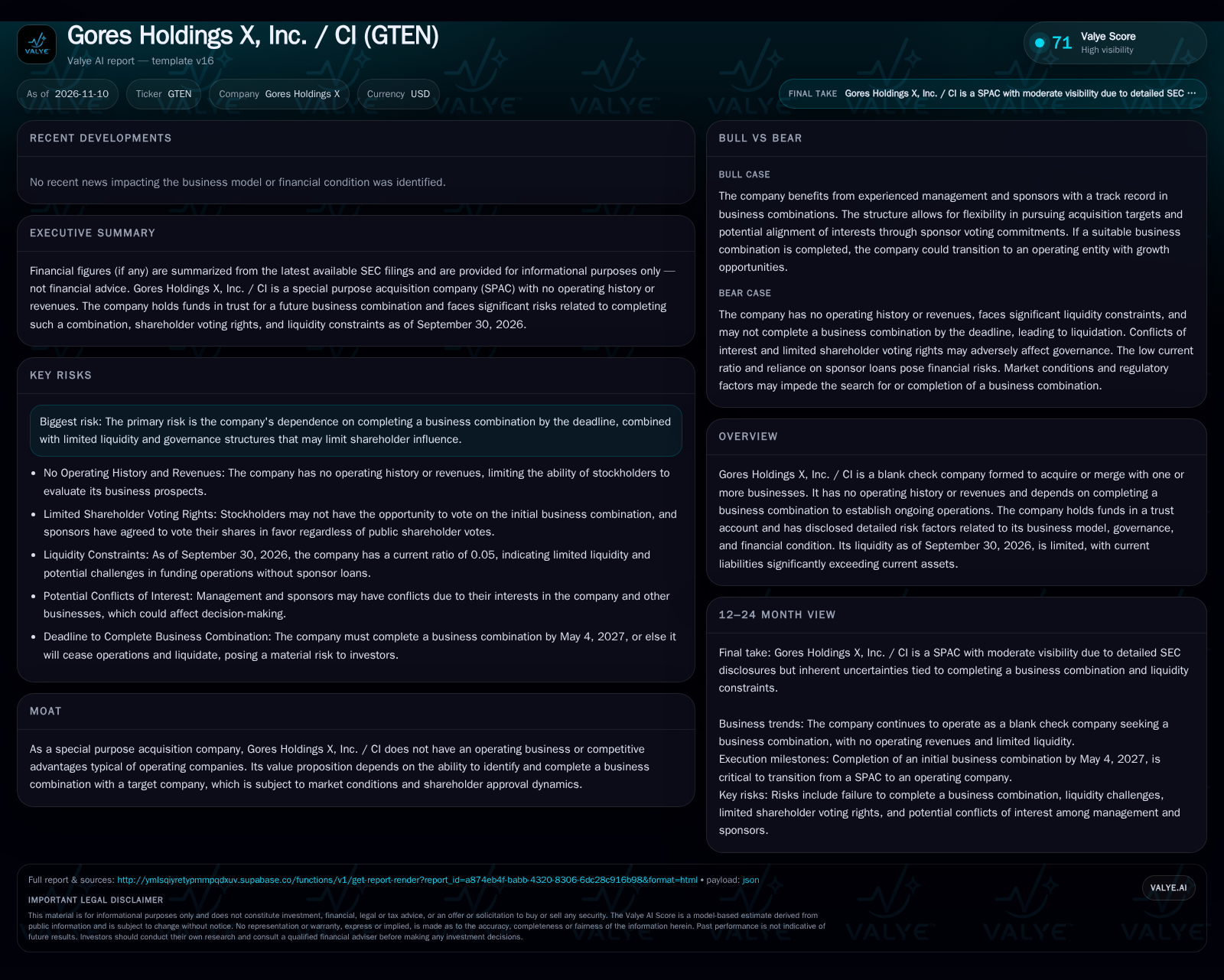
Gores Holdings X, a SPAC with no operating history or revenue, must complete a business combination by May 4, 2027, or liquidate. The company’s current assets are dwarfed by its liabilities, reflecting reported liquidity position. Sponsor voting commitments and potential conflicts of interest constrain public shareholder influence, making the outcome highly dependent on management’s deal execution and the quality of any target identified. [S2]
Gores Holdings X, Inc. is a late-stage SPAC facing the classic crossroads of the blank check model: a rapidly closing window to identify and close a business combination, minimal liquidity outside its trust account, and a governance structure that heavily favors sponsor control over public shareholders. With only months remaining before a May 2027 liquidation deadline, the company’s fate is now essentially binary—either management lands a credible acquisition and navigates the complex regulatory and shareholder dynamics, or the SPAC winds down and returns remaining trust funds to investors. The next steps will test both the sponsor’s deal-making prowess and the resilience of the SPAC structure in a more skeptical market environment.
Liquidity Constraints and the Business Combination Deadline Define the Next Chapter
The most material current facts shaping Gores Holdings X’s outlook are its severe liquidity constraints and the looming May 4, 2027 deadline to complete a business combination. As of September 30, 2026, the company reported current assets of just $275,179 against current liabilities of $5,551,756, resulting in a current ratio of 0.05. This financial posture means the company is almost entirely dependent on trust account funds (restricted for acquisition or redemption purposes) and possible sponsor loans to cover ongoing expenses. The absence of operating revenue underscores the urgency: if no acquisition is completed by the deadline, the company will be forced to liquidate and return remaining trust funds to shareholders. Sponsor and management voting agreements further complicate the path, as they ensure internal alignment but limit the influence of public shareholders over the eventual deal. [S2]
SPAC Economics: Fee Structures, Funding Reliance, and the Binary Nature of Value Creation
SPACs like Gores Holdings X operate with a unique economic model: value is only created if a business combination is completed, as there is no operating business or recurring revenue prior to a merger. The funds raised in the IPO are held in trust and generally restricted to acquisition or shareholder redemption purposes, with limited ability to use these funds for operating expenses. Ongoing costs—legal, regulatory, search, and administrative—must be covered by the limited current assets or, if depleted, by sponsor-provided loans. This introduces both dilution risk and potential conflicts of interest, as sponsors may negotiate terms that prioritize their recovery of loans or promote fees post-merger.
Fee structures are a central economic lever: sponsors typically receive founder shares (often at a nominal cost) and may collect additional fees or warrants if a merger closes. For public shareholders, value is realized only if the acquired company justifies the SPAC’s implied valuation and delivers post-merger growth. If no deal is struck, SPAC sponsors lose their initial investment, while public shareholders are entitled to trust account redemptions (minus allowable deductions for taxes and regulatory costs). The economics are thus highly asymmetric and binary: a successful deal can generate substantial sponsor returns, while failure results in a wind-down with minimal upside for any party.
SPAC Market Saturation, Deal Quality, and the Erosion of the Sponsor Edge
The competitive landscape for SPACs has shifted dramatically since the boom of the early 2020s. There is now a glut of blank check companies, many with experienced sponsors, all seeking to acquire a finite pool of attractive targets. Gores Holdings X’s sponsor may benefit from established relationships and prior deal experience, but this edge has diminished as more sophisticated targets demand favorable terms and as regulatory scrutiny has increased.
SPACs now compete not just with each other, but with traditional IPOs, strategic buyers, and private equity. The most attractive targets often have multiple options for capital raising and may negotiate aggressively on valuation and post-merger governance. Additionally, the poor performance of many de-SPACed companies in recent years has made public market investors more skeptical, raising the bar for what constitutes an acceptable acquisition. In this environment, Gores Holdings X’s ability to source and close a high-quality deal is neither assured nor solely a function of sponsor pedigree.
Securing a High-Quality Target and Delivering Post-Merger Value
The positive scenario for Gores Holdings X is driven by the identification and successful acquisition of a high-quality target—ideally a company with strong growth prospects, clear path to profitability, and market credibility. If the SPAC can negotiate favorable terms, structure an appealing capital stack, and convince the market of the target’s value proposition, the combined entity could achieve robust trading performance post-merger. This outcome depends on effective due diligence, disciplined valuation, and the ability to attract anchor investors or PIPE (private investment in public equity) commitments to support the transaction.
Early signals of this scenario would include a definitive merger announcement with a credible, well-vetted target; strong PIPE participation; and a positive market reaction to the deal terms. Confirmation would come from post-merger trading above trust value, sustained investor interest, and operational milestones delivered by the acquired company. Falsification would occur if the SPAC fails to identify a compelling target or if shareholder redemptions overwhelm the deal, forcing a renegotiation or abandonment.
Deal-Making Under Pressure: The Most Likely Outcome Is a Marginal or Late-Stage Combination
Given the saturated SPAC market, regulatory headwinds, and the company’s financial constraints, the most plausible scenario is that Gores Holdings X announces a business combination in the later part of its deadline window, likely with a target that is either less proven or available at more favorable terms to the SPAC. The sponsor’s voting power ensures that any proposed deal will be internally supported, but high public shareholder redemptions could drain the cash available for the merger, making the combined entity undercapitalized.
Confirmation of this scenario would come from a merger announcement close to the deadline, high redemption rates, and a post-merger entity that trades near or below trust value. Falsification would require either a surprisingly strong deal with low redemptions and strong PIPE participation or, conversely, no deal announcement at all as the deadline approaches.
Failure to Close a Deal or Extreme Dilution from Sponsor Loans and Redemptions
The adverse scenario is straightforward: Gores Holdings X fails to secure a business combination by May 4, 2027, triggering liquidation and the return of remaining trust funds to shareholders. Given the company’s minimal liquid assets outside the trust and the need to fund ongoing expenses, the risk of sponsor loans increasing dilution for public shareholders is high if the process drags on. Alternatively, if a low-quality or rushed deal is consummated, high redemptions and insufficient PIPE support could leave the post-merger company with inadequate capital and poor trading performance.
Confirmation of downside risk would include repeated sponsor loans, mounting operating expenses, and the absence of a credible deal announcement as the deadline nears. A failed shareholder vote, if required, or the inability to secure regulatory approvals would also trigger this scenario.
Milestones That Will Determine If Gores Holdings X Delivers Value or Liquidates
The announcement of a definitive business combination agreement, particularly the identity and financial health of the target company, will be the most critical development.
Any disclosed PIPE financing commitments or anchor investor participation would clarify post-merger capitalization and market confidence.
Shareholder redemption rates upon deal announcement and at closing will indicate public investor sentiment and affect the capital available to the combined entity.
If disclosed, the terms and size of any sponsor loans used to fund ongoing operations will signal dilution risk and the company’s near-term cash needs.
Regulatory or stock exchange approval status for the proposed combination would provide insight into deal execution risk.
Any change in the timeline or structure of the redemption process, especially restrictions or modifications, would signal governance and liquidity maneuvering.
If disclosed, ongoing operating expense burn rates and trust account drawdowns would help test the ability to reach the deadline without impairing shareholder redemptions.
Disclaimer: This is research-only, informational analysis and not investment advice. It may include AI-generated interpretation and general industry context. Always verify important details using primary sources.

Comments