
Coherus Oncology: Clinical Momentum, Persistent Losses, and the Stakes of Oncology Pipeline Execution
Coherus Oncology’s high response rates in esophageal cancer trials and a strategic portfolio shift underscore its ambition, but ongoing losses and muted revenues highlight the dependency on successful trial outcomes, regulatory progress, and capital discipline.
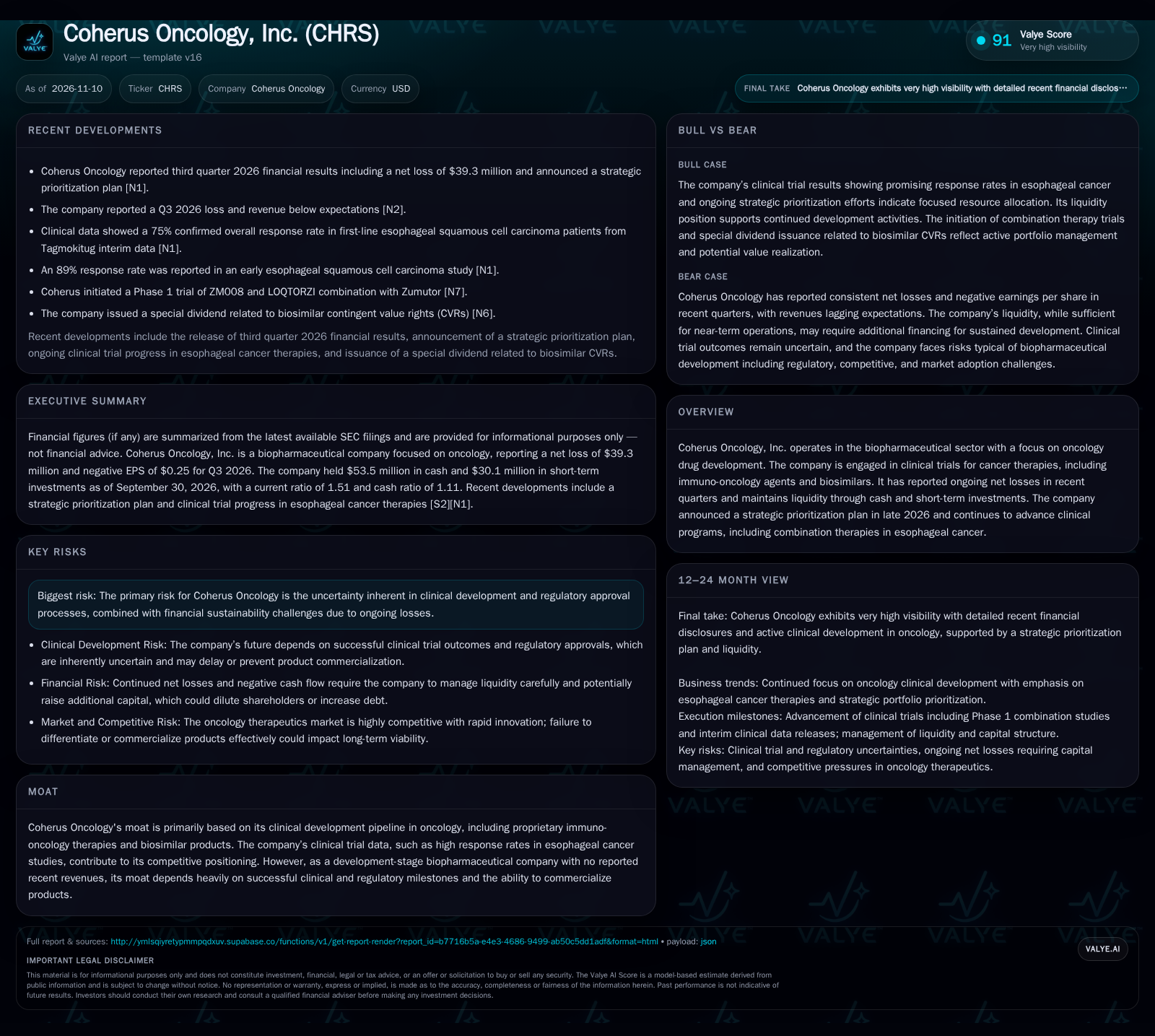
Coherus Oncology is advancing its oncology drug pipeline, highlighted by strong interim response rates in esophageal cancer trials. Despite a reported liquidity position cushion, the company continues to post net losses and lags revenue expectations, underscoring the urgency of clinical milestones and potential capital needs to sustain its strategy. Near-term prospects hinge on translating promising clinical data into regulatory and commercial progress before financial pressures intensify. [S2] [N1] [N2]
Coherus Oncology stands at a pivotal juncture, with its future riding on the dual pillars of clinical progress and financial discipline. Recent esophageal cancer trial results point to potentially best-in-class efficacy, and the company has responded by doubling down on its oncology pipeline through a strategic portfolio prioritization. The next 12-24 months will test whether Coherus can bridge the gap between innovation and sustainable commercialization.
Recent Clinical Breakthroughs and Financial Realities Define the Moment
Coherus Oncology’s Q3 2026 update revealed a net loss of $39.3 million and basic/diluted EPS of -$0.25, continuing a pattern of negative earnings. The company reported cash and liquidity metrics for the period; these figures do not by themselves establish operating runway, investment capacity, financial flexibility, or financing capacity. Clinical development remains the centerpiece: interim data in first-line esophageal squamous cell carcinoma showed a 75% confirmed overall response rate, with an earlier cohort even higher at 89%—outcomes that, if sustained, could support regulatory filings and future commercialization. The cited source reports dividend-related activity; that disclosure alone does not establish dividend-policy continuity, management confidence, or a material constraint on capital flexibility. [S2] [N1] [N2] [N6]
The interplay between clinical milestones and financial health is particularly acute in oncology drug development, where trial outcomes can dramatically alter a company's valuation and strategic options. For Coherus Oncology, the interim response rates in esophageal cancer trials suggest a potential inflection point, but the persistence of net losses underscores the importance of managing burn rate and capital allocation prudently. The timing of subsequent trial phases and regulatory interactions will critically influence cash runway, necessitating disciplined expense management and contingency planning for financing needs. Moreover, the impact of external factors such as competitive trial results and evolving treatment guidelines could affect both trial design and regulatory strategy, adding layers of complexity to execution risk.
Pipeline-Driven Value Creation and the Economics of Biopharma Development
Coherus Oncology’s business model is anchored in the high-risk, high-reward economics of oncology drug development. Success hinges on advancing compounds through costly, multi-phase clinical trials and ultimately achieving regulatory approval. Should lead assets gain approval, the revenue model may transition to a mix of direct drug sales (if self-commercialized) or milestone/royalty payments (if partnered). Pricing in oncology is often premium, but commercial success depends on differentiation, market access, and payer acceptance. The company’s operating leverage is substantial: fixed R&D costs dominate until a product launch, after which revenue may scale rapidly if adoption is strong. However, persistent cash burn means Coherus may need additional financing—potentially dilutive equity or debt—if clinical or regulatory timelines slip. The special dividend from biosimilar CVRs reflects a strategy to unlock value from legacy assets but does not materially alter the underlying economics of the core oncology pipeline. [S2] [N6]
The economics of oncology drug development inherently involve a high fixed-cost base with uncertain timelines to revenue generation, which intensifies the need for capital efficiency and strategic prioritization. Coherus’ approach to unlocking value from biosimilar CVRs, while helpful for near-term liquidity, does not substitute for sustained investment in proprietary oncology assets that carry greater long-term upside but also higher risk. The potential for milestone payments or royalties from partnerships can provide non-dilutive capital infusions, but these depend heavily on successful clinical and regulatory outcomes. Additionally, payer dynamics in oncology—where reimbursement decisions increasingly incorporate comparative effectiveness and real-world evidence—may pressure pricing power, necessitating robust health economics and outcomes research to support market access and maximize lifetime product value.
Pipeline Promise Versus Intense Oncology Market Competition
Coherus Oncology operates in one of the most competitive and innovation-driven sectors of biopharma. Its potential advantage lies in proprietary immuno-oncology assets showing high response rates in esophageal cancer—a field with significant unmet need and limited best-in-class therapies. However, large pharmaceutical incumbents and emerging biotechs are also targeting similar indications, often with broader pipelines, deeper resources, and established commercial infrastructure. The oncology market is characterized by rapid scientific advances, frequent new entrants, and evolving standards of care, making clinical differentiation and regulatory success prerequisites for lasting market presence. Biosimilar assets may provide tactical optionality but do not offer a durable moat unless they achieve significant market share or reimbursement traction. Ultimately, Coherus’ competitive position depends on translating clinical data into approved, reimbursed therapies and building or accessing commercial scale before rivals with similar or superior assets reach the market.
In an oncology landscape marked by rapid innovation and shifting treatment paradigms, differentiation extends beyond clinical efficacy to encompass biomarker-driven patient selection, combination therapy potential, and safety profiles. Coherus’ immuno-oncology assets must demonstrate not only superior response rates but also durability of response and manageable toxicity to achieve a competitive edge. The company's ability to engage key opinion leaders and integrate real-world evidence into clinical development could influence adoption curves post-approval. Furthermore, strategic alliances or licensing agreements may be critical to augment commercial reach and navigate payer negotiations, especially given the scale and complexity of oncology markets globally. The evolving regulatory environment, including accelerated approval pathways and post-marketing requirements, also shapes competitive dynamics and resource allocation.
If Esophageal Cancer Data Drive Regulatory Success and Commercial Uptake
In the most favorable scenario, Coherus converts its strong clinical response rates in esophageal squamous cell carcinoma into positive pivotal trial outcomes, leading to regulatory filings and eventual approvals. Rapid regulatory review—potentially aided by breakthrough designation or fast-track status—could accelerate time-to-market. If the therapy demonstrates a clear efficacy or safety edge over standard of care, payers may grant favorable reimbursement, and oncologists could adopt the product quickly. This would unlock high-margin revenue, improve cash flow, and potentially attract partnering or acquisition interest from larger pharma players. Confirmation of this scenario would require additional positive clinical data, regulatory progress (such as acceptance of a new drug application), and early signals of commercial traction post-approval.
Sustained Clinical Progress But Commercialization Remains Over the Horizon
The most plausible near-term outcome is continued advancement of lead oncology assets through mid- to late-stage trials, with incremental clinical readouts supporting ongoing development. However, regulatory filings and commercial launch are unlikely within the next 12–18 months, meaning Coherus remains pre-revenue and cash flow negative during this period. The company may need to pursue additional financing if trial timelines extend or if portfolio prioritization does not yield cost savings. Evidence supporting this scenario would include continued positive but non-pivotal clinical data, steady cash burn, and periodic capital-raising announcements. Falsification would come from either a major clinical setback or unexpectedly rapid regulatory/market progress.
Clinical or Regulatory Setbacks Compel Restructuring or Dilutive Financing
Should pivotal trials in esophageal cancer or other pipeline programs fail to confirm efficacy or safety, Coherus would face severe challenges. Negative or equivocal data could halt development, force asset write-downs, and erode investor confidence. Delays or rejections from regulatory agencies would prolong the pre-revenue phase, intensifying cash burn and likely requiring urgent, potentially dilutive capital raises or strategic asset sales. In this scenario, liquidity constraints could force pipeline downsizing or a search for partnerships on unfavorable terms. Confirmation would come from negative clinical headlines, regulatory setbacks, or emergency financing events that materially dilute existing shareholders.
What Will Determine Whether Coherus Oncology Converts Promise to Value?
Interim and final clinical trial data in esophageal squamous cell carcinoma and other lead oncology indications.
Regulatory milestones, including IND/CTA submissions, acceptance of pivotal trial protocols, and any fast-track or breakthrough therapy designations.
Updates on cash burn and runway, with a useful metric being quarterly net cash used in operations (if disclosed).
Announcements of new financing, partnerships, or licensing deals that could extend runway or accelerate commercialization.
Progress in portfolio prioritization, including decisions to advance, pause, or divest specific assets.
Any early signs of payer engagement, market access planning, or commercial infrastructure build-out.
Resolution and financial impact of the biosimilar CVR-related special dividend and any additional monetization of non-core assets.
Management guidance on expected regulatory and commercial timelines for lead programs (if disclosed).
Disclaimer: This is research-only, informational analysis and not investment advice. It may include AI-generated interpretation and general industry context. Always verify important details using primary sources.

Comments