
World Acceptance Corp: Credit Risk Management and Branch Model Under Scrutiny as Lending Mix Shifts
World Acceptance Corp’s recent results reveal a cautious return to new customer lending and a shift toward higher-yield loans, but a rising debt-to-equity ratio and persistent credit risk underscore the complexity of balancing growth, risk, and regulatory exposure in consumer finance.
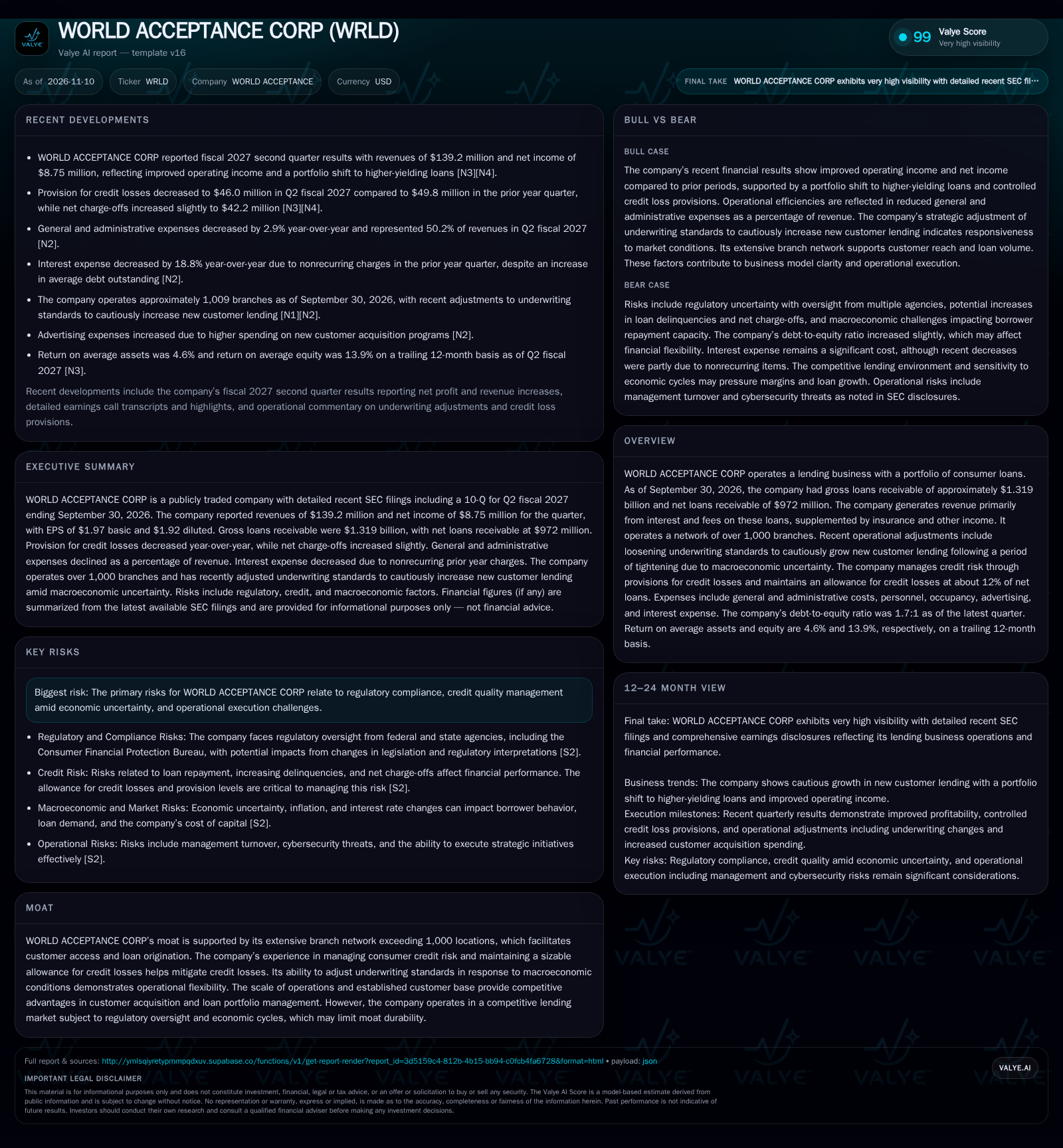
World Acceptance Corp reported Q2 fiscal 2027 revenues of $139.2 million and net income of $8.75 million, with a loan portfolio of $1.319 billion gross and $972 million net. The company is loosening underwriting standards to cautiously target new customer growth after a period of tightening, while credit provisioning and charge-offs remain central to its risk profile. Operating efficiency gains and a large branch footprint support reach, but the business remains highly sensitive to regulatory, credit, and macroeconomic forces. The sustainability of current profitability depends on managing these risks amid competitive and economic headwinds. [S2] [N3] [N4]
World Acceptance Corp stands at a pivotal moment as it cautiously reopens lending to new customers, aiming to capture loan growth amid a competitive and highly regulated consumer finance landscape. The company’s Q2 fiscal 2027 results show steady revenues and net income, with a loan book now tilting toward higher-yielding products. However, the interplay between loosening credit standards, rising net charge-offs, and a modestly higher leverage ratio poses questions about the durability of current profitability. As regulatory scrutiny and economic uncertainty persist, World Acceptance’s ability to balance growth ambitions with disciplined risk management will be the central test for its branch-based lending model.
Recent Loan Growth, Credit Metrics, and Underwriting Policy Shifts
World Acceptance Corp reported Q2 fiscal 2027 revenues of $139.2 million and net income of $8.75 million, maintaining profitability as it grew its gross loans receivable to $1.319 billion and net loans receivable to $972 million [S2] [N3] [N4]. The company’s allowance for credit losses remained elevated at 12% of net loans, and while the provision for credit losses decreased to $46.0 million, net charge-offs ticked up slightly to $42.2 million [S2]. Notably, management has begun to loosen underwriting standards following a period of tightening, signaling a cautious push to expand new customer lending [S2] [N1] [N2]. The debt-to-equity ratio increased to 1.7:1, reflecting a marginal rise in leverage as the company pursues loan growth [S2]. These developments frame the immediate challenge: can World Acceptance grow its loan book without materially increasing credit risk or overextending its capital structure?
Loan Yield, Credit Losses, and the Economics of Branch-Based Lending
World Acceptance’s primary revenue source is interest and fees on consumer loans, which are typically unsecured and higher-yielding relative to prime lending products. The company’s business model is highly volume-driven, relying on a broad branch network (over 1,000 locations) to originate and service loans, creating substantial fixed operating costs in personnel, occupancy, and compliance. Recent reductions in general and administrative expenses (down 2.9% year-over-year to 50.2% of revenues) suggest some operating leverage, but the model remains sensitive to loan volumes and loss rates [S2].
Credit losses and the cost of capital are the two largest variable expense drivers. The provision for credit losses, while down year-over-year, remains high in absolute terms, reflecting the inherent risk in subprime lending. Net charge-offs slightly increased, indicating that even modest changes in borrower performance can quickly erode profitability [S2]. The company’s debt-to-equity ratio of 1.7:1 highlights its dependence on external funding, and while interest expense fell due to nonrecurring prior year charges, ongoing cost of capital will remain a constraint as rates fluctuate [S2].
The recent loosening of underwriting standards is a tactical move to drive loan growth, but if not matched by improved credit performance, could pressure margins. The business is capital-intensive, and the necessity of maintaining a substantial allowance for credit losses (12% of net loans) ties up balance sheet capacity, limiting how far the company can stretch leverage without risking regulatory or rating agency pushback.
Branch Network Reach Versus Digital and Regulatory Headwinds
World Acceptance’s competitive strength remains its extensive physical branch network, which enables direct customer interaction and supports loan origination in markets less penetrated by digital-only lenders. This footprint can help drive customer loyalty and facilitate collections, particularly among underbanked populations. However, the traditional branch model is increasingly challenged by fintech entrants offering digital origination, faster approval, and sometimes lower rates—especially as regulatory frameworks evolve to facilitate online lending.
The company’s ability to adjust underwriting standards in response to macroeconomic signals demonstrates operational flexibility, but this is not a unique capability. Established competitors in the nonprime lending space, including both regional installment lenders and national digital platforms, have similar tools and are often less encumbered by fixed branch costs. Regulatory scrutiny is another critical factor: World Acceptance is subject to oversight from both federal and state agencies, and any tightening of consumer protection laws or caps on rates/fees could disproportionately impact its core products.
In summary, while the branch network and local relationships provide some differentiation, the company’s moat is not insurmountable, and competitive, regulatory, and technological headwinds could erode its relative advantage over time.
If Credit Quality Holds, Loan Growth Could Drive Margin Expansion
The most favorable scenario for World Acceptance is that its cautious loosening of underwriting standards successfully expands new customer lending without triggering a material increase in delinquencies or charge-offs. If the company’s credit performance remains stable—evidenced by a steady or declining allowance for credit losses as a percentage of net loans and flat or reduced net charge-offs—then higher loan volumes could deliver operating leverage, especially as fixed branch costs are spread over a larger portfolio.
Confirmation of this scenario would come from sequential growth in loan balances, stable or improving delinquency and net charge-off rates, and continued declines in general and administrative expenses as a percentage of revenue. Additional signs would include higher return on assets and equity, as well as the ability to maintain or reduce the debt-to-equity ratio even as loan growth accelerates.
Falsification would occur if credit quality metrics deteriorate—such as a rising percentage of accounts past due 61 days or more, or a spike in net charge-offs—undermining profitability and forcing renewed tightening of credit standards.
Normalizing Credit Trends and Incremental Growth Amid Persistent Risk
The most plausible outcome is a period of moderate loan growth driven by the incremental loosening of underwriting, offset by persistent but manageable credit risk and elevated provisioning levels. In this scenario, World Acceptance grows its gross loans receivable at a pace similar to recent quarters, but must continue to maintain a high allowance for credit losses (around 12% of net loans) and absorb net charge-offs that remain at or slightly above current levels.
Operating leverage from the branch network and modest efficiency gains in overhead costs help sustain profitability, but margin expansion is limited by the ongoing need for aggressive credit provisioning. The debt-to-equity ratio remains elevated but stable, and the company’s ability to sustain or modestly grow net income depends on the external macro environment not deteriorating further.
This scenario would be confirmed by steady sequential growth in loan balances, stable credit loss ratios, and flat to slightly improving operating metrics. Risk to the scenario would be signaled by any uptick in delinquencies, unexpected regulatory changes, or a sharp increase in the cost of funds.
Credit Deterioration or Regulatory Action Could Force Retrenchment
The primary risk is that the current loosening of underwriting standards coincides with a worsening macroeconomic environment or latent credit quality issues, leading to a spike in delinquencies and net charge-offs. If the allowance for credit losses proves insufficient and must be increased, profitability could rapidly erode, particularly given the company’s high fixed costs and leverage.
A regulatory shock—such as new rate caps, fee restrictions, or enhanced scrutiny from federal or state agencies—could also force the company to tighten lending, reduce loan yields, or absorb additional compliance expenses. In either case, the result could be a contraction in the loan portfolio, rising nonperforming assets, higher funding costs, and potentially a need to deleverage.
Confirmation of this downside would include a rising percentage of accounts past due 61 days or more, a material increase in net charge-offs, upward revisions to the allowance for credit losses, or explicit regulatory actions that curtail lending activity or compress margins.
Developments That Will Determine World Acceptance’s Resilience
Net charge-off rates and the allowance for credit losses as a percentage of net loans—deterioration here would signal rising credit risk.
Sequential growth in gross and net loans receivable—whether loan growth is achieved without compromising credit quality.
Percentage of accounts past due 61 days or more—an early indicator of emerging credit stress.
Trends in general and administrative expenses as a percentage of revenue—whether efficiency gains can be sustained.
Debt-to-equity ratio—monitoring for further leverage increases that could constrain flexibility.
Regulatory developments or enforcement actions—new rules on lending practices, rate/fee caps, or compliance costs.
Interest expense as a percentage of revenue—sensitivity to changing cost of funds and debt structure.
Branch count and productivity metrics, if disclosed—evidence that the physical network is delivering incremental value versus digital competitors.
Disclaimer: This is research-only, informational analysis and not investment advice. It may include AI-generated interpretation and general industry context. Always verify important details using primary sources.

Comments