
SIGA Technologies: Government Reliance, Regulatory Crossroads, and the Stakes of Orthopox Preparedness
The near-term future hinges on label expansion, European regulatory reviews, and the durability of its procurement-driven business model.
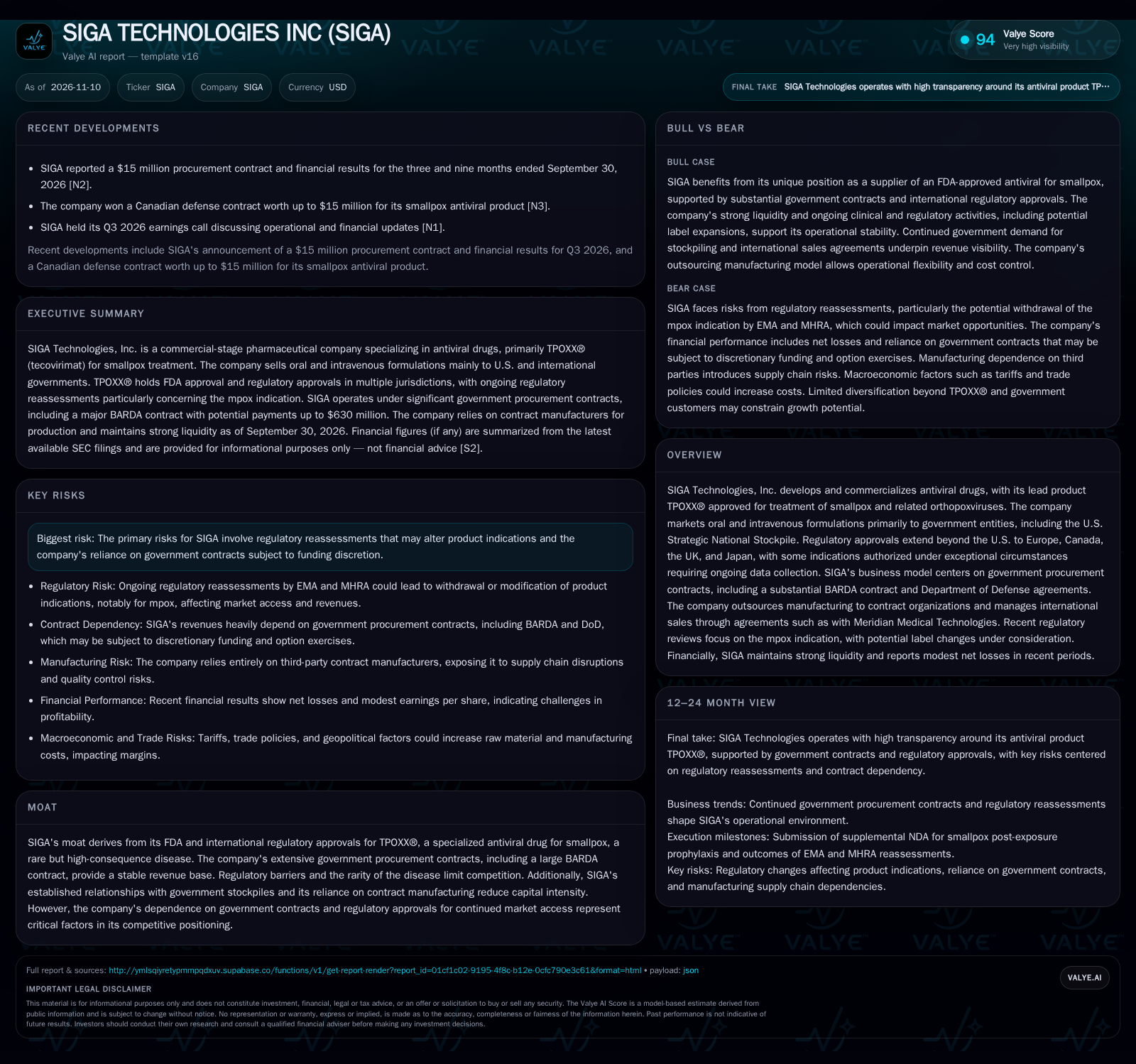
SIGA Technologies, maker of the antiviral TPOXX®, continues to anchor its business on large government contracts and international regulatory approvals. Recent wins—including a Canadian defense contract and a $15 million procurement award—underscore its position in global biodefense. However, the business faces critical tests: potential withdrawal of the mpox indication in Europe, dependence on discretionary government funding, and a modest net loss for 2026 year to date. The coming year will reveal whether SIGA can sustain contract momentum and diversify beyond a single product and customer base. [S1] [S2] [N2] [N3]
SIGA Technologies, Inc. occupies a rare niche at the intersection of pharmaceutical innovation and national security, supplying its FDA-approved antiviral TPOXX® for smallpox to stockpiles in the U.S. and abroad. As SIGA pursues label expansion and navigates potential loss of its mpox indication, the core questions are whether it can continue converting regulatory status into procurement revenue and if it can broaden its franchise beyond a single high-stakes product.
Recent Contracts and Regulatory Reviews Shape the Strategic Landscape
In the past quarter, SIGA Technologies secured a $15 million procurement contract and won a Canadian defense contract worth up to $15 million for its flagship smallpox antiviral TPOXX®, reinforcing its central role in government orthopox preparedness programs. These contracts follow a pattern of SIGA’s revenues being anchored by large, lumpy government orders, particularly from the U.S. Strategic National Stockpile and international defense agencies. [N2] [N3]
SIGA’s liquidity position is notable: as of September 30, 2026, the company reported $116.4 million in cash and equivalents, a current ratio of 24.57, and a cash ratio of 17.27. Despite these metrics, net income for the first nine months of 2026 was negative at -$2.9 million, reflecting the inherent volatility of its contract-driven revenue model and the absence of a diversified commercial base. [S2]
A critical near-term risk is regulatory: the EMA’s CHMP initiated a review in July 2025 on the effectiveness of Tecovirimat-SIGA for mpox, with a recommendation expected by March 2026. While the mpox indication could be withdrawn, other smallpox-related authorizations are expected to remain. This review could affect SIGA’s market access and future international sales, particularly in Europe. [S1]
How SIGA Converts Regulatory Approval into Revenue Streams
SIGA’s business model is built on converting regulatory approvals for TPOXX® into procurement contracts with government agencies tasked with biodefense and pandemic preparedness. Revenue is primarily driven by large, infrequent purchases rather than recurring, high-frequency sales. This creates significant quarter-to-quarter variability and limits visibility into future cash flows, as most contracts—such as the $630 million BARDA agreement—are subject to option exercises and government funding cycles. [S1]
Pricing power is underpinned by the lack of direct substitutes and the high-stakes nature of smallpox preparedness. However, volume is dictated by government threat assessments and budget priorities, which can be unpredictable and subject to political change. Margins may benefit from a capital-light model—SIGA outsources all manufacturing to contract organizations—but this also means less control over production costs and potential exposure to supply chain disruptions.
Operating leverage is limited: while SG&A and R&D do not scale linearly with revenue, the company’s dependency on a single product constrains its ability to amortize fixed costs across a broader portfolio. Capital needs are modest due to the absence of internal manufacturing infrastructure, but future investments may be required if SIGA seeks to diversify its pipeline or pursue new indications.
Barriers, Substitutes, and the Realities of a Government-Driven Niche
SIGA’s competitive moat rests on regulatory exclusivity—TPOXX® is the only FDA-approved antiviral for smallpox—and on deep, established relationships with government stockpiles and procurement agencies. The rarity of smallpox (eradicated globally) means there is little direct commercial competition, but also limits the size and growth of the addressable market. [S1]
Indirect competition could emerge from broader-spectrum antivirals, new vaccine strategies, or alternative medical countermeasures developed by other specialty pharma or biotech firms. However, regulatory and scientific barriers to entry are high, especially given the need for animal rule approvals and the complexity of government procurement processes.
The greatest threat to SIGA’s position is not product substitution, but loss of regulatory status or government funding. As most sales are to a handful of sovereign buyers, the company is highly exposed to changes in procurement policy, shifts in perceived biothreat risk, and the outcomes of ongoing regulatory reviews—particularly in Europe.
What Could Unlock Durable Growth: Label Expansion and Diversified Demand
A favorable scenario for SIGA would see the company successfully securing FDA label expansion for oral TPOXX® as a post-exposure prophylactic, opening up new procurement opportunities and potentially increasing the size and frequency of government orders. If the EMA and MHRA maintain broader orthopox indications (including mpox), international demand could stabilize or even grow, especially if new outbreaks or biothreat concerns arise.
Sustained contract momentum—evidenced by further multi-year procurement awards in the U.S. and allied countries—would reduce revenue volatility and improve visibility. Over time, SIGA could leverage its regulatory and manufacturing infrastructure to expand its portfolio, whether through new indications for TPOXX® or adjacent antiviral assets.
Evidence supporting this scenario would include: approval of the supplemental NDA for post-exposure prophylaxis, positive EMA/MHRA reassessments, new international contracts, and a shift toward multi-product or multi-indication revenue streams.
SIGA’s Most Likely Trajectory: Lumpy Revenues, Regulatory Vigilance, and Steady Government Reliance
The most plausible near-term path is continued dependence on large, episodic government contracts for TPOXX®, with revenues fluctuating based on procurement cycles in the U.S. and select international markets. The loss of the mpox indication in Europe would reduce some international opportunity but likely not threaten the core smallpox business, which remains underpinned by multi-year U.S. BARDA commitments.
Profitability will likely remain modest, with net income oscillating between small losses and gains depending on contract timing.
Confirmation of this scenario would be the renewal or extension of major U.S. contracts, incremental international wins, and maintenance of regulatory approvals for smallpox indications, even if the mpox label is withdrawn.
What Could Derail the Franchise: Regulatory Setbacks and Contract Gaps
A material downside risk is that the EMA and/or MHRA withdraw the mpox indication, resulting not only in the loss of European market access for that indication but also triggering a perception of reduced product utility among other international buyers. If this coincides with a gap or reduction in U.S. or BARDA procurement—due to budget constraints, changing threat assessments, or political shifts—SIGA could face a sharp revenue contraction.
The company’s reliance on third-party manufacturing amplifies exposure to supply chain disruptions, which could delay deliveries and erode customer confidence. Without new indications or product diversification, fixed costs such as regulatory compliance and SG&A would become harder to absorb, potentially deepening net losses.
Evidence of this downside could include: official withdrawal of the mpox indication in Europe, failure to secure new or renewed U.S. procurement contracts, prolonged periods of revenue drought, or publicized supply chain issues affecting product delivery.
Thesis-Testing Markers for SIGA’s Resilience and Growth Potential
Outcome of the EMA and MHRA regulatory reassessments for Tecovirimat-SIGA, especially regarding the mpox indication.
Submission and regulatory progress of the supplemental NDA for oral TPOXX® as post-exposure prophylaxis.
Announcement of new or renewed large-scale procurement contracts with BARDA, the U.S. Department of Defense, or allied international governments.
Material changes in U.S. federal or international biothreat preparedness budgets and policy priorities.
Expansion of the product pipeline or new regulatory filings for additional indications or geographies (if disclosed).
Operational or supply chain disruptions reported by SIGA or its contract manufacturing partners.
Trends in quarterly net income and cash burn, especially in periods between major contract deliveries.
Updates on the International Promotion Agreement with Meridian Medical Technologies and evidence of expanded international sales reach (if disclosed).
Disclaimer: This is research-only, informational analysis and not investment advice. It may include AI-generated interpretation and general industry context. Always verify important details using primary sources.

Comments