
HIVE Digital Technologies: Pivoting from Hashrate to AI Compute in a Power-Constrained World
HIVE Digital Technologies is evolving from a pure-play Bitcoin miner to a vertically integrated AI infrastructure provider, leveraging renewable energy and upgraded data centers. The company’s ability to scale high-performance computing while navigating regulatory and financial pressures will determine whether its transition can offset the volatility and capital intensity of legacy crypto mining.
HIVE Digital Technologies is advancing beyond traditional cryptocurrency mining by investing in AI and high-performance computing infrastructure, underpinned by renewable energy assets in North and South America.
HIVE Digital Technologies is at a pivotal juncture, transforming from a cryptocurrency mining operator into a diversified digital infrastructure company with a growing focus on AI and high-performance computing. The company’s investments in advanced ASIC miners, GPU-rich Tier-III data centers, and renewable energy assets reflect a strategic response to the volatility and maturing economics of Bitcoin mining. However, persistent net losses, heavy capital requirements, and mounting regulatory headwinds raise the stakes for successful execution. The next phase will test whether HIVE’s operational scale and sustainability positioning can drive profitable growth in the power-hungry AI era.
Strategic Shifts and Financial Pressures Set the Stage
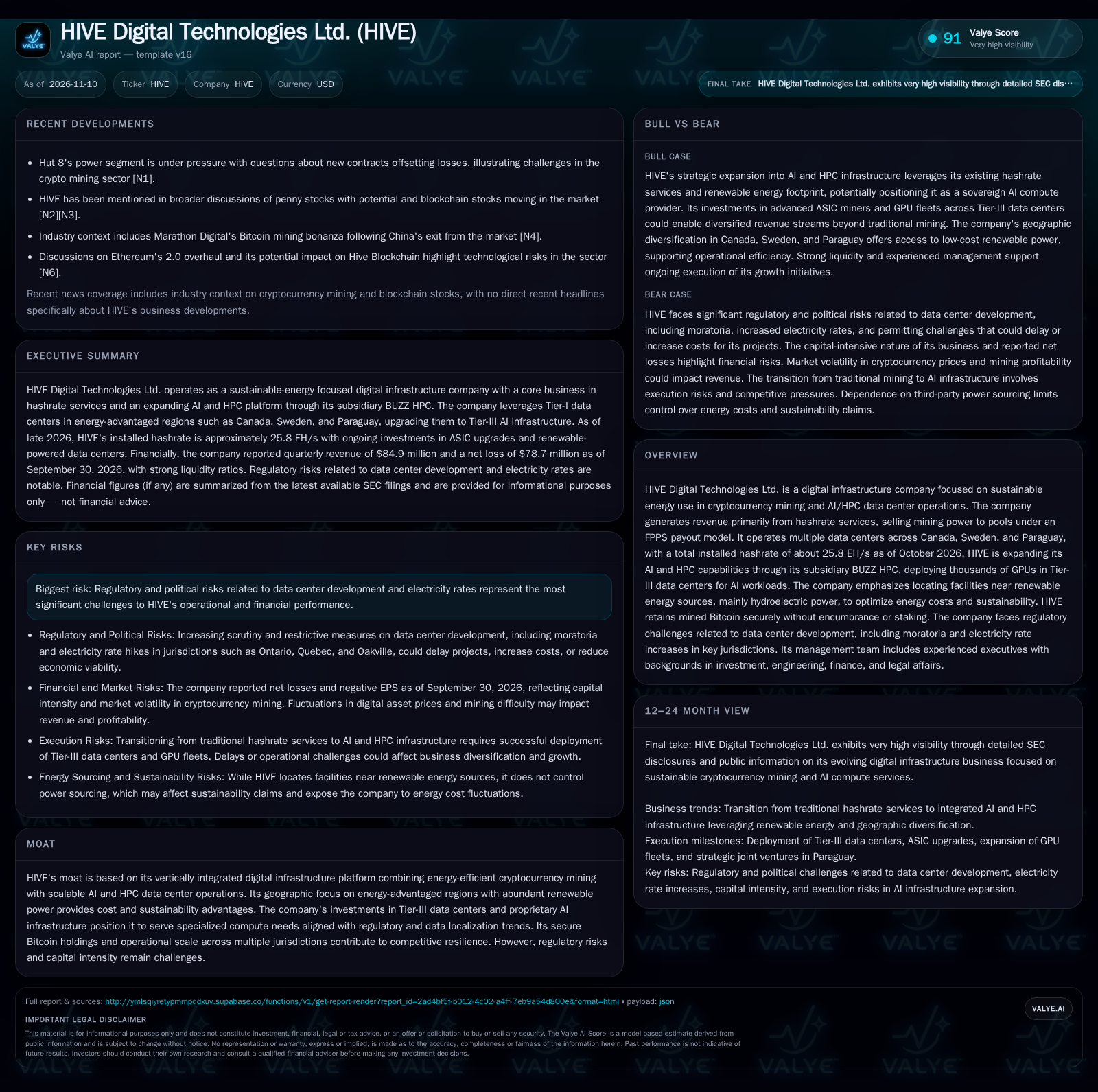
HIVE Digital Technologies posted quarterly revenue of $84.9 million and a net loss of $78.7 million as of September 30, 2026, highlighting ongoing financial headwinds amid its business transformation [S2]. Its installed hashrate stood at 25.8 EH/s in October 2026, with recent fleet upgrades improving efficiency to 15.8 J/TH [S2]. The company’s expansion into AI and HPC infrastructure is evidenced by the deployment of 6,000 GPUs across Tier-III data centers in Montreal and Stockholm, as well as the launch of an AI cloud platform in Paraguay via joint venture [S2]. The company reported cash and liquidity metrics for the period; these figures do not by themselves establish operating runway, investment capacity, financial flexibility, or financing capacity. [S2] Regulatory and energy market risks, particularly in Ontario, Quebec, and Oakville, threaten cost structures and expansion timelines [S2].
Evolving Revenue Streams and Capital Demands in Digital Infrastructure
HIVE’s legacy business model revolves around selling hashrate to mining pools under an FPPS payout structure, earning digital currencies recorded at fair value [S2]. This exposes revenue to Bitcoin price volatility, mining difficulty swings, and network-level events. The economics of mining are increasingly dictated by access to low-cost, stable energy and hardware efficiency—areas where HIVE’s hydro-powered facilities and new ASIC fleets may confer advantages.
The company’s pivot to AI/HPC infrastructure introduces a fundamentally different revenue mix. AI compute services, especially those leveraging high-density NVIDIA GPUs in Tier-III data centers, could command higher and more stable pricing via contracts with enterprise AI customers, cloud-native startups, or sovereign compute buyers. However, the capital expenditure required for GPU procurement, advanced cooling systems, and high-availability data center upgrades is significant. The economics hinge on achieving high utilization rates and successfully selling capacity in a market where hyperscalers and specialized AI infrastructure providers are formidable competitors.
Operating leverage could improve if HIVE fills AI capacity and amortizes fixed costs over growing volumes, but the risk of underutilization or slow ramp in customer demand would leave the company exposed to heavy depreciation and overhead.
Positioning for AI Compute: Advantages, Rivals, and Substitution Risks
HIVE’s competitive edge derives from its presence in energy-advantaged regions, with direct access to hydroelectric power in Canada, Sweden, and Paraguay [S2]. This supports lower energy costs—a critical input for both mining and AI workloads. Its scale, with multiple owned and leased data centers, and its investments in Tier-III infrastructure, position it to serve enterprise-grade compute needs.
However, HIVE faces competition from well-capitalized Bitcoin miners expanding into AI, established colocation and cloud providers, and hyperscale data center operators with deeper customer relationships and technical expertise. Barriers to entry in AI infrastructure are rising, with supply chain constraints for top-tier GPUs and increasing regulatory scrutiny over power consumption and data localization.
Substitution risks also loom: advances in ASIC efficiency could erode the economics of Bitcoin mining, while the rapid evolution of AI model architectures may shift demand dynamics for certain types of compute. HIVE’s ability to differentiate on sustainability, reliability, and regional diversification may help, but it must demonstrate that its infrastructure and go-to-market model can compete for high-value AI workloads.
Unlocking AI Growth: From Mining Volatility to Compute Sovereignty
If HIVE can successfully ramp its AI and HPC business, leveraging its 6,000+ GPU fleet and Tier-III data centers, the company could diversify revenue away from Bitcoin mining’s inherent volatility. Securing anchor customers—such as AI startups, research institutions, or government agencies seeking sovereign compute—would validate the business model and drive higher, more predictable margins.
Evidence of upside would include rapid growth in AI/HPC service revenue, high utilization rates of GPU clusters, and multi-year contracts with blue-chip clients. Additional confirmation would come from further expansion of renewable-powered capacity, successful integration of new GPU technologies, and the ability to scale in Paraguay and other low-cost geographies.
This scenario depends on HIVE’s ability to navigate regulatory hurdles, avoid power cost shocks, and maintain a technological edge in both hardware and operational efficiency. Growth in global AI demand and tightening power constraints for data centers could amplify the value of HIVE’s renewable-powered infrastructure.
Balancing Mining Volatility with AI Ambitions Amid Regulatory Friction
The most plausible near-term outcome is a mixed model where HIVE’s core revenue continues to be driven by Bitcoin mining, with incremental but initially limited contributions from its nascent AI/HPC segment. The company’s upgraded ASIC fleet and energy-advantaged locations help mitigate some mining cost pressures, but persistent net losses and capital intensity constrain its pace of expansion.
AI infrastructure investments may yield modest revenue as HIVE builds operational expertise, customer relationships, and track record. Regulatory and permitting challenges in key jurisdictions could delay or limit new data center projects, while energy price volatility remains a structural risk.
Confirmation of this scenario would be continued mining-driven revenue with gradual AI/HPC growth, ongoing net losses or thin margins, and periodic capital raises or joint ventures to fund expansion. Material acceleration in AI revenue, customer wins, or regulatory relief could shift the trajectory.
Regulatory, Energy, and Execution Risks Derail the Transition
In a downside scenario, HIVE faces compounding headwinds: regulatory moratoria or electricity rate hikes in Ontario, Quebec, or Oakville could stall data center expansion or materially inflate costs, undermining both mining and AI economics. Prolonged Bitcoin price weakness or rising mining difficulty would compress margins and accelerate cash burn.
The AI/HPC pivot could falter if GPU supply constraints, slow customer adoption, or execution missteps prevent HIVE from achieving meaningful utilization and revenue. Under this scenario, persistent net losses could force asset sales, restructuring, or dilutive capital raises, eroding shareholder value.
Evidence supporting this scenario would include regulatory project delays, declining hashrate or fleet efficiency, underutilized GPU infrastructure, and worsening financial metrics. Inability to secure significant AI/HPC contracts or recurring revenue would further confirm a challenged outlook.
Milestones That Will Test HIVE’s AI Transition and Digital Infrastructure Ambitions
Revenue mix evolution between hashrate services and AI/HPC compute, and the pace of growth in non-mining income streams.
Utilization rates and contracted capacity for deployed GPU clusters—if disclosed, would indicate traction in AI/HPC offerings.
Progress on regulatory approvals, permitting, and electricity rate stability in Canada, Sweden, and Paraguay.
Updates on additional renewable energy capacity, especially in Paraguay, and the cost structure of new power agreements.
Magnitude and timing of capital expenditures for data center upgrades, GPU procurement, and new campus development.
Customer announcements, multi-year service contracts, or strategic partnerships in the AI/HPC segment.
Changes in fleet efficiency metrics—J/TH for mining and PUE (if disclosed) for data centers—to assess operational competitiveness.
Disclaimer: This is research-only, informational analysis and not investment advice. It may include AI-generated interpretation and general industry context. Always verify important details using primary sources.

Comments