
Consolidated Water: License Uncertainty and Receivables Pressure Test Multi-Segment Model
Consolidated Water’s diversified water solutions platform faces a critical inflection as regulatory rate resets and chronic government receivable delays offset the stability of its multi-segment revenue base. The outcome of ongoing Cayman Islands license negotiations and Bahamian collections will determine whether scale and service breadth can deliver sustainable returns.
Consolidated Water’s near-term earnings profile is shaped by two material uncertainties: a regulatory-driven margin reset in its Cayman retail business and persistent collection delays from its largest Bahamian utility customer. While the company’s breadth across water production, services, and manufacturing offers revenue diversification, the stability of cash flows now depends on government counterparties and execution on fixed-price projects. The balance of regulatory outcomes, receivable management, and project discipline will decide whether the company can convert its operational scale into sustained value creation.
Consolidated Water Co. Ltd. occupies a unique position among small-cap water utilities, blending regulated retail franchises, government bulk supply, project-based services, and manufacturing. The company’s geographic and operational diversity has historically insulated it from single-market shocks. However, the simultaneous emergence of a regulatory-driven margin reset in its core Cayman Islands retail business and chronic receivables pressure from The Bahamas exposes the limits of diversification when counterparties are governments and project economics hinge on contract precision. The next phase will reveal whether Consolidated Water’s platform can absorb these shocks and still deliver compounding returns.
License Reset and Receivables: The Two Headwinds Shaping 2026
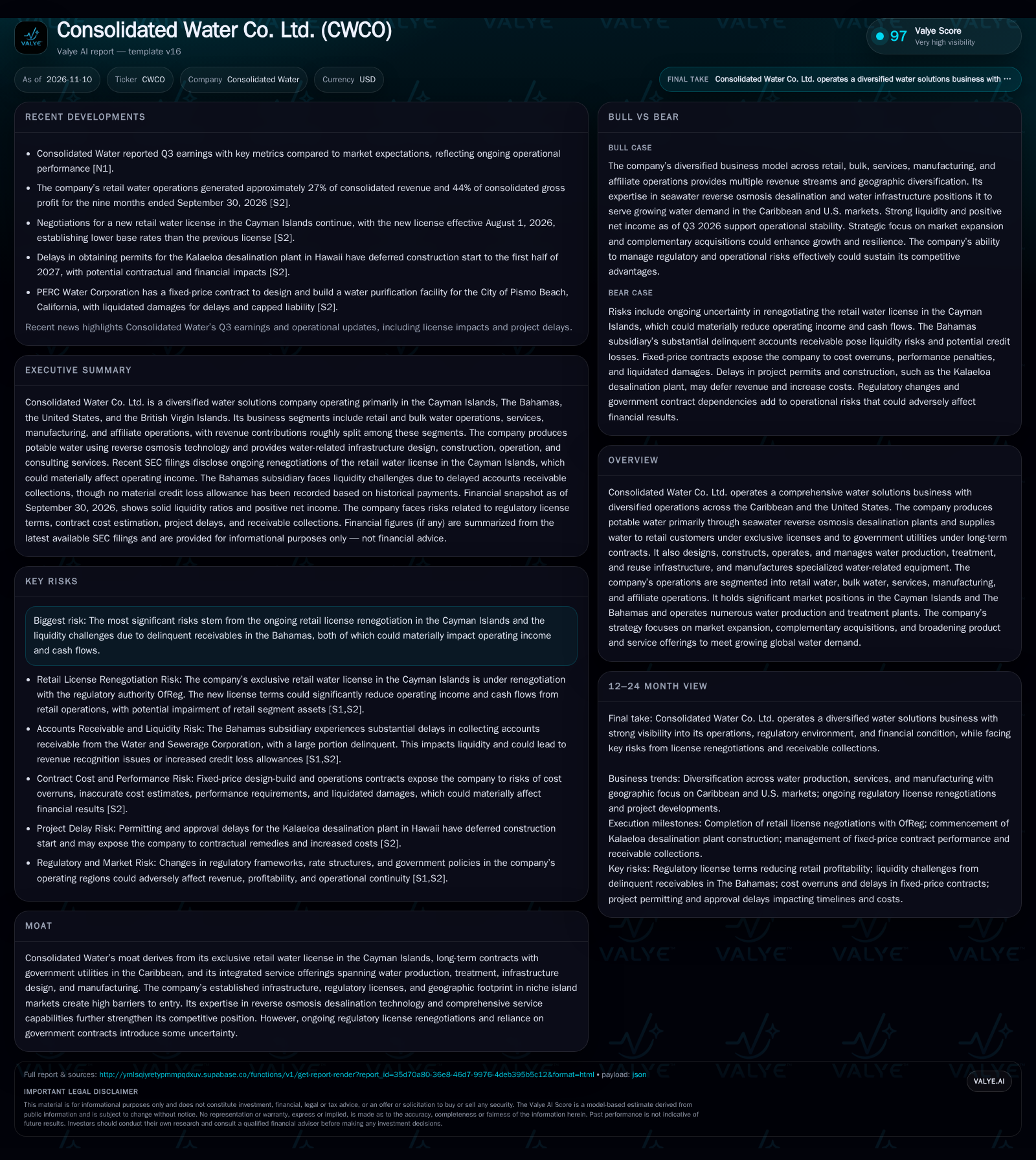
Two developments now define Consolidated Water’s near-term outlook. First, as of August 1, 2026, the company’s Cayman Water subsidiary operates under a new retail license with lower base rates, directly reducing both revenue and operating income from its historically most profitable segment [S2]. This segment accounted for 27% of consolidated revenue and 44% of gross profit for the first nine months of 2026, highlighting its outsized impact on group margins [S2]. Second, the company’s Bahamas subsidiary continues to face substantial delays in collecting receivables from the government-owned Water and Sewerage Corporation. These delinquent balances remain a significant portion of total receivables, constraining liquidity and raising the risk of future credit losses despite the company’s current decision not to book a material allowance [S1] [S2]. Together, these factors represent a structural shift in the risk profile: retail water’s former margin stability is now in question, and cash flow predictability is increasingly hostage to government payment discipline.
How the Segment Mix and Contract Structure Drive Profitability
Consolidated Water’s revenue engine is built on a blend of regulated retail sales, bulk water contracts, service projects, and manufacturing. Retail and bulk water segments are capital-intensive but traditionally offer recurring cash flows—especially where exclusive licenses or long-term government contracts exist. The retail segment, with its exclusive Cayman license, has historically delivered high gross margins due to rate regulation and limited competition, but the new license’s lower base rates compress this advantage [S2]. Bulk water operations, while less lucrative per unit, provide volume stability but are exposed to government counterparty risk, as seen in The Bahamas.
Services operations—now the largest revenue contributor—drive growth through design, construction, and operation of water infrastructure, especially in the U.S. and Caribbean. These are typically structured as fixed-price contracts, shifting cost overrun and performance risk onto the company. Margins can be attractive if cost estimation and execution are disciplined, but miss-pricing or project delays (such as those affecting the Kalaeloa plant in Hawaii) can quickly erode profitability [S2]. Manufacturing provides a smaller but differentiated revenue stream, leveraging in-house expertise for external customers.
Operating leverage is mixed: retail and bulk segments benefit from high fixed asset utilization, while services and manufacturing carry more variable cost structures. The company reported cash and liquidity metrics for the period; these figures do not by themselves establish operating runway, investment capacity, financial flexibility, or financing capacity. [S2] However, the quality of this liquidity is contingent on receivables conversion and contract discipline.
Barriers to Entry and the Fragility of Regulatory Moats
Consolidated Water’s competitive strength derives from exclusive or long-standing government licenses and contracts, especially in island markets with high infrastructure barriers and few substitutes for desalinated water. Its expertise in reverse osmosis technology and ability to deliver turnkey infrastructure projects further differentiate it among regional water utilities and engineering firms.
However, regulatory and political risks dilute this advantage. The Cayman retail license, once a near-impenetrable moat, is now subject to unilateral rate resets, demonstrating the fragility of such regulatory protections. In The Bahamas, dependence on a single government utility customer exposes the company to sovereign risk and payment delays, regardless of technical or operational performance.
The U.S. project services segment faces more competition from engineering, procurement, and construction (EPC) firms, but the company’s track record in water reuse and desalination provides some differentiation. Its multi-segment model offers some resilience, but the concentration of profit in government-linked contracts and licenses remains a double-edged sword.
What Would It Take for Diversification to Outweigh Regulatory Drags?
The most favorable outcome would see Consolidated Water’s services and manufacturing segments scaling rapidly enough to offset margin compression in Cayman retail and cash flow delays in The Bahamas. This could occur if U.S. project execution accelerates—especially if the Kalaeloa plant in Hawaii overcomes permitting delays and delivers strong returns—or if additional infrastructure contracts are won in high-demand regions.
Receivables risk in The Bahamas may recede if sovereign payment discipline improves, especially following Moody’s upgrade of the country’s credit rating in April 2026 [S2]. Timely payments would unlock trapped working capital and reduce the need for credit loss allowances.
Evidence confirming this scenario would include: (1) sustained double-digit revenue growth in services and manufacturing, (2) visible margin recovery from project execution, (3) a meaningful reduction in Bahamian receivable days outstanding, and (4) successful completion or expansion of major U.S. projects. Conversely, continued cash drag from receivables or cost overruns on new projects would falsify the upside case.
Multi-Segment Offsets: Can Growth Balance Regulatory and Collection Risks?
The most plausible trajectory is one where regulatory and collection headwinds are only partially offset by growth in services and manufacturing. The new Cayman retail license likely locks in lower margins for the foreseeable future, reducing the segment’s contribution to consolidated profit. Receivables in The Bahamas may remain chronically slow but not catastrophic, especially if the historical pattern of eventual payment holds and no material credit losses are booked [S2].
Services and manufacturing are positioned to grow, but their ability to fully offset lost retail profitability depends on disciplined contract execution and the avoidance of major cost overruns or project delays. The U.S. market remains a growth lever, but permitting and regulatory complexity could keep expansion lumpy.
Support for this scenario would be stable (but not accelerating) consolidated revenue, flattish or modestly declining margins, and ongoing but manageable working capital pressure. Falsification would require either a sharp deterioration in Bahamian collections or significant losses on fixed-price contracts.
What If Government Counterparty Risks Compound?
The bear case materializes if multiple government-linked risks break against the company simultaneously. If The Bahamas’ Water and Sewerage Corporation further extends payment delays or defaults, Consolidated Water could be forced to recognize large credit losses, directly hitting cash flow and potentially impairing the value of its receivables [S1] [S2]. If the new Cayman retail license proves even less favorable than anticipated—via further rate cuts, onerous regulatory requirements, or asset impairment—retail segment profits could be structurally impaired.
On the project side, significant cost overruns or delays (for example, in Kalaeloa or Pismo Beach) could result in liquidated damages, lost profits, or reputational harm. In this scenario, balance-sheet liquidity could erode rapidly, especially if expansion or acquisition opportunities are pursued without a corresponding improvement in cash conversion.
Evidence of downside would include a spike in credit loss provisions, persistent or worsening negative operating cash flow, contract losses, or a rapid decline in cash and equivalents despite reported profits.
Benchmarks for Testing Consolidated Water’s Resilience
Progress in collecting overdue receivables from the Water and Sewerage Corporation of The Bahamas—measured by days sales outstanding and any disclosed settlements—would help test the thesis.
Net margin trends in the Cayman retail segment under the new license regime, especially as a percentage of consolidated profit, will indicate the true impact of regulatory resets.
Growth rate and margin performance in services and manufacturing, especially in the U.S. market, should be monitored for evidence of successful diversification.
Timelines and cost performance for major U.S. projects (e.g., Kalaeloa, Pismo Beach), including any disclosures of liquidated damages or material delays, would provide an early warning on contract risk.
Updates on the renewal, extension, or renegotiation of other government-linked contracts or licenses, particularly in the Caribbean, could foreshadow similar regulatory risks elsewhere.
Disclosure of new multi-year contracts, acquisitions, or joint ventures in the U.S. or new geographies would clarify the company’s ability to execute on its expansion strategy.
Disclaimer: This is research-only, informational analysis and not investment advice. It may include AI-generated interpretation and general industry context. Always verify important details using primary sources.

Comments