
AI Integration, Seasonality, and Competitive Pressure: The Strategic Stakes for H&R Block
H&R Block’s blend of AI-powered tax solutions and traditional in-person services underpins its brand strength, but pronounced seasonality, rising expenses, and shifting digital competition pose structural questions for margins and growth.
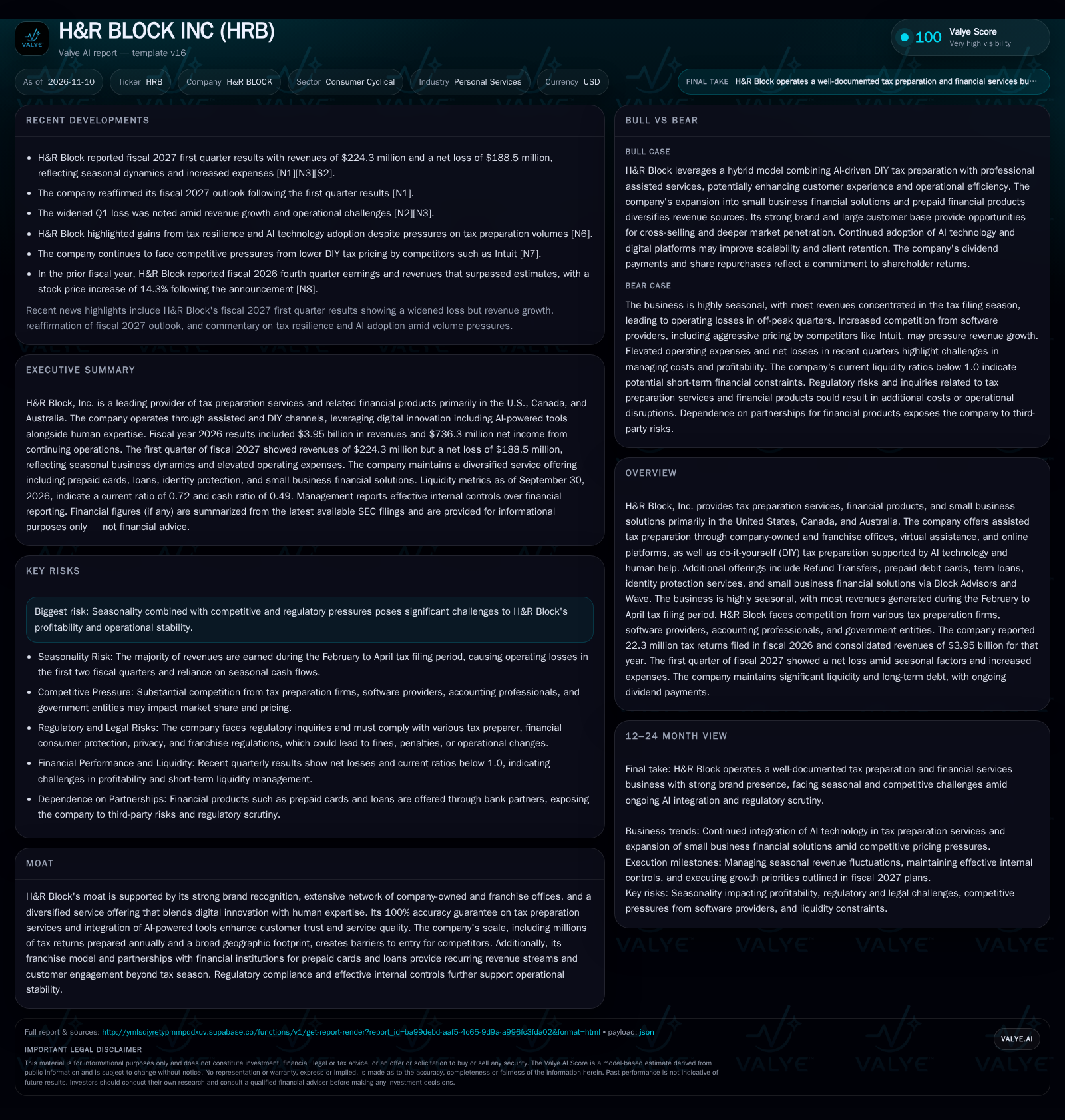
H&R Block’s fiscal 2027 kicked off with a net loss of $188.5 million on $224.3 million in revenue, reflecting sharp seasonality and heightened expenses. Despite reaffirming its annual outlook and highlighting AI-driven innovations, the company’s current ratio of 0.72 and cash ratio of 0.49 underscore short-term liquidity limitations. The path forward depends on whether AI and diversified offerings can offset competitive and regulatory headwinds while stabilizing off-season performance. [S2] [N1] [N3] [N6]
H&R Block enters fiscal 2027 navigating a complex landscape: while its brand and hybrid tax preparation model remain formidable, the company’s first-quarter results underscore the ongoing impact of extreme seasonality and competitive disruption. Despite growing adoption of AI-driven offerings and reaffirmed full-year guidance, the persistence of off-season losses, heightened operating costs, and liquidity ratios below 1.0 signal that digital transformation and cost discipline are not optional—they are existential. The company’s ability to leverage its scale and technology investments while defending margins and customer loyalty will determine whether it can sustainably outpace rivals in an evolving tax services market.
Seasonal Losses and Digital Initiatives Shape H&R Block’s Immediate Outlook
H&R Block reported a net loss of $188.5 million on $224.3 million in revenue for Q1 fiscal 2027, a period historically marked by operating losses due to the concentration of tax-filing activity in later quarters. Operating expenses for the quarter reached $456.2 million, reflecting both cost of revenues and SG&A outlays. As of September 30, 2026, the company’s liquidity profile included $390.5 million in cash and cash equivalents, a current ratio of 0.72, and a cash ratio of 0.49, alongside $1.49 billion in long-term debt. Management reaffirmed its full-year outlook despite these pressures, signaling confidence in the resilience of its core business and the potential for technology-driven efficiency gains. [S2] [N1] [N3] [N6]
The continued rollout of AI-powered features, such as generative AI for DIY tax support and the hybrid availability of human expertise, was highlighted as a lever for customer engagement and operational scalability. However, both the widened Q1 loss and below-par liquidity ratios place a premium on execution in cost management and revenue diversification in the coming quarters. [S2] [N6]
How H&R Block Earns: Seasonality, Revenue Mix, and the Economics of Scale
H&R Block generates revenue through assisted and DIY tax preparation, complemented by financial products (prepaid cards, loans, banking apps), and small business services. The core business is profoundly seasonal, with the vast majority of revenue and profit realized in the February–April tax season, while the first and second fiscal quarters routinely produce losses. This pattern creates sharp swings in cash flow and working capital requirements, amplifying the importance of efficient capital allocation and cost control during off-peak periods. [S1] [S2]
The company’s franchise model (with franchisees paying ~30% of gross tax-preparation revenues as royalties) provides a recurring, high-margin revenue stream, while company-owned operations must absorb the full cost base. AI-driven digital tools and hybrid offerings have the potential to increase operating leverage by automating routine interactions, reducing marginal labor costs, and enabling cross-selling of financial products to a captive client base. However, the fixed costs of technology investments and persistent SG&A mean that margin expansion is not automatic; it hinges on growing volume or shifting mix toward higher-margin digital and financial services.
Capital needs remain material due to seasonal cash outflows, dividend commitments, and the need to maintain robust technology infrastructure. [S2]
Defending Market Share in a Fragmenting Tax Preparation Ecosystem
H&R Block’s competitive landscape is increasingly shaped by digital-first incumbents, such as software providers, as well as traditional accounting firms, independent preparers, and, potentially, direct government tax-filing initiatives. The company’s brand recognition, broad distribution (company-owned and franchise offices), and the 100% accuracy guarantee remain durable differentiators—especially for customers with complex returns or a preference for human interaction. [S1]
However, the continued shift of simple returns to DIY platforms (where price competition is intense) threatens both volume and pricing power. The adoption of AI-powered tools is a necessary response, but rivals are also investing heavily in automation, user experience, and customer acquisition. The addition of financial products and small business services can deepen customer relationships and provide cross-selling opportunities, yet these segments are also highly contested and subject to regulatory and partnership risks.
Ultimately, H&R Block’s ability to retain and grow its customer base in the face of digital commoditization and potential policy-driven disintermediation (e.g., government free-file programs) will be a critical determinant of its long-term competitive position.
Operational Leverage from Digital Adoption and Product Diversification Drives Margin Expansion
In a favorable scenario, H&R Block’s aggressive investment in AI and digital hybrid services successfully migrates a larger portion of its customer base to lower-cost, higher-margin channels without sacrificing retention or customer satisfaction. Assisted and DIY platforms, enhanced by AI Tax Assist and seamless human backup, enable the company to serve more clients with less incremental labor, driving operating leverage. Cross-selling of financial products (e.g., Emerald cards, Spruce banking, Refund Advance loans) and small business solutions increases average revenue per client and reduces seasonality by extending engagement beyond tax season.
Confirmation of this scenario would come from sustained growth in digital return volumes, rising attach rates for financial products, and improvement in off-season revenue and margin metrics. A narrowing of off-season losses and stabilization (or growth) in total returns prepared, particularly in the face of competitive pricing, would further validate the digital transformation thesis.
Falsification would be signaled by stalled digital adoption, flat or declining cross-sell uptake, or persistent margin compression despite technology investments.
Seasonal Profitability Persists Amid Digital Transition and Margin Pressure
The most plausible outcome is that H&R Block continues to deliver strong profitability during peak tax season, with off-season quarters remaining loss-making. AI and digital adoption incrementally improve operational efficiency, but competitive pricing and customer migration to low-cost DIY solutions limit margin expansion. The franchise model continues to provide a stable royalty stream, but company-owned operations face ongoing expense pressures.
Confirmation would involve the company meeting or modestly exceeding its reaffirmed fiscal 2027 outlook, maintaining dividend payments, and reporting incremental gains in digital engagement and financial product penetration.
Falsification would occur if off-season losses deepen, digital initiatives fail to offset cost inflation, or there is a marked decline in total tax returns prepared.
Cost Inflation, Volume Attrition, and Regulatory Shocks Erode Potential Financial Flexibility
A negative scenario could unfold if competitive pricing from software providers and government initiatives accelerates the migration of simple returns away from H&R Block, resulting in volume attrition and revenue contraction. If AI and digital investments fail to yield sufficient operating leverage, or if expense control lags, margin erosion could intensify.
Additional downside risks include adverse regulatory developments (such as restrictions on financial product partnerships or changes in tax policy) and deterioration in partner relationships. Confirmation of this scenario would come from sequential declines in return volumes, widening off-season losses, or any evidence of liquidity shortfalls (e.g., delayed payments, increased borrowing, or dividend cuts).
Falsification would require a stabilization of volume trends, successful cost containment, and maintenance of dividend payments without further deterioration in liquidity metrics.
Milestones That Will Test H&R Block’s Digital Transformation and Margin Thesis
Sustained growth in digital DIY tax return volumes and attach rates for AI-powered services—reported quarterly, if disclosed—would indicate successful technology adoption.
Quarterly trends in off-season revenue and margin performance: narrowing losses outside of tax season would suggest progress in smoothing the business cycle.
Company commentary and data on cross-selling rates for financial products (Emerald cards, Spruce banking, Refund Advance loans)—a useful metric would be penetration rates among tax clients.
Changes in customer retention or migration rates between assisted and DIY channels—if disclosed, higher retention in digital channels would support the hybrid model thesis.
Disclosure of regulatory or policy changes affecting tax preparation, financial products, or franchise relationships—any adverse developments could materially impact economics.
Franchise royalty trends and mix of company-owned vs. franchise office performance, particularly during peak season, would help assess the resilience of recurring revenue streams.
Disclaimer: This is research-only, informational analysis and not investment advice. It may include AI-generated interpretation and general industry context. Always verify important details using primary sources.

Comments