
Stellus Capital: Investment Income Ambitions Meet Net Losses
Stellus Capital Investment Corp’s latest quarter underscores the tension between its investment-driven business model and the realities of net losses and limited cash, spotlighting the importance of credit facility management, portfolio performance, and the structural risks of externally managed BDCs.
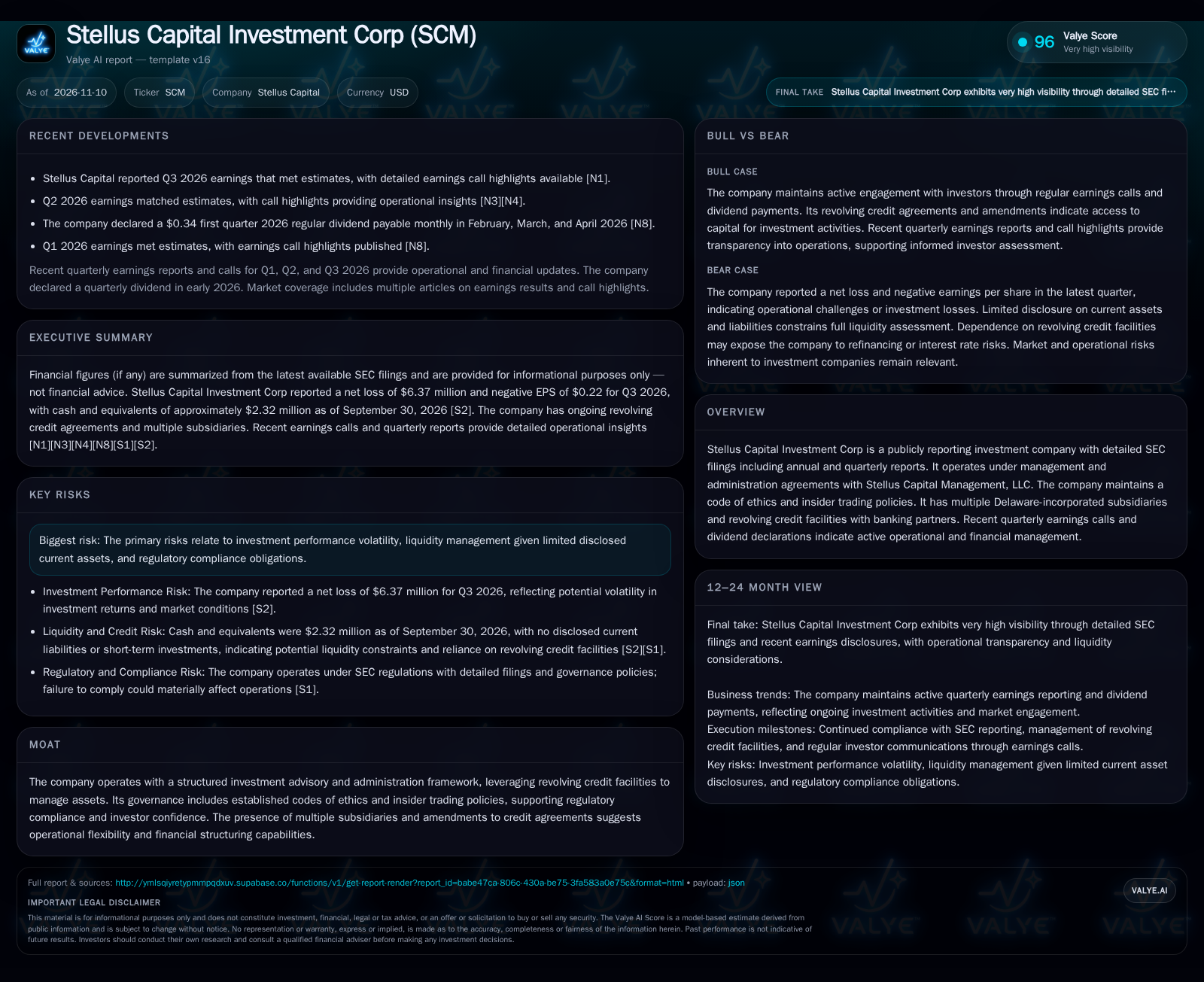
Stellus Capital reported a net loss of $6.37 million and negative EPS for Q3 2026, with just $2.32 million in cash at quarter-end. The company’s reliance on revolving credit facilities, lack of current asset disclosures, and externally managed structure raise questions about its ability to sustain distributions and navigate adverse credit cycles. The path forward hinges on investment returns, funding access, and portfolio quality transparency. [S2] [S1]
Stellus Capital Investment Corp occupies a familiar but high-stakes niche as an externally managed business development company (BDC), relying on leveraged investment strategies to generate distributable income for shareholders. Yet its Q3 2026 net loss of $6.37 million and scant $2.32 million in cash highlight the inherent fragility of the model when portfolio returns falter or liquidity tightens. With limited transparency into current asset and liability balances, and ongoing dependence on revolving credit, Stellus’s ability to sustain shareholder distributions and portfolio growth depends on both macro credit conditions and the discipline of its external manager. The next chapters for Stellus will likely be written on the axes of investment performance, funding access, and disclosure quality.
The company reported cash and liquidity metrics for the period; these figures do not by themselves establish operating runway, investment capacity, financial flexibility, or financ
The most consequential recent development is Stellus Capital’s Q3 2026 net loss of $6.37 million, translating to an EPS of -$0.22. This negative result is paired with a reported cash and equivalents balance of $2.32 million as of September 30, 2026—an amount that appears modest for an investment company of Stellus’s scale and structure [S2]. The lack of accompanying disclosure on current assets and liabilities further muddies the picture, making it difficult to assess short-term liquidity or working capital headroom. Stellus’s ongoing reliance on revolving credit agreements, including with Zions Bancorporation, remains a key pillar of its funding model [S1]. These facts set the stage for a company whose ability to originate, hold, and manage a leveraged portfolio is increasingly dependent on portfolio returns and uninterrupted access to credit.
How Stellus Capital’s Funding and Fee Structure Shape Its Economics
As a typical externally managed BDC, Stellus Capital’s core economic engine is the spread between investment income (primarily debt and equity investments in private middle-market companies) and its own funding costs. The company’s income is theoretically generated from interest, dividends, and potential capital gains on portfolio holdings, while expenses include management/advisory fees, administrative costs, and interest on borrowings. Because Stellus is externally managed, a significant portion of gross investment income is paid out to Stellus Capital Management, LLC under advisory and administration agreements [S1]. This structure can constrain operating leverage, as management fees are often calculated as a percentage of gross assets rather than net income.
The capital structure is leveraged through revolving credit facilities, which are regularly amended to maintain flexibility and accommodate portfolio changes. The absence of short-term investment or current liability disclosures in the latest filings complicates the assessment of immediate funding needs or potential liquidity mismatches [S2]. In the current environment, Stellus’s economics are acutely sensitive to both the performance of its investment portfolio and the cost and availability of debt capital—a dynamic that can amplify both upside and downside outcomes.
External Management, Portfolio Focus, and the BDC Peer Landscape
Within the U.S. BDC universe, Stellus Capital competes with a wide array of externally and internally managed peers targeting middle-market lending and private credit. The external management model can offer operational efficiency and access to experienced investment professionals, but it often creates potential misalignment between shareholder and manager interests, especially in the face of fee drag during periods of underperformance. Stellus’s competitive positioning may hinge on its ability to source high-quality, yield-generating assets while maintaining prudent leverage and risk controls.
Substitution risk is present from other private credit vehicles—both public and private—as well as direct lending arms of banks, insurance companies, and asset managers. In a benign credit environment, BDCs can capitalize on attractive yields and stable distributions; however, when credit conditions tighten or defaults rise, externally managed BDCs may face greater scrutiny regarding fee structures, risk appetite, and portfolio transparency. Stellus’s operational transparency through SEC filings is a relative strength, but persistent net losses and opaque liquidity metrics may weaken its standing among income-oriented investors.
If Portfolio Returns Rebound and Credit Remains Accessible, Distribution Growth Could Resume
The most favorable scenario for Stellus Capital is one in which portfolio performance improves—either through higher interest income, lower credit losses, or successful exits from equity stakes—leading to a return to profitability and excess cash generation. Confirmation would come from a reversal of recent net losses, consecutive quarters of positive net investment income, and growing cash balances relative to liabilities.
Additional evidence would include improved disclosure around current assets and liabilities, indicating stable or expanding liquidity headroom, as well as dividend increases or special distributions. If Stellus can demonstrate lower non-accrual rates in its loan book and maintain or expand its portfolio yield relative to peers, it would bolster the case for sustainable income generation and potential premium valuation.
Sustained Volatility and Thin Liquidity Keep Stellus in a Defensive Posture
The most plausible near-term path is one in which Stellus continues to operate in a challenging environment marked by volatile investment returns and constrained liquidity. The company may achieve periods of net investment income but remain vulnerable to episodic losses due to credit events or mark-to-market volatility. Reliance on revolving credit persists, but the absence of robust current asset and liability detail means liquidity management remains opaque and potentially tenuous.
Investors would likely remain focused on the company’s ability to avoid covenant breaches and manage refinancing risk, while also watching for any improvement in portfolio transparency or risk-adjusted yields. Falsification would require sustained positive earnings surprises, a step-change in liquidity disclosure, or a significant improvement in portfolio credit quality.
Portfolio Stress and Credit Tightening Could Trigger Distribution Cuts or Dilutive Actions
In a more adverse scenario, further deterioration in portfolio performance—such as rising non-accruals, realized losses, or asset markdowns—could deepen net losses and further erode Stellus’s cash position. Should credit markets tighten or lenders become more restrictive, the company may face higher borrowing costs, reduced facility sizes, or forced asset sales to meet obligations. These developments could lead to dividend reductions, suspension of distributions, or even dilutive equity raises to restore liquidity.
Confirmation of this downside would include sequential increases in net losses, declining cash balances, adverse amendments to credit agreements (such as higher rates or reduced capacity), and cuts or suspensions of dividends. A lack of improvement in disclosure around liquidity would further heighten risk perception. Falsification would require stabilization or improvement in portfolio metrics and clear evidence of continued access to attractively priced funding.
What Will Determine Stellus Capital’s Resilience and Shareholder Returns
Quarterly net investment income and net realized/unrealized gains or losses, as reported in SEC filings, to gauge core portfolio performance.
Cash and equivalents relative to total commitments and debt outstanding—improved disclosure or upward trends would help test liquidity resilience.
Portfolio non-accrual rates and credit quality metrics—if disclosed—are critical for assessing underlying asset risk.
Fee structure changes or renegotiations with Stellus Capital Management, LLC, which could impact operating leverage and alignment of interests.
Improved transparency on current assets and liabilities, which would allow for a more accurate assessment of short-term liquidity and runway.
Market conditions in the broader private credit and middle-market lending space, as these influence both portfolio yield opportunities and credit risk.
Disclaimer: This is research-only, informational analysis and not investment advice. It may include AI-generated interpretation and general industry context. Always verify important details using primary sources.

Comments