
Ginkgo Bioworks: Liquidity Strength Meets Persistent Losses as Synthetic Biology Execution Remains the Deciding Factor
Despite a reported liquidity position and mature governance structures, Ginkgo Bioworks continues to operate at a net loss amid market volatility. The company’s ability to convert its synthetic biology platform into durable, profitable growth remains the central strategic question.
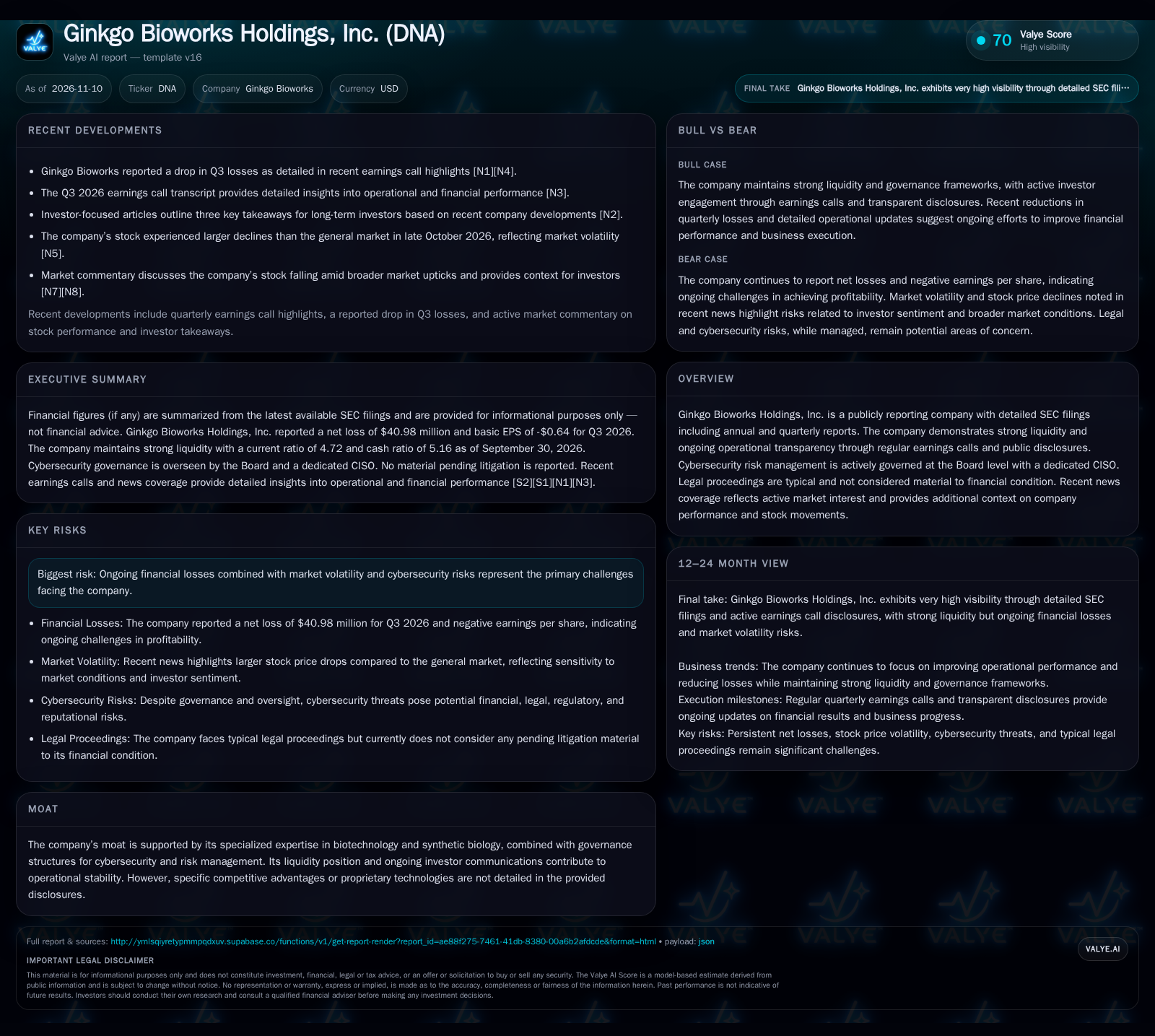
Ginkgo Bioworks reported a Q3 2026 net loss of $40.98 million, but maintains reported liquidity position with $84.5 million in cash and a current ratio of 4.72 [S2]. While governance and cybersecurity oversight are mature, the company’s ongoing losses and sensitivity to market sentiment highlight the unresolved challenge of achieving sustainable profitability in a competitive and evolving synthetic biology landscape.
Ginkgo Bioworks continues to demonstrate high operational transparency, mature governance, and a reported liquidity position, but its path to profitability remains uncertain. The company’s Q3 2026 results show persistent net losses despite a substantial reported cash balance, while its stock has been more volatile than the market at large. The next phase will test whether its platform economics can overcome persistent losses and market skepticism.
Latest Results Highlight Liquidity Strength but Ongoing Losses
[S2] This financial buffer is notable for a company still in a loss-making phase, evidenced by a Q3 2026 net loss of $40.98 million and basic earnings per share of -$0.64 [S2]. The company’s cybersecurity oversight is robust, with Board-level governance and a Chief Information Security Officer with public and private sector experience [S1]. Meanwhile, Ginkgo’s stock has experienced sharper declines than the broader market during recent volatility, suggesting heightened sensitivity to investor sentiment and macro conditions [N5] [N8]. No material litigation is currently reported [S1]. These facts set the stage for a company with clear financial runway but unresolved questions about sustainable business economics and market acceptance.
Synthetic Biology Platform Economics: Potential and Pitfalls
Ginkgo Bioworks aspires to operate a platform business in synthetic biology, aiming to design custom organisms for industrial, pharmaceutical, and agricultural customers. In theory, this model promises high-margin, scalable economics: once core bioengineering capabilities are built, incremental customer projects could generate attractive contribution margins with limited variable cost. However, in practice, synthetic biology remains capital-intensive, with high upfront R&D, significant infrastructure investments (such as foundries and wet labs), and long customer development cycles. Achieving scale is constrained by the need for bespoke engineering and regulatory complexity in end-markets.
Ginkgo’s path to profitability likely depends on shifting its revenue mix from one-off research projects to higher-margin, recurring revenue streams—such as licensing, royalties, or platform-access fees—while leveraging fixed-cost infrastructure. If successful, operating leverage could improve as the customer base scales, but persistent losses suggest that revenue growth and margin expansion are not yet matching cost structure.
The capital intensity inherent in synthetic biology platforms means that Ginkgo must carefully manage the trade-off between investing in cutting-edge R&D and achieving scalable production capabilities. If the company can develop modular, reusable biological components or standardized engineering processes, it could reduce per-project costs and accelerate time-to-market, enhancing contribution margins. Conversely, if bespoke customization remains the norm, the platform may struggle to achieve the economies of scale typical of software or digital platforms. Additionally, regulatory hurdles and validation requirements in pharmaceutical and agricultural markets could prolong sales cycles and increase customer acquisition costs, complicating the path to profitability despite promising technology.
Platform Differentiation Faces Intense Sector Headwinds
Ginkgo’s competitive position is predicated on its specialized expertise in synthetic biology and the breadth of its platform capabilities. Its moat, if established, would rest on proprietary biological design tools, process know-how, and the scale of its foundry infrastructure. However, the synthetic biology space is crowded, with numerous startups and established biotech firms pursuing similar opportunities in organism engineering, bio-manufacturing, and platform-based R&D services.
Switching costs for customers may be moderate if competing platforms offer comparable engineering outcomes or if projects are highly customized. The risk of technology substitution is real: advances in AI-driven protein design, automation, or alternative manufacturing platforms could erode Ginkgo’s differentiation. Without clear evidence of sustained pricing power or network effects, the durability of its competitive advantage remains an open question.
In a rapidly evolving sector, the sustainability of Ginkgo's competitive advantage depends not only on proprietary technology but also on the ability to build ecosystem partnerships and integrate complementary capabilities. If Ginkgo can establish itself as a preferred collaborator for downstream manufacturers or leverage data analytics to improve biological design efficiency, it may create network effects that strengthen customer lock-in. However, the pace of innovation in adjacent fields, such as AI-driven molecular design or alternative biomanufacturing techniques, could compress margins and erode differentiation. The company’s ability to continuously innovate and protect intellectual property rights will be crucial to maintaining a defensible market position amid these sector headwinds.
Scaling Platform Adoption Could Unlock Positive Operating Leverage
If Ginkgo successfully demonstrates that its synthetic biology platform can attract a growing roster of customers—particularly in multi-year or recurring commercial relationships—the company could begin to realize operating leverage. In this scenario, the high upfront investment in R&D and infrastructure would be amortized over a larger revenue base, improving gross and operating margins. The most compelling evidence for this would be sustained increases in revenue per project, a rising proportion of royalty or licensing income, and visible expansion of the customer pipeline.
Confirmation would come from future disclosures of multi-year agreements, backlog growth, or a shift in revenue mix toward recurring streams. Falsification would occur if revenue growth remains sluggish, contracts are primarily short-term, or new customer acquisition fails to accelerate despite high cash burn.
Continued Investment, Slow Margin Progress, and Ongoing Volatility
Revenue growth may continue at a modest pace, but operating leverage remains elusive as fixed costs are not yet covered by project volume or recurring business.
This scenario would be confirmed by continued negative net income, ongoing cash burn, and incremental—but not transformative—progress in customer acquisition or project throughput. Falsification would require either an abrupt improvement in profitability (suggesting a step-change in business economics) or a significant deterioration in liquidity or project pipeline.
Cash Burn Outpaces Progress as Market Skepticism Deepens
In an adverse scenario, Ginkgo’s customer and revenue growth stagnate while fixed costs remain high. The company’s liquidity buffer is depleted faster than anticipated, forcing cost-cutting, dilutionary capital raises, or strategic retrenchment. Intensifying competition or disruptive technology could further erode pricing and margin potential.
This scenario could be confirmed by acceleration in net losses, declining cash balances quarter-over-quarter, negative trends in customer announcements, or failure to secure new commercial agreements. Falsification would require clear evidence of stabilizing losses, new sources of high-margin revenue, or successful capital raises on favorable terms.
Milestones That Will Determine Whether Ginkgo’s Platform Delivers Profitable Growth
Quarterly revenue growth rates, particularly from recurring or royalty-based income streams, if disclosed, to assess transition from project-based to platform economics.
Number and value of new customer contracts or partnerships announced each quarter, which would indicate adoption velocity.
Disclosure of multi-year or recurring commercial agreements, which would help test the durability of revenue streams.
Gross margin trends, if disclosed, to test for early operating leverage as scale increases.
Updates on project pipeline or backlog (if reported), as an indicator of future revenue visibility.
Any strategic pivots, cost-reduction initiatives, or changes in capital allocation policy, which could signal management response to financial pressure or market conditions.
Board and CISO updates on cybersecurity posture, given the potential for operational or reputational risk events.
Disclaimer: This is research-only, informational analysis and not investment advice. It may include AI-generated interpretation and general industry context. Always verify important details using primary sources.

Comments