
FS Bancorp: Cybersecurity Discipline and Earnings Volatility in a Competitive Banking Landscape
FS Bancorp, Inc.
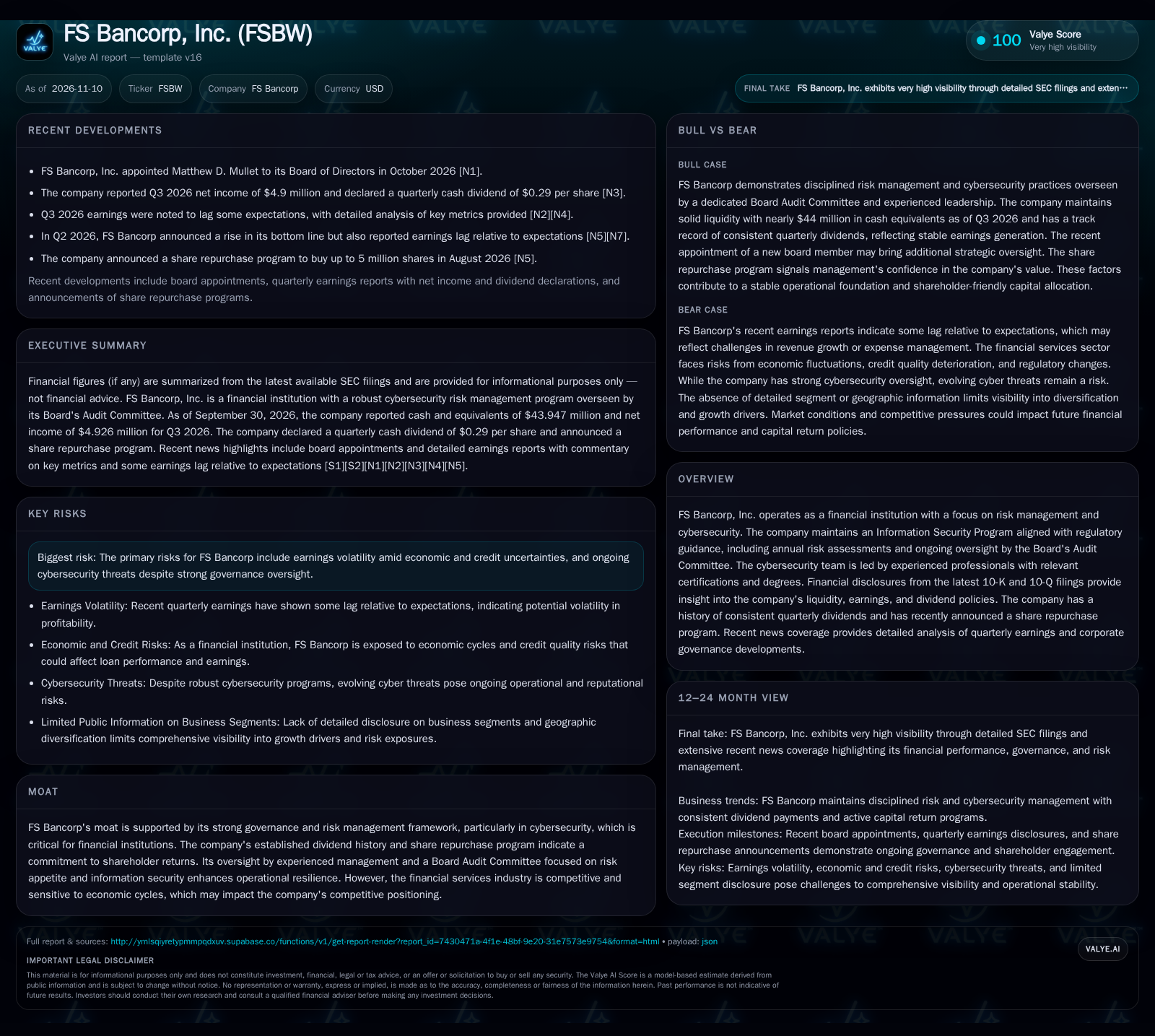
FS Bancorp, Inc. upholds a strong risk and cybersecurity governance structure and reported Q3 2026 net income of $4.9 million with $43.9 million in cash. However, recent earnings have fallen short of expectations, raising questions about growth prospects and resilience in a challenging financial sector environment. The company's dividend continuity and board refresh point to operational stability, but persistent earnings volatility and limited segment disclosure keep the long-term trajectory uncertain. [S1] [S2] [N1] [N2] [N3] [N4]
FS Bancorp, Inc. stands out among regional financial institutions for its visible commitment to cybersecurity risk management and board oversight, underpinned by an experienced information security team. In an environment where economic cycles, regulatory pressure, and technology risk shape bank performance, FS Bancorp’s ability to sustain profitability and adapt its strategy will likely determine its future trajectory.
Recent Financial Results and Governance Moves Set the Stage
FS Bancorp reported net income of $4.926 million for Q3 2026, with basic and diluted EPS of $0.65 and $0.63, respectively. Cash and cash equivalents stood at $43.947 million as of September 30, 2026, providing a clear snapshot of the company’s liquidity position [S2]. The company declared a $0.29 per share quarterly dividend, maintaining its pattern of capital returns [N3]. However, recent quarterly earnings have lagged some analyst expectations, as highlighted in news coverage, suggesting pressure on revenue or expense management [N2] [N4]. In parallel, FS Bancorp appointed Matthew D. Mullet to its Board of Directors in October 2026, potentially signaling a strategic refresh and governance continuity [N1].
How FS Bancorp Generates Profits—and Where Friction Emerges
As a traditional financial institution, FS Bancorp’s core earnings stem from net interest income—driven by the spread between interest earned on loans and securities and interest paid on deposits and borrowings. Fee-based income and service charges may provide incremental revenue, but are typically a smaller component for banks of this scale. The company’s steady dividend payments and positive net income in Q3 2026 [S2] [N3] suggest that its core lending and deposit franchise remains operationally sound.
However, the recent lag in earnings relative to expectations signals that either net interest margins are under pressure (potentially due to higher funding costs or slower loan growth), or that operating expenses—including compliance, technology, or credit loss provisions—are rising faster than revenue. Operating leverage in banking is often modest due to regulatory and branch fixed costs, but efficiency gains through technology or scale can still improve margins if achieved. The company reported cash and liquidity metrics for the period; these figures do not by themselves establish operating runway, investment capacity, financial flexibility, or financing capacity.
If FS Bancorp is unable to expand its loan book or improve margin through repricing, future earnings could remain constrained—especially in a competitive environment where larger peers may have cost or funding advantages.
In addition to core interest income dynamics, FS Bancorp’s profitability is also sensitive to the composition and quality of its loan portfolio. A higher concentration in certain loan types, such as commercial real estate or consumer lending, could expose the bank to sector-specific downturns or cyclical risks. Moreover, the pace at which the bank can convert non-interest-bearing deposits into interest-earning assets directly impacts net interest margins. The balance between maintaining reported liquidity position for regulatory and operational needs versus deploying capital into higher-yielding loans or securities requires careful calibration, especially in volatile interest rate environments. This balancing act affects both short-term earnings and long-term capital adequacy.
Risk Management as Differentiator—But Scale and Diversification Remain Challenges
FS Bancorp’s explicit emphasis on cybersecurity, with a board-overseen Information Security Program, a CIO holding CISSP certification, and a dedicated Information Security Manager [S1], is a material differentiator in an era of rising cyber risk for financial institutions. This governance framework may reduce operational and reputational risk, potentially lowering regulatory scrutiny and customer attrition if cyber events occur.
However, regional banks face stiff competition from national banks, credit unions, and increasingly from fintechs offering digital-first experiences and alternative lending models. Without clear evidence of unique product offerings, geographic reach, or digital platform differentiation, FS Bancorp’s moat is likely defined more by risk management discipline than by structural advantages in scale or technology. In commodity lending and deposit markets, pricing power is limited and switching costs for customers are low unless bundled services or relationship banking are well developed.
Absent detailed segment or geographic disclosures, it is difficult to assess whether FS Bancorp has diversified away from core lending or is exposed to concentration risks in specific markets or asset classes.
While FS Bancorp’s cybersecurity governance is a critical defensive asset, competitive differentiation in banking increasingly depends on digital customer experience and innovative product delivery. Without scalable technology platforms or partnerships that enhance digital engagement, FS Bancorp may face challenges attracting younger or tech-savvy customers who prioritize convenience and speed. Additionally, the bank’s ability to leverage data analytics for credit decisioning, risk management, and personalized marketing could be a determinant of future growth. In this context, cybersecurity is necessary but not sufficient; strategic investments in technology infrastructure and customer interface are essential to maintain relevance and defend market share against both fintech disruptors and digitally advanced incumbents.
What Would Drive a Positive Inflection? Margin Expansion and Strategic Leverage
A favorable scenario for FS Bancorp would see stabilization or expansion of net interest margins—potentially through successful repricing of loans, improved funding mix, or a favorable shift in interest rates. Continued investments in cybersecurity and operational efficiency could also reduce non-interest expenses and minimize loss events, freeing up capital for growth or higher dividends.
Board refresh and experienced executive oversight may catalyze new strategic initiatives, such as digital transformation, product innovation, or selective M&A that could expand the customer base or geographic footprint. If FS Bancorp can demonstrate above-peer loan growth, improved efficiency ratios, or growing fee-based income, this would validate a thesis of operational agility and sustainable profitability.
Earnings Stability Amid Sector Headwinds: The Most Likely Course
The most plausible outcome is that FS Bancorp maintains its core lending and deposit operations with modest profitability, supported by disciplined risk and cybersecurity management. Dividend continuity and a reported liquidity position are likely, but earnings may fluctuate around recent levels due to sector-wide pressures—such as margin compression, slower loan demand, or rising compliance costs.
No evidence yet suggests a dramatic shift in business model, geographic reach, or product mix. The company will likely remain exposed to economic cycles, credit quality swings, and ongoing regulatory scrutiny. If management sustains operational discipline and avoids credit missteps, the company could continue to serve its shareholder base with stable, if unspectacular, returns.
Evidence of ongoing earnings lag or margin erosion would challenge this scenario.
Under this scenario, FS Bancorp’s ability to maintain earnings stability will hinge on prudent credit risk management and maintaining a funding structure that balances cost and flexibility. The bank’s operational discipline in controlling non-interest expenses, including technology investments and compliance costs, will be crucial to offset margin pressures. Moreover, incremental improvements in fee income—through expanded ancillary services or cross-selling—could provide modest revenue diversification, helping to smooth earnings volatility. However, absent significant scale or geographic expansion, growth is likely to be incremental rather than transformative, with performance closely tied to regional economic conditions and interest rate cycles.
Where Could Pressure Mount? Credit Quality, Margin Squeeze, or Cyber Event
Adverse outcomes could materialize if FS Bancorp faces a significant deterioration in credit quality—such as rising nonperforming loans or unexpected charge-offs—leading to higher loan loss provisions and eroding profitability. Margin compression could intensify if deposit costs outpace loan repricing, or if competitive dynamics force lower loan yields.
A major cyber incident, despite current controls, could result in operational disruption, regulatory penalties, or reputational harm. Additionally, if sector-wide stress causes a liquidity squeeze or triggers regulatory capital requirements, FS Bancorp could be forced to curtail lending or dividends.
Evidence confirming this downside would include a sharp increase in loan loss provisions, negative earnings, dividend suspension, or public disclosure of a material cyber breach.
Tracking FS Bancorp’s Resilience: What Will Test the Risk-Reward Thesis?
Quarterly net interest margin trends—expansion would suggest pricing power or improved funding mix; compression would flag competitive or macro pressure.
Loan and deposit growth rates relative to regional and national peers—if disclosed—would clarify market positioning and customer retention.
Efficiency ratio changes (if disclosed), as a proxy for cost control and operational leverage.
Credit quality indicators: nonperforming asset ratios, charge-off rates, and provision expenses (if disclosed) to assess credit risk exposure.
Cybersecurity event disclosures or regulatory findings—material incidents would test the strength of the governance framework.
Board and management changes: further refresh or departures could indicate shifts in strategic direction or governance stability.
Segment or geographic revenue disclosures, if provided, would help clarify concentration risks and growth opportunities.
Disclaimer: This is research-only, informational analysis and not investment advice. It may include AI-generated interpretation and general industry context. Always verify important details using primary sources.

Comments