
Ranger Energy Services: Integration, Utilization, and Customer Concentration in a Cyclical Oilfield Landscape
Ranger Energy Services faces the dual challenge of integrating recent acquisitions and navigating a fragmented, price-sensitive oilfield services market. Its operational footprint and segment diversity offer potential resilience, but earnings volatility, customer concentration, and cyclical demand remain central variables for future performance.
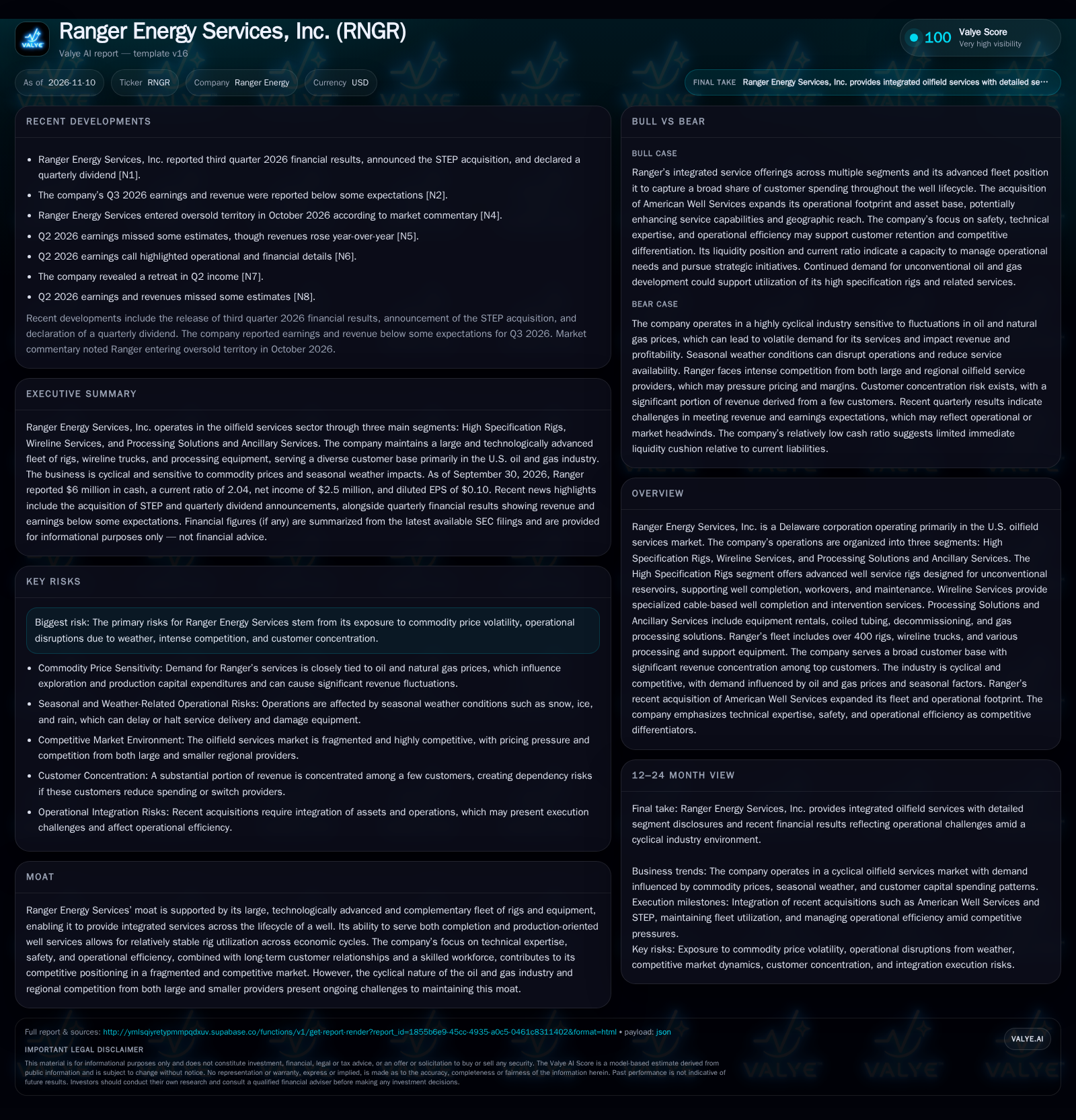
Ranger Energy Services operates through three segments—High Specification Rigs, Wireline Services, and Processing Solutions—serving a concentrated but broad customer base in the U.S. oilfield market. Recent acquisitions have expanded its fleet and geographic reach, but recent quarters have shown earnings and revenue below some expectations, highlighting both integration challenges and the impact of industry cyclicality.
Ranger Energy Services, Inc. stands at a crossroads shaped by recent acquisitions, operational scale, and the realities of a fragmented, cyclical U.S. oilfield services market. Its broad equipment fleet and segment diversity enable participation across the well lifecycle, but the company’s future trajectory hinges on successful integration of new assets, maintaining utilization amid volatile commodity prices, and managing the risks associated with a concentrated customer base. Recent earnings misses and low immediate liquidity highlight both the pressures of industry cyclicality and the stakes of execution in a competitive environment.
Recent Results and Strategic Moves Define Immediate Outlook
As of September 30, 2026, Ranger Energy Services reported $6 million in cash, total current assets of $157.7 million, and current liabilities of $77.2 million, resulting in a current ratio of 2.04 and a cash ratio of 0.08.[S2] The company posted $2.5 million in net income for the quarter, with diluted EPS of $0.10.[S2] However, both earnings and revenue came in below some expectations for Q3 2026, continuing a pattern seen in Q2 when revenues rose year-over-year but earnings missed analyst estimates.[N2] [N5]
The cited source reports dividend-related activity; that disclosure alone does not establish dividend-policy continuity, management confidence, or a material constraint on capital flexibility. [S1] [N1]
A key structural feature is customer concentration: the top five customers accounted for approximately 73% of consolidated revenue in 2025, out of a total customer base of about 180.[S1] This concentration, combined with recent financial underperformance and the operational demands of integrating new assets, defines the company’s current risk/reward profile.
How Segment Diversification and Fleet Utilization Shape Profitability
Ranger’s business model is built around three operating segments: High Specification Rigs, Wireline Services, and Processing Solutions and Ancillary Services.[S1] The High Specification Rigs segment provides advanced well services essential for unconventional oil and gas reservoirs, where operational uptime and technical performance drive customer value. This segment is capital-intensive due to the need for a modern rig fleet, but can generate operating leverage if utilization rates are high.
Wireline Services and Processing Solutions offer additional revenue streams—often with higher variable cost structures and lower capital requirements per unit of service—but are similarly sensitive to customer drilling and completion cycles. Processing Solutions (including rentals, decommissioning, and gas processing) may provide some revenue diversification, but are still exposed to the same macro drivers as the core rig business.
The economics of the business are influenced by pricing, volume of services delivered, and asset utilization. In periods of strong oil and gas prices, customer capital spending supports higher rig and equipment utilization, stronger pricing, and improved margins. Conversely, downturns can quickly erode both volume and pricing, given the fragmented and competitive market structure. Fixed costs—including depreciation on the fleet and corporate overhead—create operating leverage, magnifying both upside and downside swings in profitability.
Ranger’s recent acquisitions expand its asset base and theoretically increase its addressable market, but integration costs, potential underutilization of new assets, and the challenge of achieving synergy targets may weigh on near-term margins if market conditions remain soft.
Fragmented Oilfield Services Market Intensifies Pressure on Margins
Ranger operates in a highly competitive and fragmented U.S. oilfield services landscape, facing both national and regional providers such as RPC, ProPetro, and KLX Energy Services.[S1] Barriers to entry are moderate, as capital requirements for a modern rig fleet are significant, but service commoditization and customer bargaining power limit pricing flexibility.
The company’s competitive position rests on its ability to deliver integrated services across the well lifecycle, supported by a large and technologically advanced fleet. This breadth can be a differentiator for customers seeking operational efficiency and a single point of contact for multiple service needs. However, the absence of strong switching costs means customers can readily shift spend to other providers if price or service quality falters.
Customer concentration also amplifies competitive risk: losing a major client or facing pricing pressure from a top customer can have an outsized impact on revenue and margin. Additionally, the industry’s cyclicality and exposure to oil and gas price swings create an environment where even operationally strong companies must continually prove value and efficiency.
Technological change—such as automation, digital fleet management, or new well completion techniques—could further disrupt traditional service economics, requiring ongoing investment to maintain competitiveness.
Synergy Realization and High Utilization Could Drive Margin Expansion
A favorable scenario for Ranger centers on the successful integration of recent acquisitions (American Well and STEP), leading to improved asset utilization, cost synergies, and expanded customer relationships. If oil and gas prices remain elevated or recover further, customer capital spending could increase, driving higher demand for well services and equipment rentals across all segments.
In this environment, Ranger could leverage its expanded fleet and operational scale to win a greater share of customer spend, particularly if it can demonstrate superior safety, technical performance, and reliability. Higher fleet utilization would allow for greater absorption of fixed costs, potentially resulting in margin expansion and stronger cash flow.
Confirmation of this scenario would come from rising segment utilization rates (if disclosed), sequential improvement in operating margins, and evidence of cross-selling or expanded wallet share within existing customer accounts. Additionally, successful cost management and realization of targeted acquisition synergies would be visible in SG&A and direct operating cost trends relative to revenue growth.
Navigating Cyclicality with Moderate Growth and Ongoing Integration
The most plausible outcome is that Ranger continues to operate in a volatile but gradually improving market, with oil and gas prices supporting steady—if unspectacular—customer capital spending. The integration of new assets proceeds with some execution challenges, but the company achieves incremental gains in scale and service breadth.
Revenue and earnings growth remain modest, reflecting the offsetting effects of periodic customer project delays, weather-related disruptions, and ongoing competitive pricing pressure. Customer concentration persists as a risk, but is partially mitigated by efforts to expand the customer base and deepen relationships with existing clients through bundled service offerings.
Evidence for this scenario would include stable or slightly rising utilization rates, relatively flat operating margins, and continued—but not dramatic—additions to the customer roster. Integration costs and modest synergy realization would be visible in SG&A and direct cost line items, with no major step-changes in profitability.
Commodity Price Decline and Integration Missteps Could Disrupt Stability
A negative scenario would be triggered by a significant decline in oil and gas prices, leading to sharp reductions in customer capital expenditures and a rapid falloff in demand for Ranger’s services. This would translate into lower rig and equipment utilization, reduced pricing, and margin compression across all segments.
If the integration of acquired assets is poorly executed—resulting in higher-than-expected costs, operational inefficiencies, or customer attrition—the negative impact on earnings could be magnified. Customer concentration risk could materialize if a major client shifts spending to a competitor or aggressively renegotiates terms.
Downside confirmation would be visible in declining utilization rates, a drop in reported revenue and segment profitability, rising SG&A as a percentage of sales, and negative operating cash flow. Any signals of asset impairments or restructuring charges would further indicate stress.
Quantitative and Operational Milestones That Will Shape Ranger’s Trajectory
Active and marketable rig utilization rates (if disclosed), as a direct measure of demand for Ranger’s core service offering and a leading indicator of revenue and margin trends.
Segment-level revenue and operating margin progression, to assess the impact of integration and market conditions across High Specification Rigs, Wireline Services, and Processing Solutions.
Customer concentration trends, specifically the proportion of revenue from the top five customers and any evidence of diversification or attrition.
SG&A and direct operating cost trends relative to revenue, as signals of synergy realization, cost discipline, or integration challenges.
Quarterly operating cash flow and capital expenditure levels, to gauge the sustainability of investment in fleet maintenance and growth.
Evidence of cross-selling or bundled service adoption, such as multi-segment contracts or expanded wallet share within key customer accounts (if disclosed).
Asset impairment charges or restructuring costs, which could signal operational or market stress.
Any updates on the integration progress and realized synergies from the American Well and STEP acquisitions, including management commentary and disclosed synergy targets.
Disclaimer: This is research-only, informational analysis and not investment advice. It may include AI-generated interpretation and general industry context. Always verify important details using primary sources.

Comments