
AST SpaceMobile: Capital-Intensive Satellite Connectivity Gambit Tests Adoption, Scale, and Partner Economics
AST SpaceMobile is approaching a critical inflection point as it transitions from government and equipment sales to the commercial launch of its direct-to-smartphone satellite broadband service.
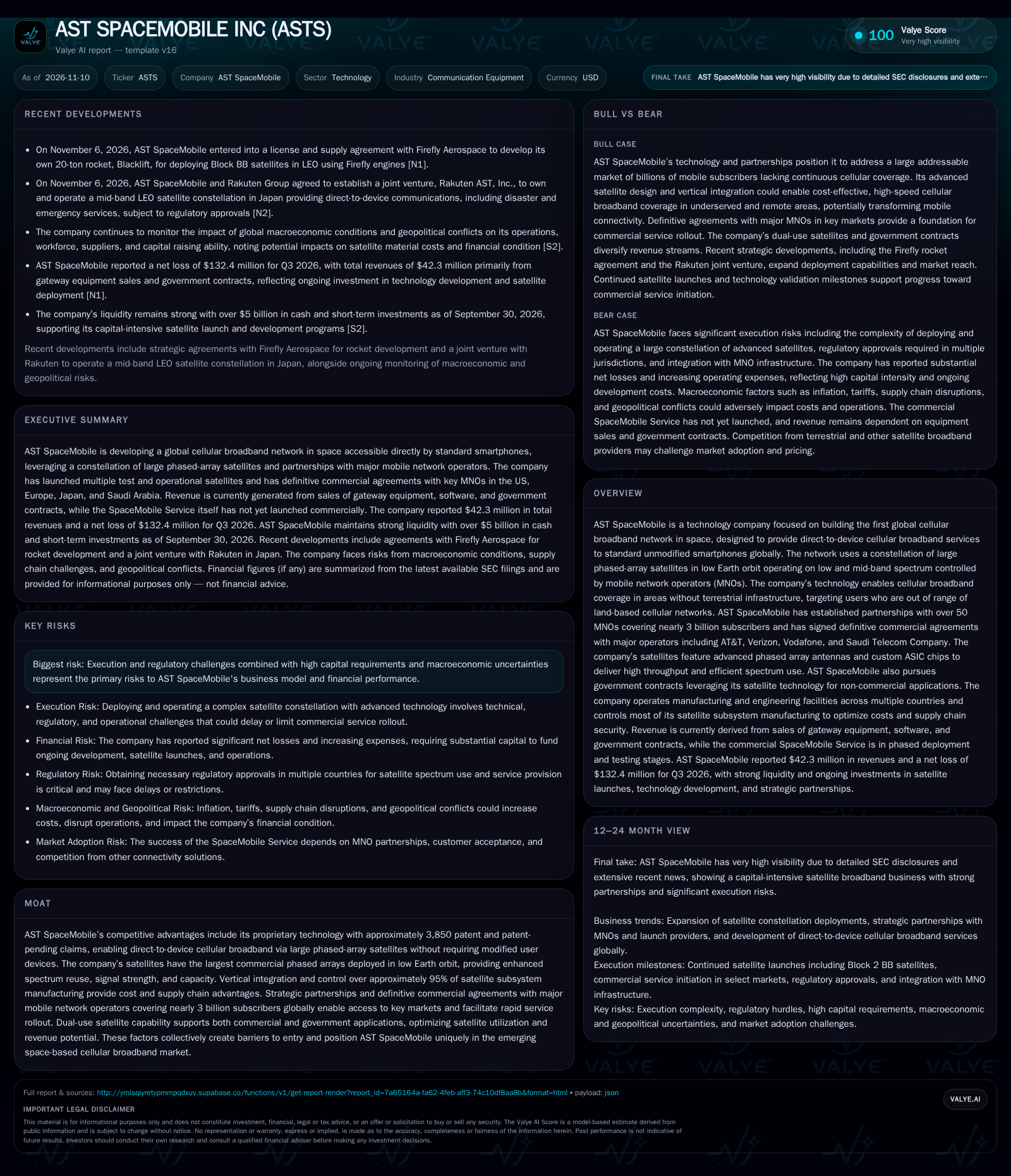
AST SpaceMobile is building a global space-based cellular broadband network designed to connect standard smartphones directly via a constellation of large phased-array satellites. The company has over $5 billion in liquidity, partnerships with major global mobile operators, and recent government and equipment revenues, but its core commercial service has not yet launched. Execution risk, capital intensity, and adoption uncertainty define the next phase.
AST SpaceMobile is at the frontier of direct-to-device satellite connectivity, aiming to bridge the world’s mobile coverage gaps by connecting standard smartphones via its proprietary low Earth orbit satellite network. With over $5 billion in liquidity, partnerships spanning nearly 3 billion mobile subscribers, and a vertically integrated technology stack, the company is well-positioned for a large-scale commercial rollout. Yet, the absence of recurring service revenues, mounting operating losses, and the complexity of executing its capital-intensive vision mean the next 12-24 months will be defined by the real-world test of adoption, economics, and operational scale.
Recent Financials and Strategic Moves Set the Stage for Commercial Service
AST SpaceMobile reported $42.3 million in total revenue for Q3 2026, driven predominantly by sales of gateway equipment and government contracts, while posting a net loss of $132.4 million as operating expenses surged with satellite development and R&D investments. The company’s liquidity position as of September 30, 2026, included $2.8 billion in cash and equivalents and $2.5 billion in short-term investments, with current assets of $3.1 billion and current liabilities of $225 million. These reported liquidity figures reflect the company's financial resources at the end of the quarter, but do not by themselves establish the duration of operating runway, investment capacity, or potential financial flexibility. Notably, AST SpaceMobile has entered into a license and supply agreement with Firefly Aerospace to build a 20-ton rocket for satellite deployment and launched a joint venture with Rakuten targeting the Japanese market. The commercial SpaceMobile Service itself, which would deliver global direct-to-device broadband, has not yet launched, keeping recurring service-based revenue unrealized. [S2]
Economic Model Hinges on Recurring Connectivity Revenue and Scale
AST SpaceMobile's current revenue mix is transitional, with most inflows from the sale of gateway equipment to mobile network operators (MNOs) and performance on government contracts. The core thesis is that, upon commercial launch, the company will shift to a recurring revenue model by charging MNOs for access to space-based coverage, likely on a usage or revenue-share basis. The direct-to-device architecture avoids the need for end-user hardware upgrades, potentially lowering adoption friction and expanding the addressable market. However, the magnitude of fixed costs—satellite manufacturing, launch, ground infrastructure, and ongoing R&D—means that profitability will likely require significant scale and sustained utilization. Operating leverage could be substantial if the network achieves widespread adoption, but near-term economics are pressured by high cash burn and delayed service ramp.
Vertical integration, with 95% of satellite subsystems manufactured in-house, is intended to optimize cost structure and supply chain resilience, but also increases fixed cost absorption risk if volumes disappoint. The dual-use nature of the satellites, supporting both commercial and government applications, theoretically diversifies revenue streams but does not fully offset the high capital intensity.
Technology Edge and MNO Partnerships vs. Terrestrial and Satellite Rivals
AST SpaceMobile’s moat is rooted in its patented technology—direct-to-standard-smartphone broadband via large LEO phased-array satellites—and its global MNO partnerships. The ability to deliver service directly to unmodified devices is a key differentiator, as competing satellite connectivity solutions often require proprietary handsets or intermediary hardware. The company’s 3,850 patent and patent-pending claims and vertical integration further strengthen its entry barriers.
However, the competitive landscape is dynamic. Traditional terrestrial carriers are expanding rural coverage, and other satellite operators (both GEO and LEO) are targeting broadband and IoT markets, some with large constellations and deep-pocketed backers. Technology substitution risk looms if terrestrial infrastructure advances faster than expected, or if other LEO players achieve similar direct-to-device capabilities. MNO relationships are a strategic asset, but their long-term economics and exclusivity terms are not disclosed, and rivals could seek to partner with competing satellite providers or build out their own coverage. Ultimately, the company’s advantage will depend on the pace and scale of commercial adoption, cost competitiveness, and the persistence of technical differentiation.
If Adoption Accelerates: Service Launch Converts MNO Agreements into High-Margin Recurring Revenue
The favorable scenario sees AST SpaceMobile successfully launching its commercial SpaceMobile Service, with rapid uptake by MNO partners who market the offering to their existing subscriber bases. Direct-to-device coverage, especially in rural and underserved regions, could deliver tangible value to both consumers and network operators, enabling incremental ARPU and reducing churn. As MNOs integrate satellite coverage into their plans, revenue visibility and predictability could improve, and economies of scale would drive operating leverage and potential margin expansion.
Evidence that would confirm this scenario includes: clear announcements of commercial service launch, publicized service-level agreements with MNOs specifying revenue terms, sequential growth in recurring service revenue, and indications that end-user adoption is meeting or exceeding expectations (e.g., through disclosed usage metrics or ARPU uplift). Further, successful expansion of government and international contracts would reinforce the dual-use value proposition. Sustained control of costs and continued technology leadership—such as further ASIC or phased-array advances—would also support the bull case.
Commercialization Proceeds in Phases, with Gradual Service Uptake and Ongoing Cash Burn
The most plausible trajectory is a phased commercial rollout, with AST SpaceMobile gradually onboarding MNOs and activating service in selected geographies. Initial adoption may be concentrated in remote or underserved regions where terrestrial coverage is weakest, with incremental revenue as MNOs bundle space-based connectivity for premium or emergency use cases. Operating expenses are likely to remain elevated as the satellite constellation is expanded and service infrastructure matures.
This scenario would be confirmed by moderate but steady growth in recurring service revenue, additional MNO partnerships or expansions of existing agreements, and evidence of cost containment despite ongoing R&D and deployment spend. Delays in network coverage milestones, slower-than-expected end-user traction, or the need for additional capital raises would suggest that the ramp is proving more difficult than anticipated, but would not necessarily undermine the long-term opportunity if the underlying demand is validated.
Execution Stumbles or Adoption Lags: High Fixed Costs Outpace Revenue Ramp
The primary risk is that technical, regulatory, or commercial execution falters—whether through satellite deployment setbacks, regulatory delays, or difficulties in integrating with MNO networks—resulting in a protracted timeline for service launch and adoption. If MNO partners are slow to market the service, or if end-user demand is tepid due to pricing, performance, or competing alternatives, recurring revenue may remain insufficient to cover high fixed costs, driving continued operating losses and eventual pressure on liquidity.
This scenario would be evidenced by further increases in net losses, stagnation or decline in equipment and government contract sales (if these are not replaced by service revenue), delays in published launch or service milestones, or public indications that MNO partners are deprioritizing or exiting agreements. Unplanned capital raises or cost-cutting measures that impact core technology development would further confirm thesis erosion.
Milestones and External Factors That Will Determine AST SpaceMobile’s Commercial Traction
Commercial service launch dates and activation of MNO agreements—a clear indicator of transition from development to recurring revenue.
Sequential growth in recurring service revenue, if disclosed, to demonstrate adoption and monetization beyond equipment and government contracts.
Publicly disclosed end-user adoption or usage metrics (e.g., number of connected devices, data volumes, ARPU uplift) would help test the demand thesis.
Updates on satellite launch cadence, in-orbit performance, and coverage milestones, as delays could signal execution risk.
Disclosures of new or expanded commercial agreements with MNOs, especially in markets with high unmet coverage needs.
Cost per satellite deployed and trends in operating expenses, to monitor progress toward scale economies and margin improvement.
Evidence of competitive responses—such as rival satellite offerings or expanded terrestrial coverage—impacting MNO partner commitment or pricing power.
Any indication of regulatory or geopolitical developments that could materially affect satellite deployment, spectrum rights, or international expansion.
Disclaimer: This is research-only, informational analysis and not investment advice. It may include AI-generated interpretation and general industry context. Always verify important details using primary sources.

Comments