
Lincoln Educational Services: Regulatory Reliance, Compliance Stakes, and the Economics of Title IV Dependency
Lincoln Educational Services’ business model is tightly bound to federal student aid programs, with current financial results showing profitability but a short-term liquidity imbalance. The company’s future will hinge on its ability to navigate shifting regulatory frameworks, manage compliance risk, and adapt to changes in government policy and student financing.
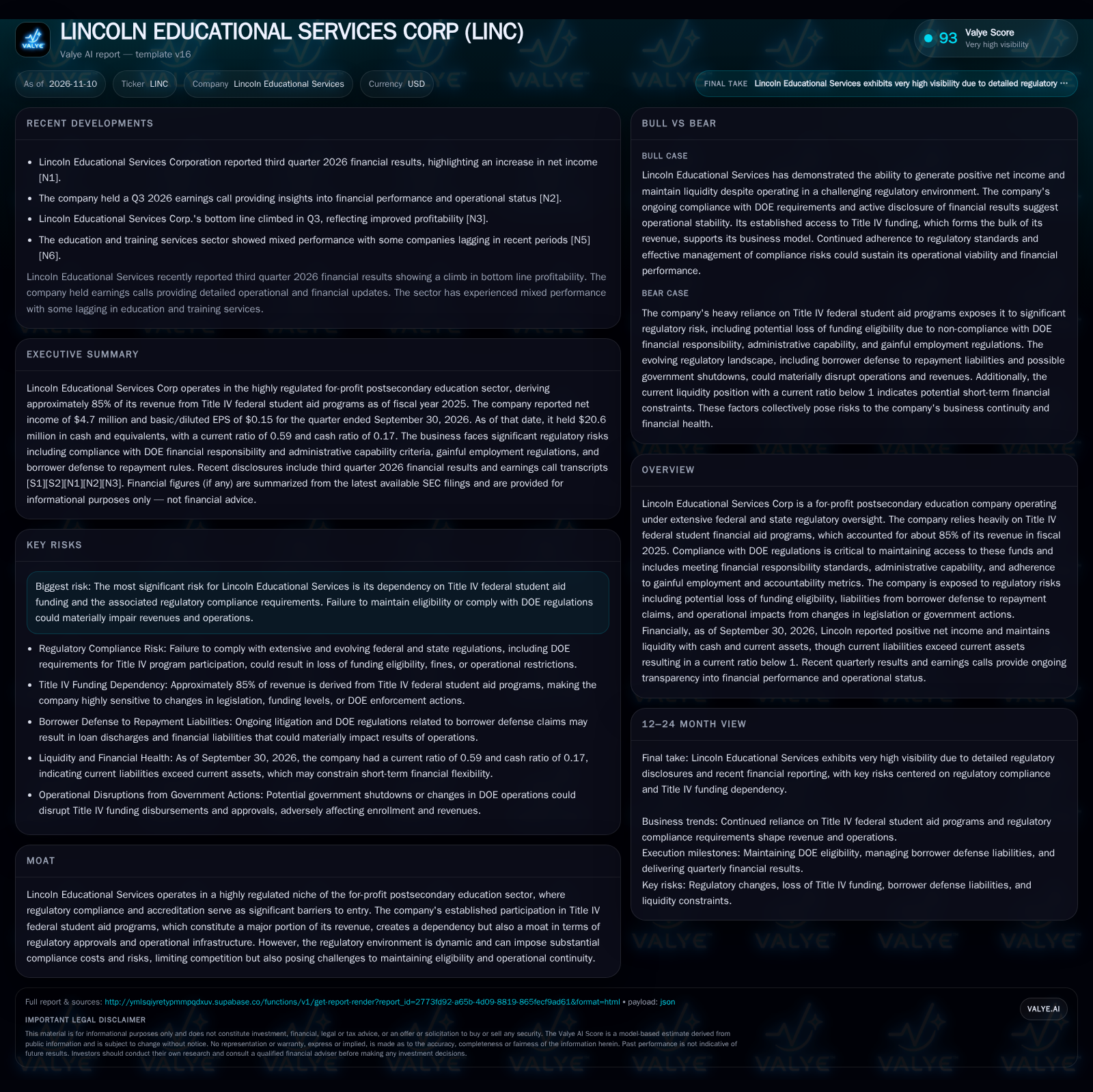
Lincoln Educational Services reported $4.7 million in net income for Q3 2026 and remains profitable, but 85% of its revenue relies on Title IV federal student aid. The central business challenge is mitigating regulatory risk while maintaining access to federal funding and demonstrating compliance with evolving Department of Education rules. [S1] [S2]
Lincoln Educational Services Corp faces a future defined by regulatory dependency and compliance risk. With approximately 85% of its revenue tied to federal Title IV student aid, and current financials showing both profitability and a short-term liquidity gap, the company’s fate is closely linked to Department of Education policies and enforcement. While recent quarters have demonstrated earnings strength, the real test for Lincoln will be its ability to sustain compliance, manage potential liabilities from evolving borrower defense rules, and respond to any shifts in federal funding or regulatory regimes—all under the shadow of a balance sheet where current liabilities exceed current assets. [S1] [S2]
Recent Profitability Offset by Liquidity Imbalance and Regulatory Exposure
Lincoln Educational Services reported net income of $4.7 million and earnings per share of $0.15 for Q3 2026, reflecting ongoing profitability in a challenging sector. However, the company’s current assets of $71.0 million are significantly outweighed by current liabilities of $120.9 million, resulting in a current ratio of 0.59 and a cash ratio of 0.17 as of September 30, 2026. The company reported cash and liquidity metrics for the period; these figures do not by themselves establish operating runway, investment capacity, financial flexibility, or financing capacity. Most critically, approximately 85% of Lincoln’s revenue in fiscal 2025 was sourced from Title IV federal student aid programs, making continued regulatory compliance essential to its business continuity. The company is subject to Department of Education rules on gainful employment, borrower defense, and financial responsibility, with non-compliance risking loss of funding eligibility and material operational disruption. [S1] [S2]
How Federal Aid Flows Shape Revenue, Cost Structure, and Financial Leverage
Lincoln’s core economic engine is the enrollment and graduation of students whose tuition is largely paid through Title IV federal student aid. This model creates high revenue visibility when regulatory access is stable, but exposes the company to sudden shocks if eligibility is threatened. Tuition pricing is generally set by program type and market demand, but actual realized revenue is dictated by federal aid rules and student borrowing capacity. The fixed cost base—comprising faculty, facilities, compliance, and administrative overhead—is substantial, creating operating leverage that can amplify both gains and losses as enrollment fluctuates. Variable costs are largely tied to student services, instructional materials, and marketing, with the latter being a significant spend in the for-profit education industry. Capital needs are moderate, focused on maintaining facilities, technology, and regulatory compliance rather than heavy physical expansion. However, the heavy reliance on federal cash flows means that any disruption (such as a government shutdown or regulatory action) directly impacts working capital and could stress obligations to vendors and staff. The company’s short-term liquidity position, with current liabilities exceeding current assets, may limit its ability to absorb shocks or invest in program enhancements without external financing or improved cash flow.
Barriers, Substitution, and the Role of Regulation in Shaping Industry Structure
Lincoln’s competitive moat is rooted in regulatory approvals, accreditation, and established Title IV program participation. These are significant barriers to entry for new for-profit colleges, as gaining and maintaining eligibility is costly and complex. However, this moat is double-edged: regulatory changes can erode competitive advantage just as quickly as they can insulate incumbents. The primary substitutes for Lincoln’s programs are public community colleges, nonprofit vocational institutions, and increasingly, online education providers. These alternatives may offer lower tuition or different value propositions, especially as workforce development priorities shift. The regulatory environment also creates a level playing field for compliance, but exposes all sector participants to the risk of sudden rule changes, adverse publicity, or funding cuts. Peer companies in the for-profit sector face similar challenges, but those with stronger balance sheets, diversified revenue away from Title IV, or more defensible program outcomes may navigate volatility more effectively. Lincoln’s operational visibility and established compliance infrastructure provide some resilience, but not immunity.
If Regulatory Compliance Holds and Enrollment Stabilizes, Margin Expansion Is Possible
The favorable outcome for Lincoln hinges on continued access to Title IV funds, stable or growing enrollment, and successful navigation of evolving DOE regulations, particularly around gainful employment and borrower defense. If the company can demonstrate strong program outcomes—such as high graduation rates, robust job placement, and manageable student debt levels—its programs may avoid adverse regulatory actions and maintain eligibility. Improvement in liquidity, either through increased operating cash flow or external financing, could further reduce financial risk and enable investment in new programs or technology. Evidence confirming this scenario would include stable or rising enrollment figures, maintenance of Title IV eligibility for all major programs, and a recovery in the current ratio toward or above 1.0. Additional confirmation would be found in positive regulatory audits, limited exposure to borrower defense claims, and continued profitability in quarterly results.
Sustained Profitability Under Regulatory Scrutiny, With Persistent Liquidity Constraints
The most plausible outlook is that Lincoln continues to operate profitably but remains under intense regulatory scrutiny and faces ongoing liquidity pressure. Enrollment is likely to remain stable or grow modestly, but the business will need to devote significant resources to compliance and risk management. The company’s short-term liquidity imbalance may persist unless operating cash flow improves or working capital is managed more aggressively. Regulatory risk remains ever-present: even minor compliance lapses or adverse interpretations of DOE rules could result in program-level funding restrictions or reputational damage. This scenario would be confirmed by continued positive net income, ongoing Title IV eligibility, but little improvement in the current ratio or cash position. Falsification would occur if the company loses eligibility for a major program, faces large borrower defense liabilities, or is forced into reactive cost-cutting that impairs educational quality.
Loss of Title IV Funding or Regulatory Shock Would Threaten Business Continuity
The adverse scenario materializes if Lincoln fails to comply with DOE requirements—whether due to gainful employment metrics, borrower defense liabilities, or administrative missteps—and loses Title IV eligibility for key programs. This would lead to a rapid decline in enrollment and revenue, as most students would be unable to finance tuition without federal aid. The company’s liquidity position, already strained, could quickly deteriorate, making it difficult to meet obligations or continue normal operations. Additional downside risk comes from government actions such as shutdowns, legislative changes, or negative sector headlines that prompt stricter enforcement or new rules. Confirmation of this scenario would include DOE actions restricting funding, a sharp drop in enrollment, a spike in borrower defense claims, or evidence that the company cannot meet its short-term liabilities.
Testing the Thesis: Regulatory, Enrollment, and Liquidity Metrics to Track
Quarterly enrollment and graduation rates by program—if disclosed—would provide insight into demand and program health.
Updates on Title IV eligibility status for all major programs, especially following regulatory reviews or audits.
Incidence, scale, and financial impact of borrower defense to repayment claims or related litigation settlements.
Outcomes of DOE gainful employment and accountability metrics for Lincoln’s largest programs.
Announcements or disclosures relating to government shutdowns, legislative changes, or DOE funding disruptions.
Any evidence of changes in tuition pricing, discounting, or shifts in the mix of student financial aid sources.
External financing events, such as new debt or equity raises, that materially alter the company’s liquidity profile.
Disclaimer: This is research-only, informational analysis and not investment advice. It may include AI-generated interpretation and general industry context. Always verify important details using primary sources.

Comments