
Aimco’s Liquidation: Asset Monetization, Distribution Range, and the Mechanics of an Orderly Wind-Down
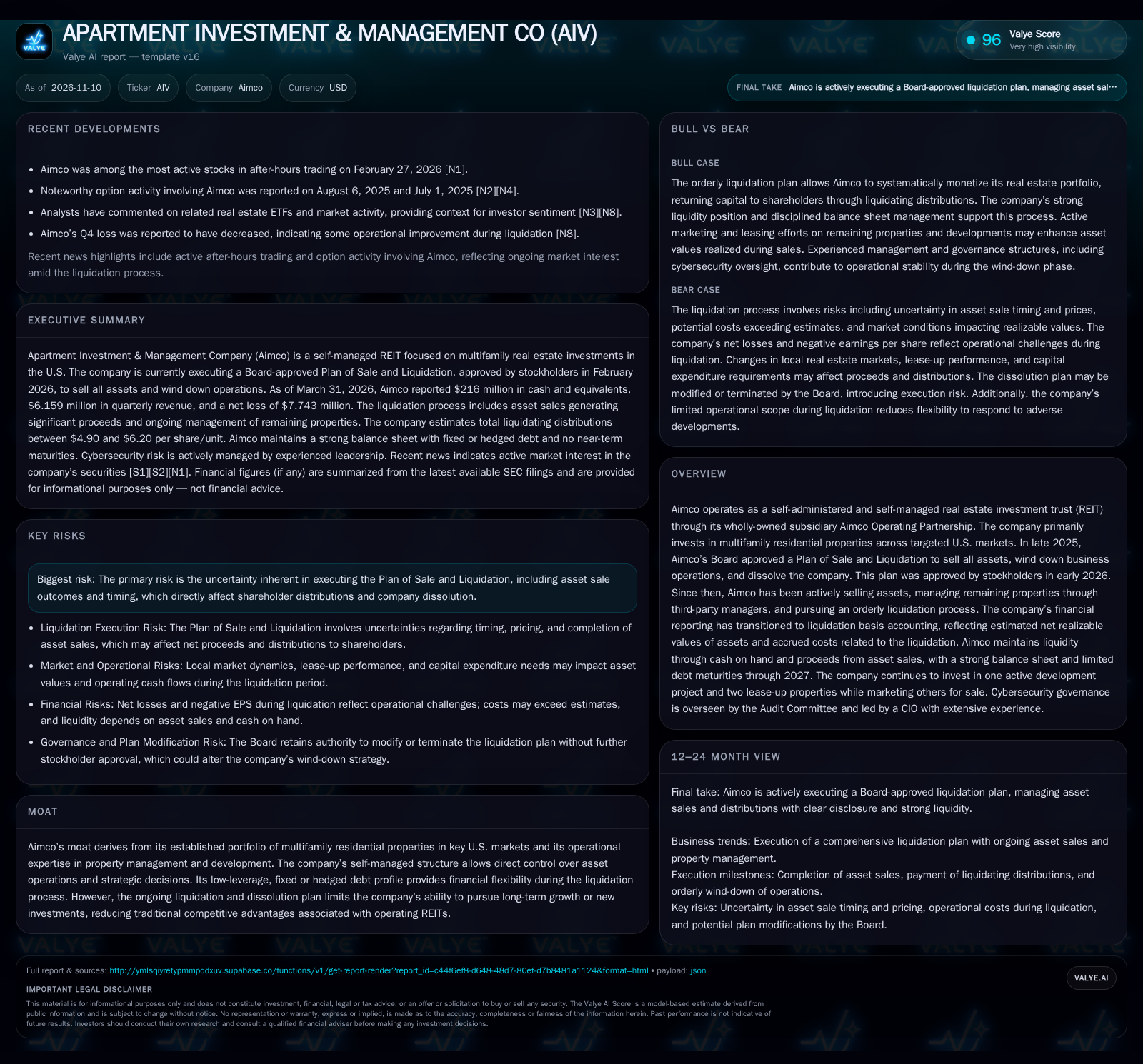
Apartment Investment & Management Company (Aimco) is executing a full liquidation, having sold significant assets and distributed $2.75 per share/unit to date. The company estimates total liquidating distributions between $4.90 and $6.20 per share/unit, with remaining value dependent on the outcome of asset sales, cost management, and market conditions.
Aimco is in the process of liquidating its multifamily real estate portfolio, with $754.6 million in asset sale proceeds and $2.75 per share/unit already distributed to shareholders. The company estimates total liquidating distributions will fall between $4.90 and $6.20 per share/unit, but the ultimate outcome depends on asset sale prices, liquidation costs, and market factors. The orderly wind-down is supported by a reported balance sheet position and limited near-term debt, but execution and market risks remain material. [S2]
Aimco’s transition from a traditional multifamily REIT to a liquidating entity marks a decisive endgame for its portfolio and investors. With $754.6 million in asset sales already completed and $2.75 per share/unit distributed, the company’s remaining value hinges on the pace and terms of final asset dispositions and the careful management of liquidation costs. While the process is underpinned by a reported balance sheet position and limited refinancing risk, the ultimate payout to shareholders remains highly sensitive to real estate market conditions, sale execution, and cost containment. The final chapter for Aimco illustrates the complexities and tradeoffs inherent in a public REIT liquidation.
Executing the Liquidation: Current Milestones and Distribution Range
Aimco is deep into its Board- and stockholder-approved Plan of Sale and Liquidation, having sold 18 assets for gross proceeds of $754.6 million. The company has transitioned to liquidation-basis accounting to better reflect the estimated net realizable value of its remaining assets and accrued costs associated with the wind-down. As of September 30, 2026, management estimates net assets in liquidation at $395 million, after accounting for $33.5 million of excess liabilities not derecognized under GAAP. Liquidating distributions totaling $2.75 per share/unit have already been paid, and Aimco now estimates total distributions will range between $4.90 and $6.20 per share/unit based on 152 million shares/units outstanding. The company maintains $216 million in cash and equivalents as of March 31, 2026, and continues to operate with low leverage, fixed or hedged debt, and no debt maturities before December 2027. [S2]
Real Estate Monetization, Cost Accrual, and Distribution Mechanics
Aimco’s business model in liquidation is fundamentally different from traditional REIT operations. Value creation now centers on maximizing asset sale proceeds, minimizing transaction drag, and managing accrued and unforeseen costs. The company’s revenue from continuing operations is now marginal compared to the scale of asset sales, with Q1 2026 revenue at $6.159 million and a net loss of $7.743 million, reflecting reduced rental income and ongoing wind-down expenses. [S2]
Distributions to shareholders are dictated by the realized proceeds net of liquidation costs, which include transaction fees, lease execution, tenant improvements, capital expenditures, and the timing of sales. Aimco’s adoption of liquidation-basis accounting means real estate assets are marked to estimated net realizable value using a mix of contractual purchase prices, offers, management estimates, and market/broker inputs. The company accrues costs expected to be incurred during the liquidation process, attempting to provide a realistic estimate of final distributable value.
Operating leverage is largely absent at this stage, as ongoing property management is outsourced to third-party managers and fixed costs are being wound down. Capital needs are limited to completing the one active development, stabilizing lease-up properties, and covering transaction and holding costs until each asset is sold. The company’s low leverage and fixed or hedged debt structure reduce the risk of forced sales or distressed pricing due to liquidity pressures.
Liquidation in a Competitive Market: Peer Dynamics and Asset Sale Headwinds
In liquidation, Aimco’s competitive position is defined less by traditional REIT measures like portfolio scale or cost of capital, and more by its ability to command attractive prices for its assets relative to prevailing market conditions. The company is exposed to the supply-demand dynamics in key multifamily markets, where rising interest rates, transaction volumes, and buyer risk appetite can all influence bidding and sale timing.
Peer groups include other liquidating REITs, private equity real estate funds, and institutional buyers seeking stabilized or value-add multifamily assets. Competitive pressure may arise if multiple sellers hit the market simultaneously, depressing prices or elongating sale timelines. Conversely, scarcity of high-quality assets in certain submarkets could bolster pricing power.
Aimco’s operational expertise, established property management protocols, and disciplined approach to capital structure may support smoother transitions for buyers and potentially faster closings. However, the fixed nature of the liquidation plan means Aimco cannot pivot to new investment opportunities, redeploy capital, or weather downturns with the same flexibility as ongoing REITs.
What Could Drive Above-Estimate Distributions?
A favorable outcome for shareholders would require Aimco to consistently achieve or exceed management’s asset value estimates, with minimal transaction friction and cost overruns. This could occur if multifamily property markets remain liquid, cap rates compress, or there is unexpected demand from institutional buyers seeking yield or scale in Aimco’s core geographies.
Additional upside could come from outperforming lease-up and development projects, if these assets stabilize ahead of schedule and command premium exit prices. If capital expenditure needs are lower than projected, or if market conditions allow for competitive bidding, net realizable value could rise.
Confirmation of this scenario would show up in asset sales closing at or above book value, realized costs coming in below accruals, and management raising the high end of its distribution range. A useful falsification would be sales at discounts to carrying value, or a downward revision in estimated distributions as costs mount.
Typical REIT Liquidation: Gradual Asset Sales, Distribution Within Range
The most plausible outcome is that Aimco completes asset sales over the next several quarters, with realized proceeds and costs landing within the current $4.90 to $6.20 per share/unit distribution range. This path would be characterized by a mix of sales at or near carrying value, some modest transaction slippage, and holding costs that reflect current estimates.
Market conditions may be moderately supportive, with multifamily fundamentals holding up but buyers remaining price-sensitive amid macro uncertainty. The active development and lease-ups are completed and sold at reasonable valuations, neither dramatically outperforming nor underperforming projections.
Evidence confirming this scenario would be steady announcements of asset dispositions, management reaffirming distribution guidance, and quarterly updates that show cost and value estimates tracking closely to prior disclosures. Negative surprises in either direction would indicate deviation from this base case.
If Real Estate Markets Weaken or Costs Escalate
The primary risk to Aimco’s liquidation value is a deterioration in real estate market conditions, causing asset sales to close at discounts to estimated value or requiring extended time on market. Rising interest rates, tighter credit, or a glut of multifamily properties for sale could all depress pricing and reduce net proceeds.
Unexpected cost inflation—be it from higher transaction fees, legal expenses, capital expenditures, or delays in lease-up and construction—could further erode distributable value. If the pace of sales slows, carrying costs would rise and net asset value could ratchet lower.
Confirmation of the downside scenario would be downward revisions to the distribution estimate, reported asset sales below book value, or disclosures of higher-than-anticipated liquidation expenses. A change in Board strategy, such as a modification or delay of the liquidation plan, would also signal increased risk for shareholders.
What Will Determine Aimco’s Final Shareholder Outcome?
Progress and pricing of individual asset sales—tracking whether realized values meet, exceed, or fall short of carrying values and management estimates.
Updates to the estimated total liquidating distribution range, especially any narrowing of guidance or upward/downward revisions.
Actual realized costs versus accrued liquidation expenses, including transaction costs, lease-up incentives, and capital expenditures.
Timing and success of the active development project and two lease-up properties, particularly whether they stabilize and sell on schedule.
Market conditions for multifamily assets in Aimco’s core geographies, with a focus on cap rate trends, buyer demand, and transaction volumes.
Any Board actions to modify, delay, or terminate the liquidation plan, as this would materially alter the risk/reward calculus.
If disclosed, updates on contingent liabilities, tax leakage, or other unforeseen claims that could impact net distributable value.
Disclaimer: This is research-only, informational analysis and not investment advice. It may include AI-generated interpretation and general industry context. Always verify important details using primary sources.

Comments