
ArriVent BioPharma: Oncology Pipeline Prospects, Capital Discipline, and the Stakes of Clinical Execution
ArriVent BioPharma’s clinical-stage oncology portfolio—led by firmonertinib and ARR-217—positions the company for potential value inflection if pivotal trials deliver.
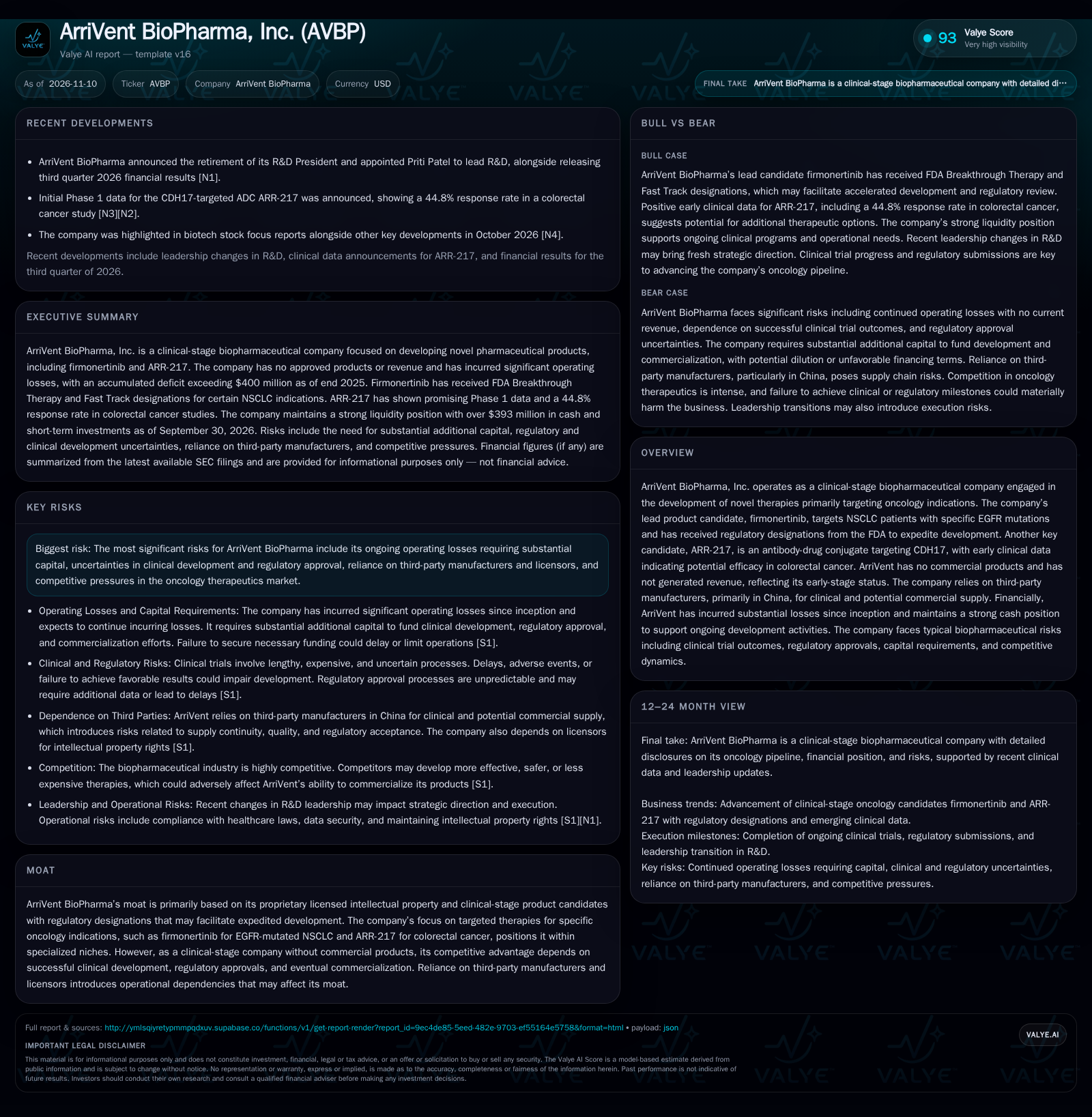
ArriVent BioPharma, Inc. is advancing two main oncology assets—firmonertinib (with FDA Breakthrough Therapy and Fast Track designations for NSCLC) and ARR-217 (with early clinical data showing a 44.8% response rate in colorectal cancer). The company’s future depends on successful late-stage trials, regulatory approvals, and the ability to mitigate manufacturing and competitive risks in a crowded oncology market. [S1] [S2] [N2] [N3]
ArriVent BioPharma stands at a pivotal juncture as it seeks to prove the value of its clinical-stage oncology assets in a fiercely competitive field. With firmonertinib advancing under expedited FDA pathways and ARR-217 posting encouraging early response rates in colorectal cancer, the company has attracted attention for its targeted approach and substantial cash reserves. Yet, the absence of commercial products, ongoing losses, and reliance on third-party manufacturing—primarily in China—underscore the execution risks ahead. The next 12–24 months will be defined by clinical milestone attainment, regulatory clarity, and the company’s ability to convert scientific promise into commercial traction.
Recent Clinical and Financial Developments Shape ArriVent’s Outlook
ArriVent BioPharma’s most material current facts are centered on its clinical pipeline progress and financial position. The company’s lead asset, firmonertinib, has secured both FDA Breakthrough Therapy and Fast Track designations for certain NSCLC indications, which could enable accelerated review if clinical results are favorable [S1]. In parallel, ARR-217, a CDH17-targeted antibody-drug conjugate, delivered a 44.8% response rate in initial Phase 1 colorectal cancer studies—a signal of early efficacy, though larger trials are needed for validation [N2] [N3].
[S2] However, the company remains pre-revenue, with accumulated losses totaling $404.6 million at year-end 2025 and ongoing negative operating margins [S1].
Leadership transition is also underway: the retirement of the R&D President and appointment of Priti Patel as R&D lead could influence future clinical and strategic priorities [N1].
Pipeline Economics and the Capital Intensity of Oncology Innovation
ArriVent’s business model is typical of clinical-stage biopharma: value creation is contingent on progressing drug candidates through expensive, multi-phase clinical trials, achieving regulatory approvals, and ultimately commercializing successful therapies. The absence of any marketed products means the company is fully reliant on external capital and investor confidence to fund operations. Cash burn is driven primarily by R&D expenses—clinical trial costs, regulatory submissions, and manufacturing scale-up activities.
If firmonertinib or ARR-217 reaches commercialization, the company’s economics could shift dramatically. Oncology drugs addressing high-mortality indications such as EGFR-mutated NSCLC or late-line colorectal cancer can command premium pricing, especially with differentiated efficacy or safety profiles. However, substantial fixed costs—manufacturing scale-up, salesforce buildout, pharmacovigilance, and post-marketing studies—would precede and accompany launch. Variable costs are typically lower relative to price in specialty oncology, but initial gross margins can be pressured by third-party manufacturing, particularly given ArriVent’s reliance on Chinese suppliers [S1].
Operating leverage is thus highly nonlinear: successful approval and uptake of a lead asset could drive rapid revenue scaling against a largely fixed cost base, while failure in pivotal trials would leave the company with little path to recoup sunk development costs. Additional capital raises (potentially dilutive) may be required before and after regulatory milestones, depending on trial outcomes and the need for commercialization investment.
Navigating Crowded Oncology Niches and the Realities of Platform Risk
ArriVent operates in some of the most competitive—and innovation-driven—segments of oncology. In NSCLC, firmonertinib faces competition from established EGFR inhibitors and next-generation targeted therapies, many from large-cap pharma with superior commercial infrastructure and deeper pipelines. The FDA designations provide a potential speed advantage, but do not guarantee market access, payer coverage, or differentiation in efficacy and safety.
ARR-217’s target, CDH17, is emerging as a novel approach in colorectal cancer, where standard therapies and other ADCs are in various stages of development. Early efficacy signals are promising, but the durability, safety, and comparative performance of ARR-217 remain to be established. The ADC space is crowded with both large and mid-cap competitors, and the bar for regulatory approval and commercial success is high.
ArriVent’s reliance on third-party manufacturers—primarily in China—introduces operational and regulatory risks. Supply continuity, quality control, and geopolitical/regulatory acceptance (especially by the FDA and EMA) could become pinch points, particularly if trade or compliance dynamics shift [S1]. The company’s competitive position will ultimately depend on clinical differentiation, successful navigation of regulatory pathways, and the ability to scale manufacturing and commercialization efficiently.
Accelerated Clinical Success Catalyzes Value Creation
The bull case for ArriVent hinges on a favorable sequence of clinical and regulatory outcomes: firmonertinib delivers compelling pivotal trial data, leverages its Breakthrough Therapy and Fast Track designations to secure expedited FDA approval, and achieves rapid market uptake in EGFR-mutated NSCLC. Simultaneously, ARR-217’s early efficacy in colorectal cancer is confirmed in larger, later-stage studies, positioning it as a differentiated ADC in a high-need patient population.
Such a scenario could enable ArriVent to transition from a pre-commercial to a commercial-stage company, unlocking premium pricing and potential partnerships or licensing deals with larger pharma.
Confirmation of this scenario would require: (a) clear evidence of statistically and clinically meaningful outcomes for both assets in pivotal trials, (b) regulatory acceptance of data from international trial sites (especially those conducted in China), (c) absence of major manufacturing or supply disruptions, and (d) rapid payer adoption and early physician uptake post-approval.
Validation and Delays Define the Probable Trajectory
The most plausible outcome for ArriVent is a mixed trajectory: firmonertinib and ARR-217 progress through late-stage development, but encounter the typical hurdles of clinical-stage oncology—enrollment delays, regulatory data requests, and the need for confirmatory studies. One or both programs may achieve regulatory submissions within the next two years, but final approvals could be delayed by the need for additional data or safety follow-up.
Commercialization, if achieved, would likely be gradual—requiring build-out of a targeted specialty salesforce and negotiation of payer coverage. Manufacturing and supply chain issues, particularly with third-party Chinese partners, may require additional investment or contingency planning but are not likely to be fatal to the programs unless geopolitical or regulatory shocks intervene.
Falsification would come from catastrophic trial failures, inability to secure regulatory acceptance of non-U.S. data, or material supply chain disruptions.
Trial Setbacks and Capital Constraints Threaten Continuity
The bear case centers on clinical or regulatory setbacks: firmonertinib or ARR-217 fail to demonstrate sufficient efficacy or safety in pivotal trials, leading to regulatory delays, outright rejections, or costly additional studies. Given the lack of commercial revenue and ongoing high cash burn, such outcomes could force ArriVent into a constrained financial position, requiring dilutive equity raises or strategic pivots, possibly including asset sales or partnering on less favorable terms.
Reliance on third-party manufacturing in China could become a critical vulnerability if regulatory authorities question CMC data, or if supply disruptions occur due to geopolitical tensions or quality issues. Leadership turnover could exacerbate execution risk, leading to pipeline reprioritization or operational missteps.
Downside confirmation would include: negative or inconclusive trial readouts, regulatory refusal to accept foreign trial data, rapid cash depletion without offsetting capital inflows, or material supply chain interruptions that halt clinical or potential commercial activities.
Milestones and Conditions That Will Define ArriVent’s Clinical and Strategic Trajectory
Progression of firmonertinib into and through pivotal trials, including enrollment rates, interim efficacy/safety data, and regulatory feedback.
Expansion and maturation of ARR-217 clinical data, especially confirmation of response rates and durability in larger, multi-center studies.
Regulatory clarity on acceptance of clinical and manufacturing data from non-U.S. sites, particularly China, for both firmonertinib and ARR-217.
Cash burn rates relative to R&D milestones and anticipated capital needs; a useful metric would be quarterly net cash outflows if disclosed.
Manufacturing and supply chain continuity, including any disclosures of CMC (chemistry, manufacturing, and controls) observations or remediation needs.
Leadership execution and R&D pipeline prioritization under new management, including any changes to clinical strategy or asset focus.
Payer and KOL (key opinion leader) sentiment regarding clinical differentiation of firmonertinib and ARR-217, if disclosed or inferred from conference presentations.
Announcements of strategic partnerships, licensing, or non-dilutive funding that could extend runway or accelerate commercialization.
Disclaimer: This is research-only, informational analysis and not investment advice. It may include AI-generated interpretation and general industry context. Always verify important details using primary sources.

Comments