
FutureFuel Corp.: Specialty Chemicals, Biofuels, and the Stakes of Customer Concentration and Regulatory Flux
FutureFuel’s integrated Arkansas facility underpins a chemicals and biofuels portfolio—but recent losses, biodiesel production idling, and customer concentration expose the limits of scale and operational excellence when end-market and regulatory volatility hit simultaneously.
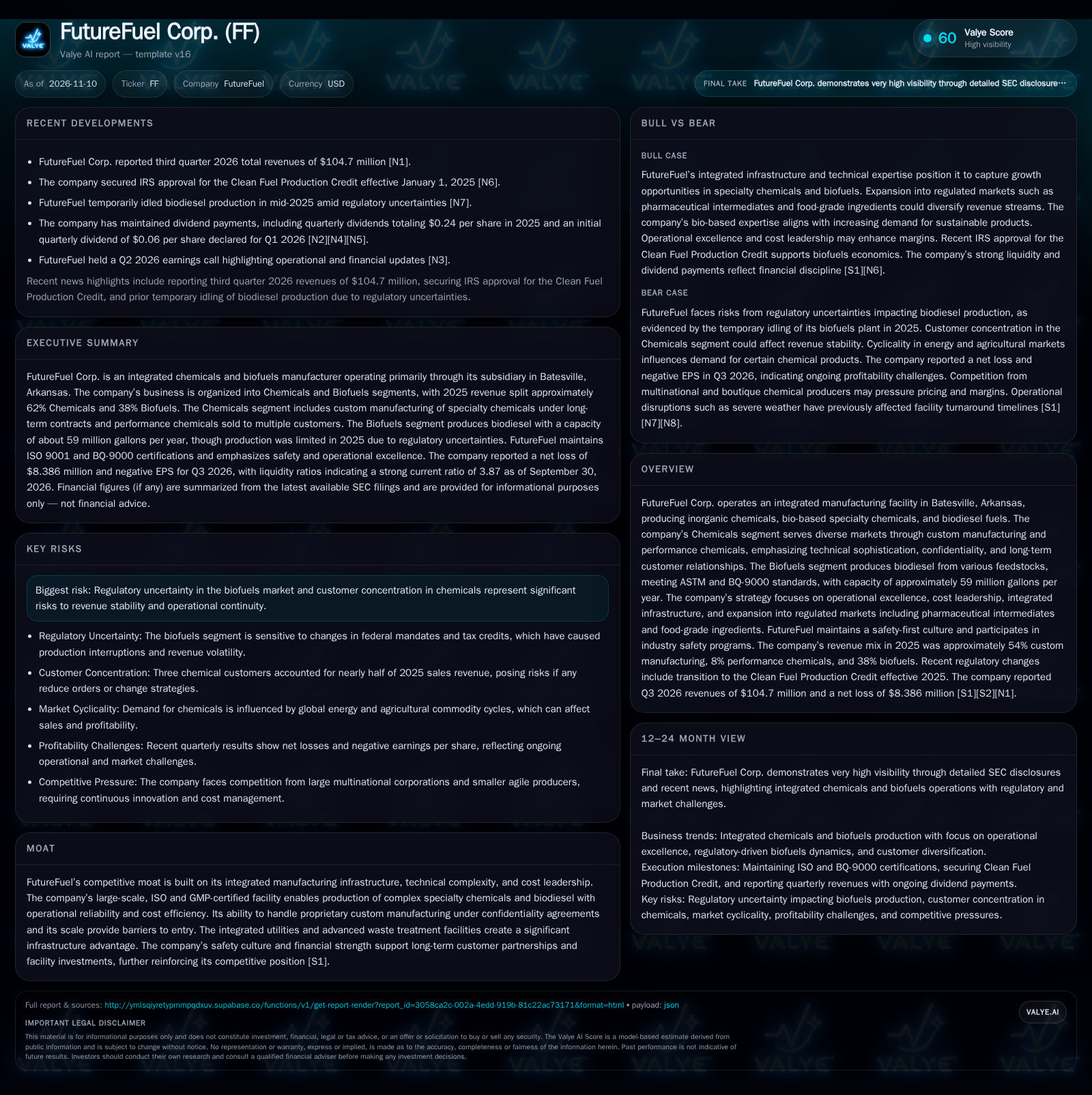
FutureFuel Corp. reported Q3 2026 revenues of $104.7 million alongside a net loss, reflecting persistent profitability challenges as its biofuels segment grapples with regulatory uncertainty and its chemicals business remains highly concentrated. The company’s cost leadership and technical infrastructure offer advantages, yet both demand cyclicality and policy risk test the resilience of its business model. Diversification into regulated markets and specialty products remains a strategic goal, but will require both end-market stability and successful customer expansion to materially alter the company’s risk/reward profile. [S1] [S2] [N1] [N7]
FutureFuel Corp. stands at the intersection of specialty chemicals and biofuels, leveraging an integrated Arkansas facility that delivers both custom chemical manufacturing and biodiesel production. While the company’s scale, technical sophistication, and cost leadership have historically provided a defensive moat, recent developments—including a net loss in Q3 2026 and a mid-2025 biodiesel production halt—underscore the limits of operational excellence when customer concentration and policy volatility converge. As FutureFuel seeks to diversify into regulated and higher-margin markets, the company’s ability to broaden its customer base and navigate shifting regulatory regimes will determine whether its infrastructure becomes a platform for growth or a fixed cost anchor.
Recent Losses and Production Disruptions Reshape the Strategic Landscape
FutureFuel reported total revenues of $104.7 million for Q3 2026, but this topline was accompanied by a net loss of $8.386 million [S2] [N1]. This negative profitability follows a period of significant volatility: the company temporarily idled its biodiesel production in mid-2025 amid regulatory uncertainty, directly impacting a segment that had contributed 38% of 2025 revenues [N7]. Meanwhile, the chemicals business—dominated by custom manufacturing—remains highly concentrated, with three customers accounting for nearly half of segment sales in 2025. These developments highlight both the company’s exposure to external shocks and the importance of strategic diversification to mitigate single-point failures.
How FutureFuel’s Revenue Mix and Cost Structure Influence Profitability
FutureFuel’s revenue model is anchored in two segments: Chemicals (custom manufacturing and performance chemicals) and Biofuels (primarily biodiesel). Custom manufacturing, which made up 54% of 2025 revenues, typically involves long-term, technically complex projects that can provide higher gross margins and some degree of revenue visibility—assuming customer retention. However, this concentration also amplifies the revenue impact of any major customer loss or contract renegotiation.
The performance chemicals subsegment, at 8% of revenue, appears less strategic but may offer higher incremental margins if scaled. The biofuels segment, at 38%, is fundamentally volume-driven but highly sensitive to feedstock prices, regulatory incentives (e.g., federal tax credits, RIN values), and policy mandates. Fixed costs (plant, utilities, advanced waste treatment) are significant, creating operating leverage that can quickly swing from a margin tailwind to a liability when volumes fall or prices compress. Capital intensity is moderate for chemicals but can spike in biofuels when regulatory changes necessitate process upgrades or idling. The company reported cash and liquidity metrics for the period; these figures do not by themselves establish operating runway, investment capacity, financial flexibility, or financing capacity.
The interplay between fixed and variable costs in FutureFuel's operations creates a nuanced profitability dynamic. While fixed costs such as plant maintenance, utilities, and compliance-related expenditures remain relatively stable regardless of production volume, variable costs like feedstock procurement and labor fluctuate with output levels. This cost structure means that volume declines—whether from regulatory disruptions or customer order variability—can disproportionately erode margins due to under-absorption of fixed costs. Moreover, the complexity of custom manufacturing projects often entails upfront capital and R&D investments that may not be immediately recoverable, adding another layer of risk if contract renewals are delayed or lost.
Additionally, the biofuels segment’s sensitivity to external factors extends beyond regulatory incentives to include commodity price volatility and supply chain constraints. Feedstock availability and cost can be influenced by agricultural cycles, geopolitical events, and global demand shifts, which in turn affect biodiesel production economics. If feedstock prices rise without corresponding increases in selling prices or subsidies, the margin compression can be severe. Conversely, a stable feedstock cost environment combined with supportive policies could enable scale efficiencies that improve overall segment profitability, highlighting the conditional nature of biofuels economics on multiple external variables.
Barriers to Entry, But Not to Volatility: Assessing FutureFuel’s Real Moat
FutureFuel’s integrated, ISO- and GMP-certified facility supports complex specialty chemical manufacturing, providing technical and infrastructure barriers that many smaller or less sophisticated competitors cannot easily replicate. Confidentiality agreements and the ability to handle proprietary processes help retain key custom manufacturing clients. In biofuels, scale and BQ-9000 certification enable compliance and cost efficiency, which can be meaningful in commodity-driven markets.
However, these advantages are not absolute. Large multinational chemical producers can match or exceed technical capabilities and may offer broader product portfolios or global supply chains. Boutique specialty firms can often outmaneuver larger players in niche segments. In biofuels, regulatory changes can commoditize or strand capacity regardless of scale. Thus, while FutureFuel’s moat is real on an operational level, it does not fully insulate the company from end-market cyclicality, customer consolidation, or policy-driven shocks.
Strategic Diversification and Regulatory Tailwinds Could Unlock Margin Expansion
The most favorable scenario for FutureFuel involves successfully expanding its chemicals business into regulated, higher-value markets such as pharmaceutical intermediates and food-grade ingredients. These end-markets typically offer longer contract durations, higher switching costs, and better margin profiles compared to commodity chemicals or biofuels. Regulatory certification and technical complexity could reinforce FutureFuel’s infrastructure advantage, supporting customer stickiness and price discipline.
On the biofuels side, a stable or favorable regulatory environment (e.g., reinstatement or expansion of federal tax credits, higher renewable fuel standards) could restore production volumes and pricing power. Evidence that would confirm this scenario includes a rebound in segment margins, new multi-year contracts in regulated chemical markets, increased customer diversification, and sustained positive net income. Conversely, failure to win new regulated contracts or continued policy instability would falsify the upside thesis.
Chemicals Stability, But Biofuels Remain a Swing Factor
The most plausible scenario is that FutureFuel’s chemicals segment provides a baseline of revenue and margin stability, anchored by existing long-term custom manufacturing contracts and incremental growth in performance chemicals. However, customer concentration remains a structural risk, and any attrition could quickly erode this stability. In biofuels, intermittent production and regulatory uncertainty persist, resulting in periodic swings in segment contribution and overall profitability.
This scenario would be confirmed by continued revenue concentration in a few key chemical customers, moderate growth in performance chemicals, and biofuels volumes that track regulatory or market-driven cycles. A material change in the customer mix, stable positive earnings, or a consistent recovery in biofuels margins would be needed to move the company out of this middle ground.
Customer Attrition and Unfavorable Policy Shifts Could Deepen Losses
If one of FutureFuel’s top three chemicals customers reduces orders or exits, the company could face a rapid revenue and margin contraction that fixed costs would exacerbate. Simultaneously, if biofuels incentives remain weak or adverse regulatory changes persist, the idling of production could become prolonged or even permanent, stranding assets and eroding segment economics.
Confirmation of the downside would include the announcement of major contract non-renewals, further biodiesel production cuts, or a sharp increase in net losses and cash burn. The thesis would be partially falsified by demonstrated customer retention, new contract wins, or a favorable regulatory shift that enables profitable biofuels production.
Milestones and Metrics That Will Test FutureFuel’s Diversification and Resilience Thesis
Quarterly customer concentration in the Chemicals segment—specifically, the percentage of revenue from the top three clients—would help gauge underlying revenue risk.
Volume and margin trends in the Biofuels segment, particularly after any regulatory developments or tax credit announcements, if disclosed.
New contract wins or expansions in regulated markets such as pharmaceutical intermediates or food-grade chemicals, which would signal successful diversification.
Facility utilization rates and any disclosed downtime or idling, especially in the biodiesel plant, as a proxy for operational leverage and asset productivity.
Net income trajectory and operating cash flow, to determine whether the business is moving toward sustainable profitability.
Any material changes in federal or state biofuels policy, tax credit status, or renewable fuel standards that could alter segment economics.
Disclaimer: This is research-only, informational analysis and not investment advice. It may include AI-generated interpretation and general industry context. Always verify important details using primary sources.

Comments