
Galaxy Digital: Integrated Digital Asset Platform and Data Center Ambitions Face Scale and Execution Tests
Galaxy Digital now operates at the intersection of institutional digital asset services and high-capacity data center infrastructure, with recent revenue growth and substantial contractual obligations underscoring both its multi-segment opportunity and the risks inherent in capital-intensive expansion.
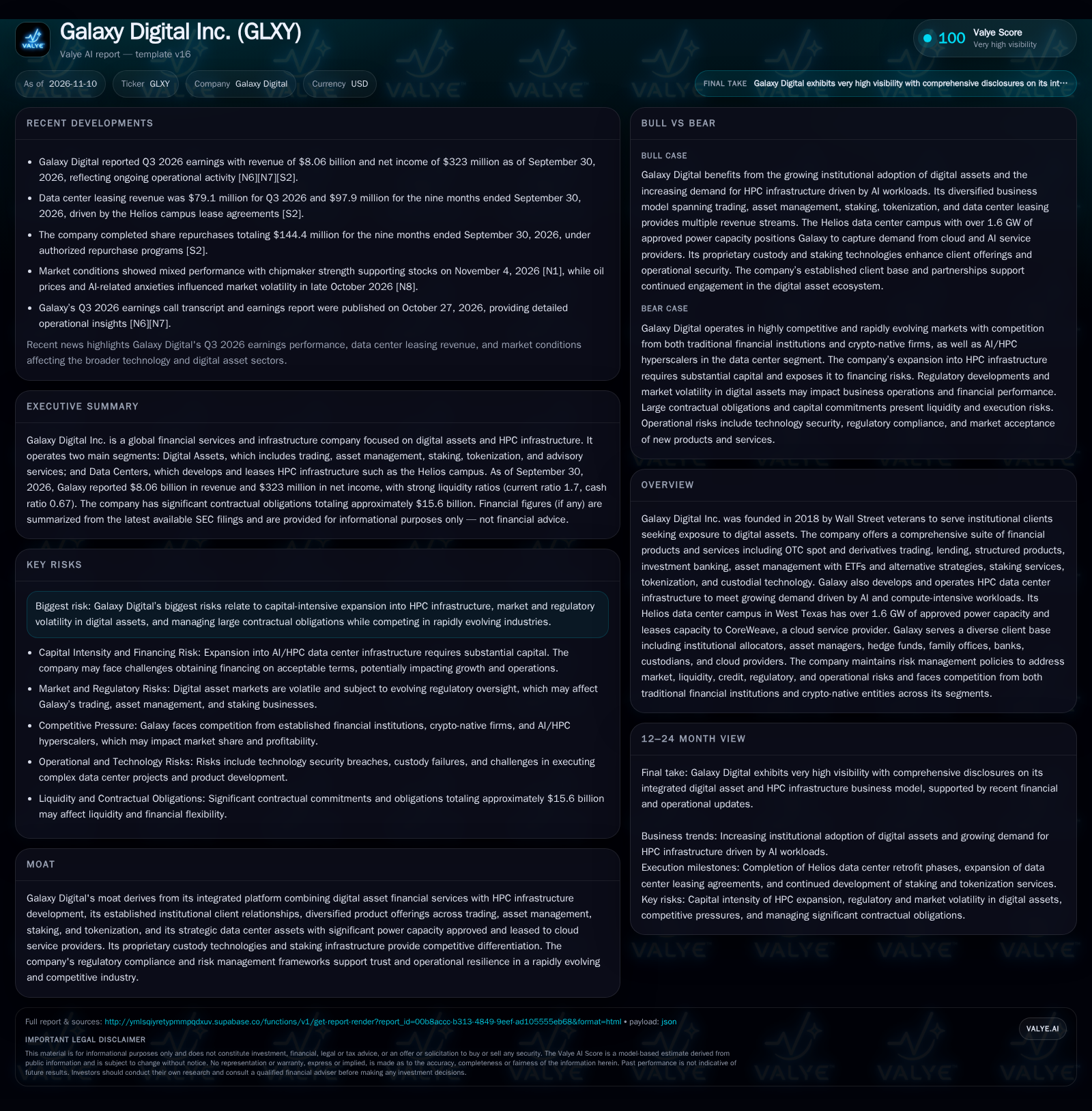
Galaxy Digital blends digital asset financial services with a growing footprint in high-performance computing (HPC) infrastructure, reporting $8.06 billion in revenue and $323 million net income for the first nine months of 2026. The company’s Helios data center campus is a cornerstone of its infrastructure strategy, but $15.6 billion in contractual obligations highlight the capital demands and execution risks as it contends with established and emerging competitors in both digital assets and AI-driven compute markets. [S2] [N6] [N7]
Galaxy Digital has evolved from a digital asset specialist into a diversified platform straddling institutional finance and the infrastructure backbone for AI and compute-intensive workloads. With $8.06 billion in year-to-date revenue and nearly $100 million in data center leasing income, the company’s Helios campus and suite of asset management, trading, staking, and tokenization services aim to capture demand from both digital asset allocators and cloud service providers. Yet, $15.6 billion in obligations and fierce competition from both traditional finance and hyperscaler tech giants mean Galaxy’s path forward hinges on disciplined execution and the ability to turn scale into sustainable returns. [S2] [N6] [N7]
Recent Financials and Operational Milestones Shape Strategic Outlook
Galaxy Digital reported $8.06 billion in revenue and $323 million in net income for the first nine months of 2026, indicating ongoing traction across its digital asset and infrastructure segments. Data center leasing revenue reached $97.9 million for the same period, with $79.1 million in Q3 alone, driven by the Helios campus’s agreements with cloud and AI service providers such as CoreWeave. On the balance sheet, Galaxy held $1.32 billion in cash and equivalents and $3.16 billion in short-term investments as of September 30, 2026, with a current ratio of 1.7. At the same time, the company’s contractual obligations stood at $15.6 billion, reflecting the capital intensity and multiyear commitments underpinning its expansion. [S2] [N6] [N7]
The company also completed $144.4 million in share repurchases in the first nine months of 2026 and authorized an additional $200 million buyback program in October, signaling capital allocation activity but not necessarily a shift in capital priorities. The operational and financial updates present a business scaling rapidly across both digital asset and infrastructure domains, but with increasing exposure to execution, financing, and competitive risks.
Multi-Segment Profit Pools and the Economics of Scale in Digital Assets and Data Centers
Galaxy Digital’s business model combines fee- and spread-based revenues from digital asset trading, lending, structured products, and asset management with recurring, contract-driven income from data center leasing. The digital asset segment is likely characterized by high transaction and management fees, with variable costs tied to trading operations, technology, and compliance. Asset management—especially ETF and alternative strategies—can offer operating leverage as assets under management (AUM) grow, but is exposed to market volatility and performance-related fee compression.
The data center segment introduces a fundamentally different economic structure. Leasing HPC capacity, especially to AI and cloud providers, generates relatively stable, long-term revenue streams, but requires substantial upfront capital for site acquisition, retrofitting, and power infrastructure. The Helios campus’s 1.6 GW of approved power capacity positions Galaxy to address hyperscale demand, but the economics hinge on utilization rates, pricing power, and the ability to amortize fixed costs over long-term client contracts. With $15.6 billion in contractual obligations, the company’s ability to maintain high occupancy, secure favorable lease terms, and manage debt service is critical. If Galaxy can scale both segments efficiently, it may realize meaningful operating leverage; if not, margin pressure and capital constraints could emerge.
Competing Across Two Fronts: Institutional Digital Assets and Hyperscale Compute Infrastructure
Galaxy Digital faces a unique competitive landscape as it straddles both institutional digital asset services and the high-performance computing infrastructure market. In digital assets, it competes with established Wall Street banks (for custody, trading, and structured solutions), crypto-native firms (for OTC trading, staking, and tokenization), and fintech upstarts in retail. The breadth of Galaxy’s offering—spanning trading, asset management, staking, and tokenization—may provide cross-sell opportunities, but also exposes it to rapid innovation cycles and regulatory flux.
On the data center side, Galaxy is up against hyperscalers, specialized colocation providers, and infrastructure funds, many of which have deeper capital reserves and established client rosters. The Helios campus’s scale and power capacity are competitive differentiators, but rivals may respond with aggressive pricing or accelerate their own expansion. The company’s ability to bundle financial services with infrastructure offerings or develop proprietary solutions (e.g., staking-as-a-service for institutional clients) could create switching frictions, but the sustainability of these advantages will be tested as market dynamics evolve.
Integrated Platform Leverages Cross-Segment Synergies and Market Adoption
The most favorable scenario for Galaxy Digital sees the company capitalizing on surging institutional demand for both digital assets and AI-driven compute infrastructure. If Helios achieves high occupancy and lease rates—especially with long-term, creditworthy tenants like CoreWeave—data center economics could drive margin expansion and steady cash flows. Simultaneously, if Galaxy’s digital asset platform continues to attract institutional flows, grows AUM, and successfully launches innovative products (such as tokenized real-world assets and staking services), the firm could benefit from both fee income and repeat client engagement.
Evidence for this scenario would include sustained growth in data center leasing revenue, announcements of new or expanded long-term contracts, rising AUM and client count in asset management, and visible adoption of tokenization and staking offerings. Confirmation would also come from improving operating margins and clear progress on de-risking capital commitments through project-level financing or joint ventures.
Balanced Growth Amid Execution and Capital Allocation Challenges
The most plausible outcome is that Galaxy Digital achieves moderate, multi-segment growth but must continually manage the tension between capital-intensive infrastructure expansion and the volatile economics of digital assets. Data center leasing builds gradually as Helios ramps up, with occupancy and pricing pressured by hyperscaler competition and cyclical demand for AI compute. Digital asset services maintain relevance with institutional clients, but fee compression and episodic market volatility limit operating leverage.
Confirming evidence would be steady data center revenue growth with incremental capacity additions, stable but not surging AUM, and ongoing product launches in staking and tokenization. Signs that Galaxy can manage its $15.6 billion in obligations—such as refinancing, extended lease maturities, or disciplined capital spending—would support this scenario. Conversely, margin stagnation, underutilized data center assets, or missed execution milestones would suggest greater headwinds.
Capital Intensity, Utilization Risk, and Market Volatility Constrain Returns
A negative scenario would see Galaxy Digital’s data center expansion outpacing demand, resulting in underutilized capacity and fixed-cost drag. Meanwhile, digital asset revenues could be pressured by adverse regulatory actions, declining trading volumes, or fee erosion from intensified competition—potentially exacerbating liquidity risk given the scale of Galaxy’s outstanding commitments.
Evidence for this scenario would include stagnating or declining data center leasing revenue, disclosure of delays in capacity retrofits or tenant onboarding, rising leverage ratios, or the need for dilutive capital raises. Weakness in digital asset revenue, client attrition, or regulatory setbacks would compound the risk profile.
Milestones and Metrics That Will Validate or Challenge Galaxy Digital’s Expansion Thesis
Quarterly data center occupancy rates and new lease signings at the Helios campus—if disclosed—would clarify the pace of infrastructure monetization.
Growth in data center leasing revenue and average lease duration would help assess the stability and scalability of the infrastructure segment.
Updates on total assets under management (AUM) and client count in the asset management business would confirm institutional adoption trends.
Breakdown of digital asset trading, lending, and staking revenue by product line would illuminate the durability of fee pools and competitive positioning.
Disclosure of major contract renewals, tenant expansions, or new partnerships in both segments would signal client stickiness and cross-sell potential.
Details on capital expenditure commitments and progress on Helios retrofits would clarify execution risk and capital discipline.
Any changes in regulatory posture or compliance costs affecting digital asset businesses would test the resilience of Galaxy’s operating model.
Evidence of refinancing, project-level financing, or risk-sharing arrangements to manage the $15.6 billion in obligations would be critical for evaluating liquidity and balance sheet health.
Disclaimer: This is research-only, informational analysis and not investment advice. It may include AI-generated interpretation and general industry context. Always verify important details using primary sources.

Comments