
Infinity Natural Resources: Managing Commodity Volatility, Tax Complexity, and Financial Controls After IPO
Infinity Natural Resources, Inc. faces the dual challenges of commodity price volatility and internal control weaknesses while leveraging its reserve-backed credit facility and established hedging program. The company’s post-IPO structure introduces complex tax obligations with contingent liabilities, making execution in both operations and financial management critical for value creation.
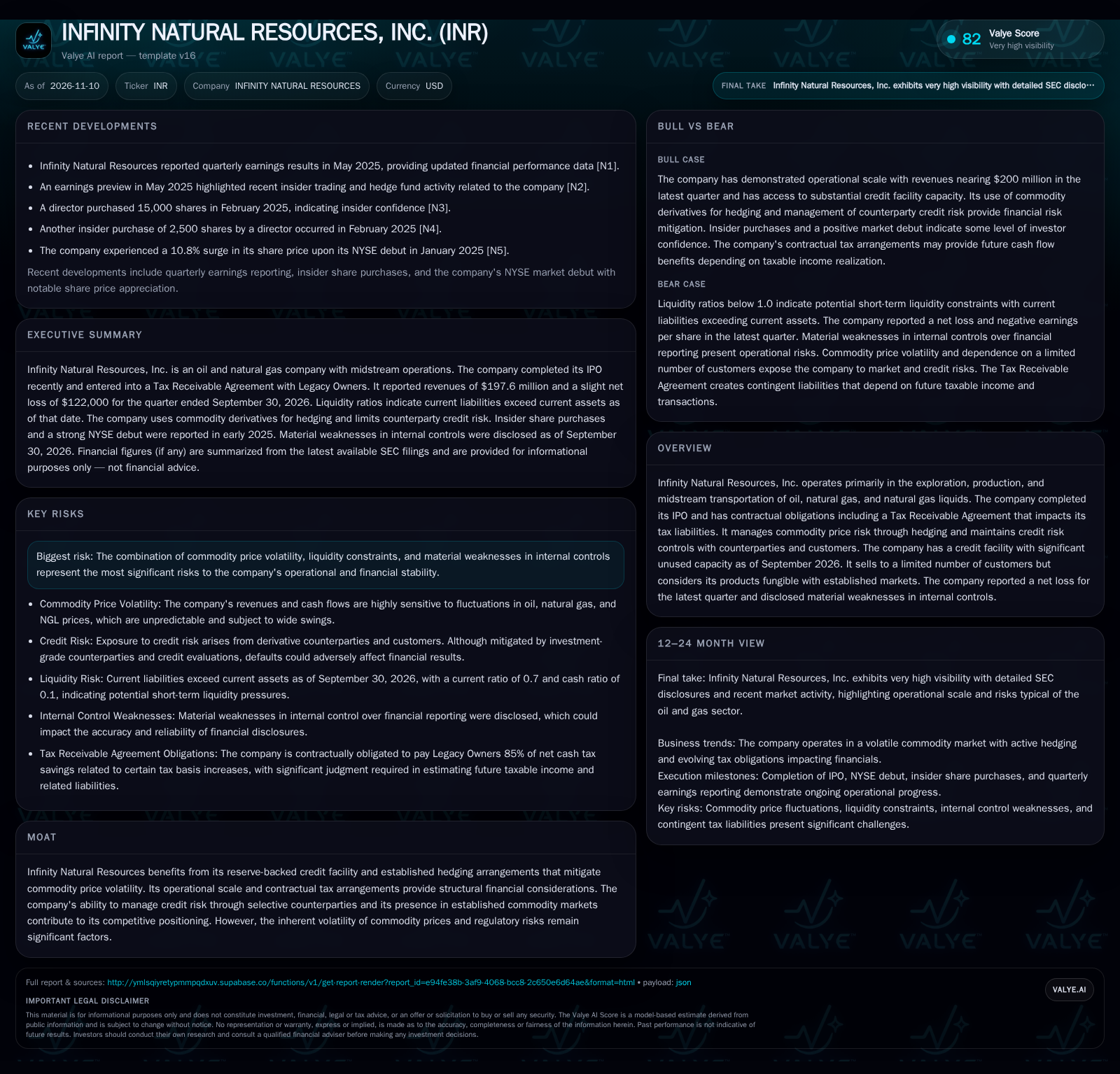
Infinity Natural Resources (INR) operates in the volatile oil and gas sector, reporting $197.6M in quarterly revenue but a slight net loss as of September 2026. Despite a fully undrawn $875M credit facility, liquidity ratios remain weak and material weaknesses in internal controls persist. Tax Receivable Agreement obligations and reliance on a small customer base add layers of long-term financial and operational complexity. The core thesis: INR’s path forward hinges on addressing liquidity pressures, strengthening controls, and sustaining operational scale amid commodity uncertainty. [S1] [S2]
Infinity Natural Resources, Inc. (INR) has quickly established operational scale in the oil, natural gas, and NGL sector following its NYSE debut, but the company now faces a complex mix of financial, operational, and structural risks. Its latest quarterly results reveal both strength—nearly $200 million in revenue and a fully available $875 million credit facility—and vulnerability, with a net loss, sub-1.0 liquidity ratios, and ongoing internal control weaknesses. The firm’s Tax Receivable Agreement introduces contingent tax liabilities that further complicate its financial profile. For INR, the ability to navigate commodity swings, shore up financial controls, and convert scale into sustained profitability will determine whether its post-IPO trajectory delivers durable shareholder value.
Recent Financial Results Highlight Structural Exposures Shaping Near-Term Outlook
Infinity Natural Resources reported $197.6 million in revenue for the quarter ending September 30, 2026, but posted a small net loss of $122,000, translating to -$0.37 in basic and diluted EPS. Notably, INR had a fully undrawn $875 million credit facility, providing theoretical capital access, but this has not translated into a reported liquidity position as measured by balance-sheet ratios. The company also disclosed material weaknesses in internal control over financial reporting during the same period. Finally, the Tax Receivable Agreement obligates INR to pay Legacy Owners 85% of certain tax-related cash savings, creating a contingent liability that depends on future taxable income and involves significant estimation uncertainty. [S1] [S2]
How Commodity Revenue and Margins Influence Potential Financial Flexibility
INR’s core economics are tied to the exploration, production, and midstream transportation of oil, natural gas, and NGLs, with revenue and margin profiles highly sensitive to commodity prices. Volume and realized price mix drive topline results, while operating leverage arises from significant fixed infrastructure and development costs. Midstream activities can offer more stable, fee-based income, but this stability is often offset by the volatility of upstream production economics and spot market pricing.
The company’s use of commodity derivatives provides some insulation from near-term price swings, but hedging strategies can only partially offset the impact of sustained downward price trends or basis differentials. INR’s reserve-backed $875 million credit facility theoretically enables capital deployment for drilling or acquisitions, but actual funding flexibility is constrained by the need to maintain compliance with debt covenants and manage liquidity ratios. The Tax Receivable Agreement adds another layer: while it could provide future cash tax benefits, it also creates a long-duration cash outflow obligation that directly reduces retained earnings as tax benefits are realized. In practice, INR’s ability to generate free cash flow, invest for growth, and service both operational and contingent liabilities will depend on its success in sustaining production volumes, managing costs, and navigating commodity cycles.
Market Position and Risks Within a Fragmented Energy Sector
Infinity Natural Resources operates in the intensely competitive Appalachian Basin, where peers range from major integrated oil companies to independent E&P and midstream specialists. The company’s operational footprint in the Utica and Marcellus shales offers access to high-potential resource plays, but also exposes INR to price competition, service cost inflation, and regulatory scrutiny endemic to the region. Product fungibility means that switching frictions for customers are low—buyers can substitute supplies with little penalty—limiting pricing power and making customer concentration more of a credit risk than a revenue continuity risk.
While INR mitigates some counterparty risk by dealing primarily with investment-grade buyers and counterparties, the broader threat of commodity substitution (e.g., renewables, electrification, demand-side management) and evolving environmental regulation remains. The company’s hedging program and reserve-backed credit facility provide some competitive ballast, but these are widely available tools within the sector. True differentiation may depend on cost structure, resource quality, operational efficiency, and the ability to execute complex tax and capital strategies in a volatile market.
Unlocking Structural Value Through Commodity Strength and Control Execution
Successful remediation of internal control weaknesses would bolster investor confidence and potentially lower the company’s cost of capital. Should realized taxable income consistently exceed projections, the Tax Receivable Agreement would deliver cash tax savings—even after Legacy Owner payments—improving net cash generation.
Upside confirmation would come from consecutive quarters of positive net income, a reported liquidity-ratio trends, tangible progress on internal control remediation, and evidence that production volumes and realized pricing outpace sector averages. In this scenario, the company could consider opportunistic bolt-on acquisitions or dividend initiation, further supporting equity value.
Handling Cyclicality and Obligations During Energy Downturns
The most plausible outcome is that INR continues to operate with moderate earnings volatility, driven by ongoing commodity price fluctuations and the structural realities of its business model. The undrawn credit facility offers a safety valve for short-term liquidity management, but persistent sub-1.0 current ratios suggest continued working capital tightness unless commodity prices improve or cost discipline intensifies.
Base case performance would be confirmed if INR delivers steady production volumes, maintains access to its credit facility without covenant breaches, and shows incremental improvement in internal controls. Tax Receivable Agreement payments would remain a manageable, if persistent, drag on net cash flows. The company’s ability to avoid major operational disruptions or significant customer defaults, while incrementally improving its liquidity position and addressing control issues, would characterize a typical mid-cap E&P trajectory.
Financial Risk Intensifies with Price Weakness and Control Lapses
Should commodity prices deteriorate sharply or remain depressed, INR’s revenue and cash flow could decline materially, pressuring its already reported liquidity position and forcing reliance on its credit facility or asset sales. If internal control weaknesses persist or worsen, the risk of financial reporting errors, regulatory scrutiny, or restatements could increase, further undermining market confidence and possibly restricting access to capital.
A scenario of operational setbacks—such as production shortfalls, unexpected cost overruns, or customer payment defaults—would compound these risks. If realized taxable income falls short, the company may not generate enough cash tax savings to offset Tax Receivable Agreement obligations, resulting in a net cash drain. Downside confirmation would include a sustained decline in current and cash ratios, borrowing under the credit facility, negative free cash flow, or disclosure of adverse regulatory or audit findings.
Tracking INR’s Financial, Operational, and Strategic Progress
Consecutive quarters of positive net income and free cash flow would help validate the company’s ability to convert operational scale into sustainable profitability.
A reported liquidity-ratio trends, especially above 1.0, would indicate progress in addressing short-term liquidity pressures.
Resolution and external validation of remediation efforts for internal control weaknesses—auditor sign-off or removal of the material weakness disclosure—would reduce operational risk.
Disclosure of Tax Receivable Agreement cash payments, as well as realized cash tax savings, would clarify the net impact of this obligation on long-term cash flows.
Production volume trends and realized commodity pricing versus regional benchmarks would demonstrate operational execution and market competitiveness.
Borrowing activity or changes in availability under the credit facility would signal shifts in underlying liquidity or capital needs.
Customer concentration metrics—if disclosed—would help assess exposure to counterparty default risk and the effectiveness of INR’s claim that product fungibility limits revenue risk.
Updates on regulatory compliance, especially related to environmental standards or new permitting requirements, could materially affect both cost structure and operational continuity.
Disclaimer: This is research-only, informational analysis and not investment advice. It may include AI-generated interpretation and general industry context. Always verify important details using primary sources.

Comments