
Key Tronic’s Restructuring Gambit: s, Margin Pressures, and the Stakes of Execution
The company’s path forward depends on execution, cost structure improvements, and its ability to navigate competitive and macroeconomic headwinds.
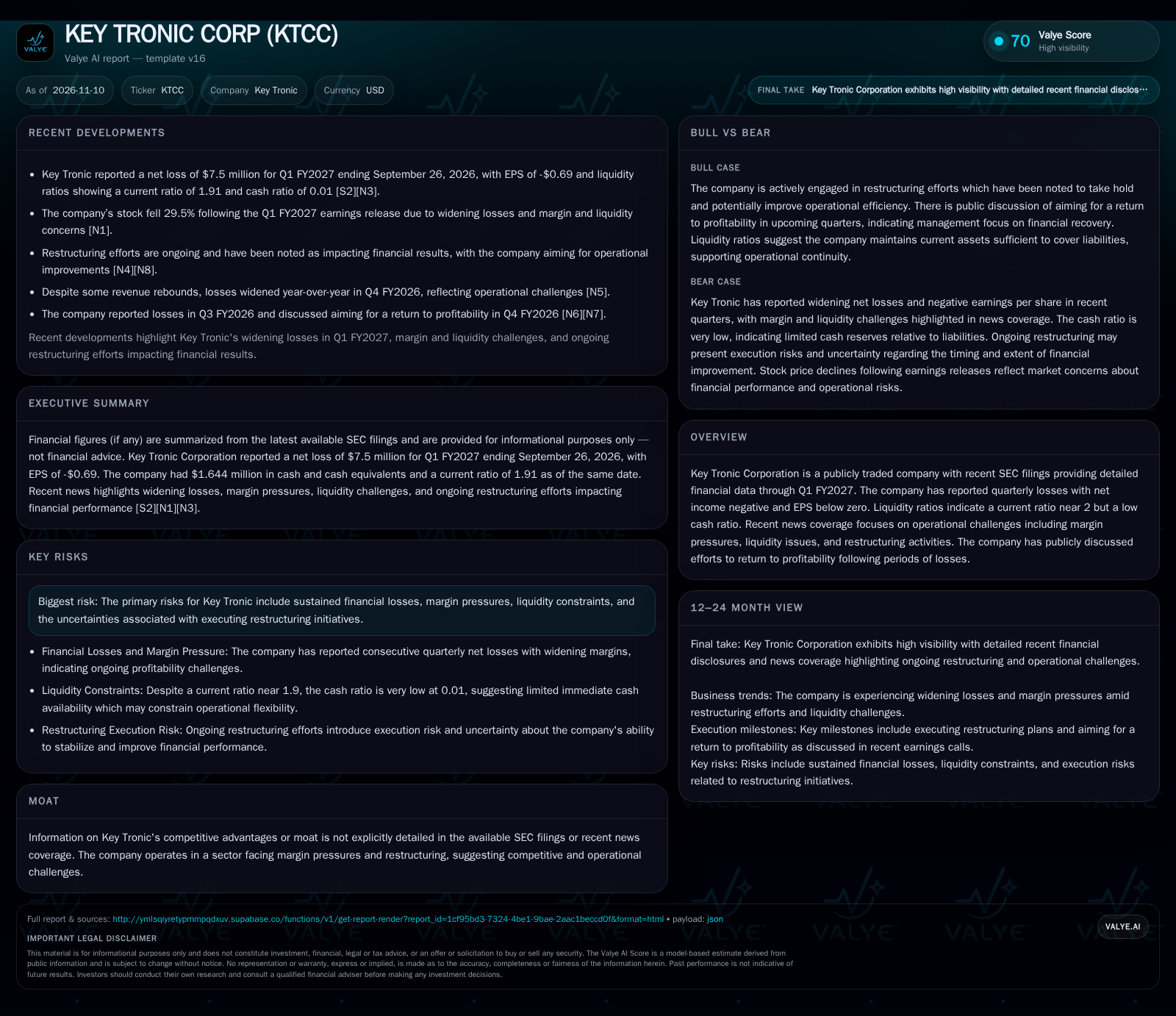
[S2] [N3] Despite revenue rebounds, losses have widened and restructuring efforts continue. The company’s near-term outlook hinges on achieving operational efficiencies and returning to profitability.
The stakes are high: execution missteps or further margin erosion could test the company’s ability to stabilize its operations and fund its obligations, while successful restructuring could lay the groundwork for a return to profitability.
Recent Losses, Cash Constraints, and the Urgency of Restructuring
Key Tronic reported a net loss of $7.5 million for the quarter ended September 26, 2026 (Q1 FY2027), with a basic and diluted EPS of -$0.69 [S2] [N3]. The company’s balance sheet shows $1.644 million in cash and cash equivalents against current assets of $228.974 million and current liabilities of $119.991 million, resulting in a current ratio of 1.91 and a cash ratio of just 0.01 [S2]. Despite pockets of revenue stabilization—Q3 FY2026 revenue was $89.571 million—losses have widened year-over-year, and margin pressures remain acute [N5]. Management has publicly signaled a goal of returning to profitability, with restructuring efforts ongoing [N6]. These facts set the stage for a business facing both immediate liquidity challenges and the longer-term necessity to improve its cost structure and operational efficiency.
The interplay between liquidity constraints and operational performance creates a feedback loop that can either accelerate recovery or deepen financial distress. This dynamic underscores the critical importance of aligning restructuring timelines with liquidity management to avoid a scenario where operational improvements come too late to prevent solvency pressures.
How Key Tronic’s Cost Structure and Working Capital Shape Its Profit Potential
Key Tronic operates in the electronics manufacturing services (EMS) sector, a business characterized by thin margins, high working capital needs, and significant exposure to variable costs such as labor, materials, and logistics. The company’s revenue is typically tied to manufacturing contracts, with most sales recognized upon delivery of goods rather than long-term recurring contracts, limiting forward visibility and pricing power [S2]. Fixed costs—such as plant, equipment, and SG&A—can create operating leverage, but only if volumes and margins are sufficient to cover overhead. In recent quarters, margin compression has outpaced any operational leverage, leading to persistent losses. This dynamic can strain liquidity if customer payment cycles lengthen or if inventory builds up due to demand volatility.
Working capital management is particularly pivotal in the EMS sector, where inventory turnover and receivables collection directly impact cash flow. If Key Tronic can shorten its cash conversion cycle by negotiating better payment terms with suppliers or accelerating customer collections, it could alleviate liquidity pressures without necessarily increasing revenue. However, aggressive working capital tightening risks straining supplier relationships or compromising customer satisfaction, which may have downstream effects on contract renewals and pricing leverage. Thus, the company must balance cash flow improvements against potential impacts on operational continuity and market competitiveness.
Competitive Pressures in a Margin-Sensitive EMS Landscape
Key Tronic operates in a highly competitive EMS sector, where contract manufacturers vie for business from original equipment manufacturers (OEMs) across industries such as computing, industrial, and consumer electronics. Competition is driven by price, quality, reliability, and the ability to offer value-added services such as design, prototyping, and logistics. Larger EMS peers often benefit from scale, global footprint, and stronger purchasing power—allowing them to better absorb cost spikes and offer lower pricing. In this context, Key Tronic’s margin pressures suggest that it may lack the scale or differentiation to command premium pricing or secure long-term, high-margin contracts. Moreover, EMS customers typically have low switching costs and can shift volumes in response to cost, quality, or supply chain disruptions. The company’s multi-country manufacturing footprint (Mexico, China, Vietnam, U.S.) offers some geographic flexibility but also exposes it to labor, logistics, and geopolitical risks, further complicating cost management and competitive positioning.
In addition to scale and geographic footprint, technological capabilities and customer service quality increasingly differentiate EMS providers. Firms able to integrate advanced manufacturing technologies, such as automation and data analytics, can achieve cost advantages and respond more nimbly to customer requirements. If Key Tronic invests in such capabilities, it could enhance its value proposition despite scale limitations. However, these investments require upfront capital and a skilled workforce, which may be challenging amid current financial constraints. Furthermore, the company's multi-country operations introduce complexity in standardizing quality and process improvements, potentially diluting the benefits of technological upgrades.
If Restructuring Delivers: Margin Recovery and Operating Leverage
A successful restructuring could enable Key Tronic to streamline its cost base, improve operational efficiency, and restore gross margins. This would require disciplined execution: reducing labor and overhead costs, optimizing its manufacturing footprint, and tightening working capital management to generate cash. If the company can align its cost structure with current demand levels and stabilize margins, even modest revenue growth could yield significant operating leverage due to the fixed-cost nature of its facilities and SG&A. Evidence confirming this scenario would include a return to positive operating income, sequential margin expansion, and improved cash flow from operations. Additionally, if restructuring leads to more competitive pricing or the ability to win higher-value contracts, the company could regain some pricing power. Falsification would come from continued margin compression, persistent losses, or further liquidity deterioration despite restructuring efforts.
Operational restructuring that successfully reduces fixed costs and streamlines manufacturing processes may also improve the company's agility in responding to market shifts. Enhanced flexibility could allow Key Tronic to scale production up or down more efficiently, preserving margins during demand fluctuations. Moreover, improved working capital management could free up cash to reinvest in product development or customer engagement initiatives, further strengthening competitive positioning. However, realizing these benefits depends on effective change management and employee buy-in, as resistance or execution delays could undermine restructuring outcomes and prolong financial strain.
Stabilization Hinges on Cost Control and Working Capital Discipline
The most plausible scenario is that Key Tronic achieves some stabilization through incremental improvements in cost control and working capital management, but persistent industry headwinds—pricing pressure, inflation, and customer volatility—limit the pace of margin recovery. The company may reduce the severity of losses and slow cash burn, but without a step-change in demand or a breakthrough in operational efficiency, a swift return to robust profitability appears unlikely. Confirming evidence would be narrower quarterly losses, stable or improving gross margins, and positive cash flow from operations. Signs of falsification would include renewed losses that outpace cost savings, rising inventory or receivables days, or the need to secure external financing to cover short-term obligations.
Margin Erosion and Liquidity Stress Could Force Harder Choices
If restructuring fails to contain costs or if external shocks—such as further input inflation, customer losses, or geopolitical disruptions—hit, Key Tronic could face deeper margin erosion and acute liquidity stress. In an adverse scenario, persistent losses could erode equity, damage supplier and customer confidence, and threaten covenant compliance or solvency. Evidence supporting this scenario would include negative operating cash flow, shrinking current ratios, delayed payments to suppliers, or announcements of asset sales, layoffs, or debt restructuring.
Testing the Turnaround: What Will Determine if Key Tronic’s Recovery Sticks?
Quarterly gross margin trends: Sequential improvement would indicate restructuring benefits are materializing; continued compression would suggest deeper problems.
Cash flow from operations: Positive or improving cash generation would signal better working capital management and cost control.
Trends in inventory and accounts receivable days: A useful metric would be the conversion cycle—deterioration could signal rising working capital risk.
Operating expense as a percentage of revenue: Declines would indicate successful cost cutting; increases may reflect restructuring inefficiency or revenue pressure.
Revenue concentration and customer churn, if disclosed: Increased concentration or elevated churn could signal competitive or credit risks.
Progress and disclosures around restructuring milestones: Announcements of completed facility consolidations, headcount reductions, or cost savings would help test the thesis.
Ability to secure additional liquidity or credit lines, if needed: New financing terms or capital raises would indicate external confidence (or lack thereof) in the turnaround.
Management guidance and forward-looking commentary: Shifts in tone or outlook on earnings calls may provide early signals of stabilization or further distress.
Disclaimer: This is research-only, informational analysis and not investment advice. It may include AI-generated interpretation and general industry context. Always verify important details using primary sources.

Comments