
Babcock & Wilcox: Contract Risk, Refinancing Stakes, and the Industrial Project Cycle
Babcock & Wilcox faces a pivotal twelve months as it manages a shrinking backlog, break-even earnings, and the need to refinance or repay $6.50% Senior Notes by late 2026. The company’s specialized engineering services and industrial project pipeline offer durable customer ties, but fixed-price contract exposure, skilled labor shortages, and supplier dependencies create persistent operational and financial volatility.
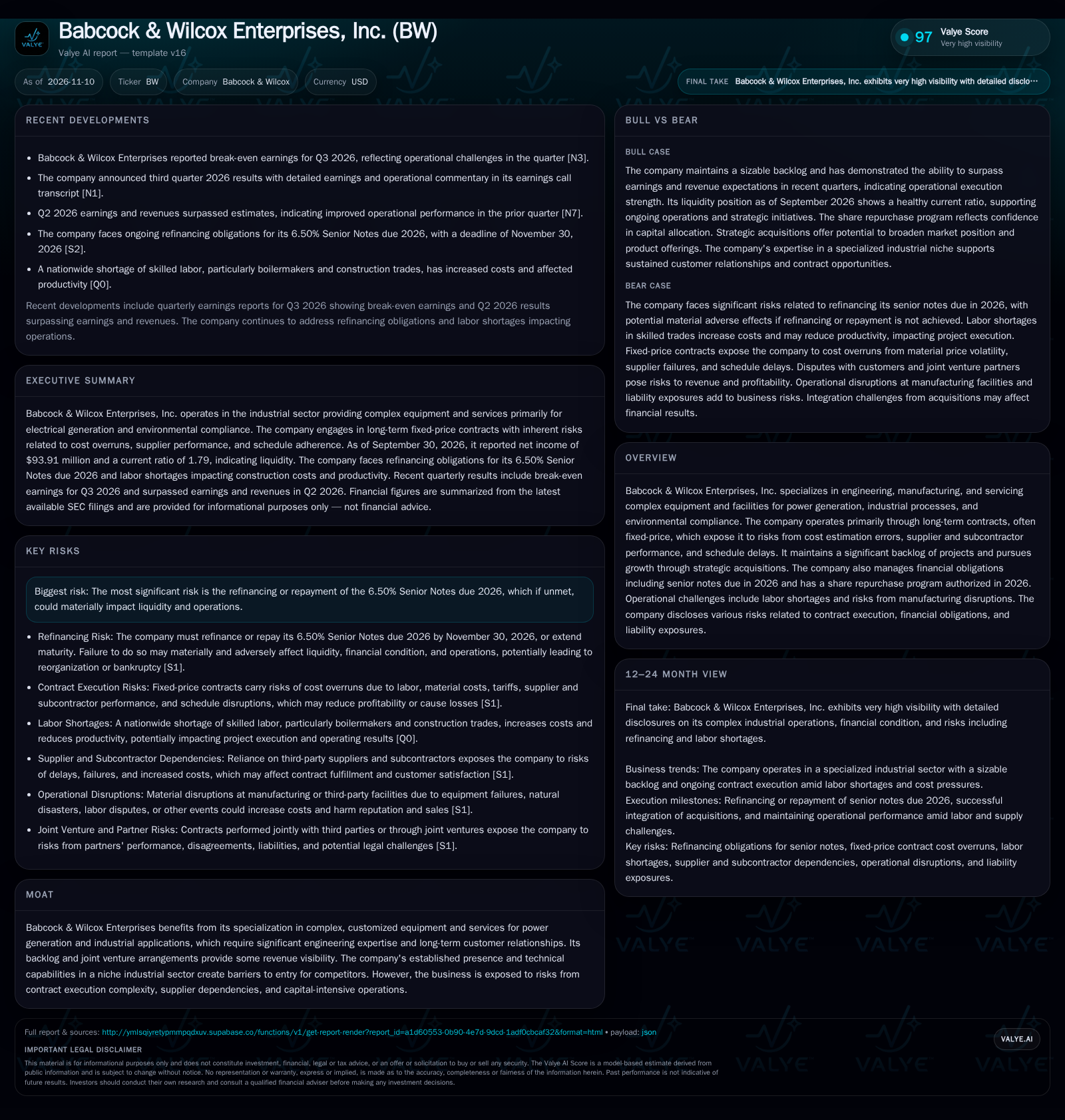
Babcock & Wilcox Enterprises, Inc. (BW) enters late 2026 with a $423.6 million backlog, break-even Q3 earnings, and a looming November 2026 deadline to refinance or repay its 6.50% Senior Notes. The company’s reliance on fixed-price, long-term industrial contracts creates both revenue visibility and cost-overrun risk, amplified by labor shortages and supply chain dependencies. The refinancing event and project execution outcomes will define near-term valuation and business stability. [S2] [N3]
Babcock & Wilcox Enterprises, Inc. stands at a crucial crossroads in late 2026. Its core business—delivering complex, custom-engineered systems for power generation and industrial clients—anchors a robust but declining project backlog and exposes the company to the twin risks of project execution and financial leverage. With break-even earnings in Q3 2026 and a looming deadline to refinance or repay $6.50% Senior Notes by November 30, 2026, BW’s performance over the next year will hinge on its ability to manage fixed-price contract risk, navigate skilled labor shortages, and secure new work to replenish its pipeline. The stakes are heightened by the capital-intensive nature of its offerings and the cyclical, relationship-driven industrial project market. [S2] [N3]
Shrinking Backlog, Break-Even Quarter, and Looming Refinancing Deadline
Babcock & Wilcox reported a backlog of $423.6 million as of September 30, 2026, representing a decline from $495.2 million year-over-year and reflecting the pace of project completions relative to new orders. This backlog provides near-term revenue visibility but also signals potential softness in order intake or project wins. For Q3 2026, the company posted break-even earnings, a notable deceleration from the Q2 period when both earnings and revenues surpassed expectations. These results underscore the volatility inherent in large, custom project-based business models. Critically, the company faces a requirement to refinance or repay its 6.50% Senior Notes by November 30, 2026; failure to address this obligation could have material adverse effects on liquidity and operations. [S2] [N3] [N7]
How Fixed-Price Contracts and Project Mix Shape Profitability
Babcock & Wilcox primarily generates revenue through long-term, often fixed-price contracts for power generation, industrial process, and environmental compliance equipment and services. This model offers upfront backlog and revenue visibility but exposes the company to cost overrun risk if material, labor, or subcontractor expenses exceed estimates. Fixed-price contracts transfer a significant portion of project risk to the contractor, so margin realization depends on accurate initial estimates, disciplined execution, and supply chain reliability.
The company’s cost base is weighted toward skilled labor, specialized engineering, and materials such as steel—input costs that can be volatile and subject to broader macroeconomic or supply chain disruptions. The nationwide shortage of skilled labor, especially boilermakers and construction trades, has increased costs and could constrain project delivery or require premium compensation.
Operating leverage can be significant in periods of high backlog turnover and efficient execution, but earnings can swing sharply if projects encounter delays, disputes, or cost inflation. Capital needs are episodic, driven by working capital requirements for projects in progress and the timing of milestone payments. The company reported cash and liquidity metrics for the period; these figures do not by themselves establish operating runway, investment capacity, financial flexibility, or financing capacity. [S2]
Specialization, Engineering Depth, and the Limits of Industrial Moats
BW’s competitive position derives from its technical expertise in designing and delivering complex, customized solutions for power and industrial clients. Long-standing customer relationships and a reputation for execution in highly regulated, safety-critical environments provide some barriers to entry and recurring business opportunities, especially for retrofit and maintenance work.
However, the company competes against a range of global industrial engineering firms and regional specialists, many of whom can also bid on large infrastructure or compliance projects. The fixed-price contract structure commoditizes some aspects of competition, as customers may select on price and perceived reliability rather than pure technology differentiation. Supplier and subcontractor dependencies also limit BW’s ability to fully control project outcomes, and joint venture arrangements can introduce counterparty risk and dilute margins if partner execution falters.
Technology substitution risk is modest, as the underlying demand for power generation, emissions control, and industrial process reliability is durable, but shifts in regulatory requirements or customer capex priorities could change the mix or timing of projects.
Margin Recovery and Backlog Replenishment Drive a Positive Re-rating
A constructive scenario for Babcock & Wilcox would involve timely and cost-effective execution of its current backlog, resulting in margin recovery and improved profitability versus the recent break-even quarter. If the company is able to secure new project wins at attractive terms, backlog could stabilize or grow, providing greater revenue visibility into 2027. Successful refinancing or repayment of the $6.50% Senior Notes on favorable terms would remove a major financial overhang, potentially enabling resumed share repurchases and strategic investments.
Evidence that would confirm this scenario includes a rebound in quarterly earnings and margins, announcement of significant new contract awards, and public disclosure of a completed refinancing or debt extension. A return to positive earnings momentum and backlog growth would likely be accompanied by improved cash flow conversion and increased management willingness to deploy capital for buybacks or bolt-on acquisitions.
Managing Through Volatility: Navigating Project Cycles and Debt Maturity
The most plausible trajectory is that BW continues to manage through project-cycle volatility, with earnings fluctuating based on the timing and mix of large contract completions and new order intake. Backlog may remain stable or decline modestly if new bookings only partially offset project run-off. The company will likely devote significant management attention to refinancing or repaying the Senior Notes due November 2026, with the outcome potentially influenced by market conditions and BW’s operating performance over the next four quarters.
This scenario would be confirmed if backlog stabilizes near current levels, quarterly earnings remain uneven but generally positive, and the company discloses refinancing progress or interim extensions. Conversely, a sharp drop in backlog, persistent operating losses, or indications of refinancing difficulty would undermine this base case.
Refinancing Failure and Project Execution Missteps Trigger Financial Stress
The adverse scenario centers on an inability to refinance or repay the $6.50% Senior Notes by the November 2026 deadline, which could result in material adverse effects on liquidity, force asset sales, or potentially trigger reorganization or bankruptcy proceedings.
Evidence for this scenario would include public disclosure of failed or delayed refinancing negotiations, material covenant breaches, or the announcement of asset sales or restructuring initiatives. Significant project write-downs, escalating disputes with customers or partners, or a rapid decline in backlog would reinforce this risk path.
Operational and Financial Milestones That Will Define BW’s Next Chapter
Quarterly changes in total backlog and the rate of new order wins versus project run-off, as disclosed in earnings releases, will indicate demand trends and revenue visibility.
Gross margin percentage and project-level margin disclosures (if available) will reveal cost discipline and execution quality under fixed-price contracts.
Progress updates or completed transaction announcements regarding refinancing or repayment of the $6.50% Senior Notes due November 2026 are crucial for assessing liquidity risk.
Trends in skilled labor cost inflation and availability, especially for boilermakers and construction trades, will affect project execution and profitability.
Disclosures of major contract awards, cancellations, or disputes with customers or JV partners could materially alter the company’s earnings outlook.
Cash flow from operations and working capital trends, as reported in quarterly filings, will help test BW’s ability to self-fund commitments and manage project cycles.
Share repurchase activity (if disclosed) will signal management’s confidence and potential financial flexibility post-refinancing.
Disclaimer: This is research-only, informational analysis and not investment advice. It may include AI-generated interpretation and general industry context. Always verify important details using primary sources.

Comments