
PubMatic’s AI-Powered Ad Platform: Proprietary Tech, Client Dynamics, and Omnichannel Expansion
PubMatic’s Q3 2026 results highlight the growing relevance—and complexity—of independent ad tech platforms as digital advertising fragments across formats, devices, and regulatory regimes. The company’s proprietary infrastructure, AI-powered features, and expanding commerce media ambitions define both its opportunity and its exposure to intensifying competition, shifting privacy laws, and customer concentration risks.
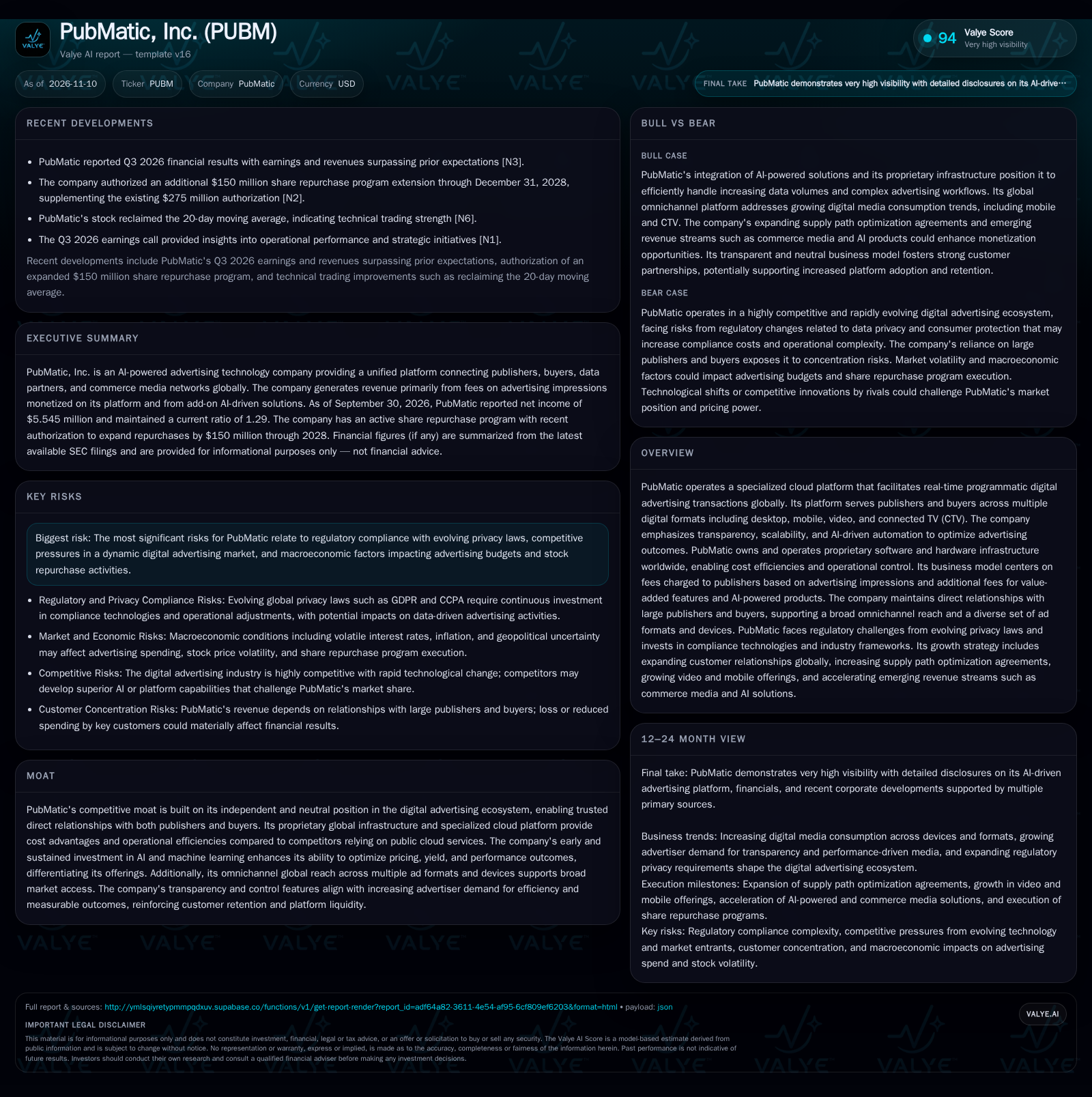
PubMatic’s unified, AI-driven advertising technology platform continues to grow across digital formats, leveraging proprietary infrastructure and omnichannel reach. Q3 2026 results beat expectations, but the company remains exposed to regulatory, competitive, and customer-concentration risks. Its next phase hinges on deepening customer relationships, scaling new revenue streams such as commerce media and AI products, and navigating evolving privacy requirements—all while maintaining cost advantages and platform neutrality. [S2] [N2] [N3]
PubMatic’s latest quarter underscores the evolving demands of digital advertising: precision, transparency, and efficiency across a sprawling, privacy-constrained ecosystem. The company’s distinct approach—owning its infrastructure and layering AI-driven optimization onto a unified platform—aims to deliver measurable value to publishers and buyers navigating a complex, multi-format ad landscape. But as regulatory, commercial, and technological crosscurrents intensify, the company’s ability to scale its value-added features, deepen customer entrenchment, and maintain operational agility will determine whether it can outpace both incumbents and next-generation rivals.
Financial Performance and Strategic Moves: Recent Results and Buyback Growth
PubMatic reported net income of $5.545 million for Q3 2026, with a cash balance of $120.3 million and a current ratio of 1.29 as of September 30, 2026. These results came alongside a headline that Q3 earnings and revenue surpassed prior expectations, suggesting that operational execution has outpaced market forecasts in the near term. [S2] [N2] [N3]
The company has repurchased $226.6 million of Class A common stock under its 2023 Repurchase Program, and recently authorized an additional $150 million in buybacks through 2028. While this signals management’s willingness to return capital, it also reflects confidence in long-term cash generation and valuation. [S2] [N2]
PubMatic continues to emphasize its proprietary infrastructure and AI-driven product suite as competitive differentiators, with a strategic focus on expanding supply path optimization (SPO) agreements, video/mobile, and commerce media. These priorities are shaping investment and go-to-market activities. [S1]
Monetization Model in Digital Advertising: Platform Fees, Add-Ons, and Cost Drivers
PubMatic generates the bulk of its revenue by charging publishers a percentage fee on advertising impressions monetized through its platform. This core transaction-based model is supported by additional fees for value-added features, including Connect, Activate, OpenWrap, and AI-powered tools such as Intelligent Yield. The company’s platform serves publishers across display, video, mobile web, app, and connected TV (CTV), allowing for diversified exposure to shifting digital ad budgets. [S1]
Ownership of proprietary software and hardware infrastructure globally is a central element of PubMatic’s cost structure. This approach provides potential fixed-cost leverage as the business scales, particularly when compared to peers reliant on public cloud services. The result is a cost base that may be more controllable, with opportunities for margin expansion if volume and mix shift favorably toward higher-value formats or features.
PubMatic’s business is sensitive to both ad volume (impressions processed) and mix (the share of premium video, CTV, mobile, and commerce media formats). The addition of AI-powered and commerce media features may allow for incremental pricing or attach rates, but also require ongoing investment in R&D and compliance as privacy regulations evolve. Capital needs are thus split between infrastructure upkeep, product innovation, and regulatory adaptation.
Competitive Edge in Ad Tech: Proprietary Systems, Neutrality, and AI Integration
PubMatic positions itself as an independent, neutral platform—an increasingly important stance as advertisers and publishers seek transparent, efficient supply paths and alternatives to vertically integrated giants. Its proprietary infrastructure allows for cost and performance advantages, particularly in latency-sensitive formats like video and CTV. [S1]
AI-driven automation for pricing, yield optimization, fraud detection, and performance measurement underpins its differentiation, but the competitive bar in ad tech is rising quickly. Larger competitors and specialized point solutions are investing heavily in similar capabilities, often at greater scale or with deeper first-party data access.
The company’s omnichannel reach and direct relationships with publishers and buyers are strengths, but also create exposure to customer concentration—large partners may negotiate harder or shift spend to rival platforms. Regulatory compliance is a further axis of competition, as evolving privacy regimes can favor those with robust, adaptive compliance frameworks.
Substitutes include other supply-side platforms (SSPs), vertically integrated ad tech stacks, and emerging commerce media networks. The question is whether PubMatic can sustain its cost and feature advantages as the industry consolidates and customer expectations shift toward performance guarantees and transparent supply chains.
Potential Growth Catalysts in AI and Commerce Media: Requirements for a Breakout
A favorable outcome for PubMatic would see accelerated adoption of its AI-powered features and commerce media solutions, driving higher attach rates and expanding its share of premium video, mobile, and retail-driven ad budgets. If SPO agreements deepen and more major publishers and buyers standardize on PubMatic’s platform for efficiency and transparency, revenue per impression and retention could rise.
Evidence confirming this scenario would include sustained double-digit growth in commerce media and AI add-on revenues (if disclosed), new or expanded SPO partnerships with top-tier publishers or commerce networks, and a mix shift toward higher-margin video and CTV formats. Operating leverage would manifest in expanding gross and operating margins as infrastructure costs scale more slowly than revenue.
Falsification would be apparent if attach rates on new features stagnate, if premium video/CTV share stalls, or if large partners opt for alternative SSPs or direct integrations, limiting PubMatic’s ability to capture incremental economics from emerging ad formats.
Maintaining Position Amid Programmatic Market Evolution: Growth, Margins, and Compliance
The most likely trajectory for PubMatic is continued, but uneven, growth as digital ad budgets expand and shift across devices and formats. The company should be able to maintain or modestly grow its core publisher relationships, with incremental gains from AI and commerce media features offset by ongoing price and margin pressure from competition and procurement dynamics.
Margins may gradually improve if infrastructure utilization increases and higher-value formats gain share, but offsetting forces include the rising cost of privacy compliance and required investments in product and security. Revenue per impression may fluctuate with mix and competitive dynamics, and customer concentration will remain a structural vulnerability unless the company can further diversify its publisher and buyer base.
Confirmation of this outcome would come from stable or modestly rising revenue per publisher, steady gross margins, incremental new customer wins, and continued investment in compliance and product innovation. A reversal—such as margin compression, revenue stagnation, or customer churn—would indicate that competitive and regulatory headwinds are outpacing PubMatic’s innovation cycle.
Risks from Regulatory Changes, Client Attrition, and Platform Disintermediation
A more adverse scenario would materialize if regulatory changes—such as new privacy laws or enforcement actions—significantly raise compliance costs or restrict the data flows underpinning PubMatic’s optimization and targeting capabilities. This could erode the effectiveness of its AI-driven features and diminish its value proposition to both publishers and buyers.
Further, loss or reduced spending by large publishers or buyers—whether from competitive displacement, insourcing, or industry consolidation—could have an outsized impact on revenue and profitability due to concentration risk. Intensifying price competition or commoditization could compress margins and limit the ability to fund ongoing innovation.
This scenario would be confirmed by spikes in compliance-related expenses, declines in revenue from major customers, loss of high-profile SPO agreements, or a mix shift away from premium video/CTV toward lower-margin formats. Failure to maintain infrastructure cost advantages or adapt to new privacy standards would accelerate downside risks.
Factors Influencing PubMatic’s Progress in AI, Commerce, and Customer Growth
Growth rate and mix of commerce media and AI-powered add-on revenues (if disclosed), indicating success in monetizing emerging ad formats beyond core display and video.
Expansion, renewal, or termination of major supply path optimization (SPO) agreements with top publishers and commerce media partners.
Gross and operating margin trends, especially as infrastructure utilization and higher-value formats scale.
Customer concentration metrics—such as revenue share from top five publishers or buyers (if disclosed)—to assess structural risk and diversification progress.
Incremental compliance costs and capitalized investments related to privacy and security requirements, as a proxy for regulatory headwinds.
New product launches or adoption rates for features like Intelligent Yield, Connect, Activate, and OpenWrap.
Evidence of publisher or buyer churn, direct bypass, or migration to alternative SSPs or vertically integrated platforms.
Disclaimer: This is research-only, informational analysis and not investment advice. It may include AI-generated interpretation and general industry context. Always verify important details using primary sources.

Comments