
Ispire Technology: Innovation, Operational Risks, and the Stakes of Global Vaping Hardware Expansion
Ispire Technology’s patented coil innovations and expanding manufacturing footprint underpin ambitions in the nicotine and cannabis vaping hardware markets. Yet, rising credit losses, regulatory complexity, and related-party dependencies highlight the execution risks and financial strains shaping future outcomes.
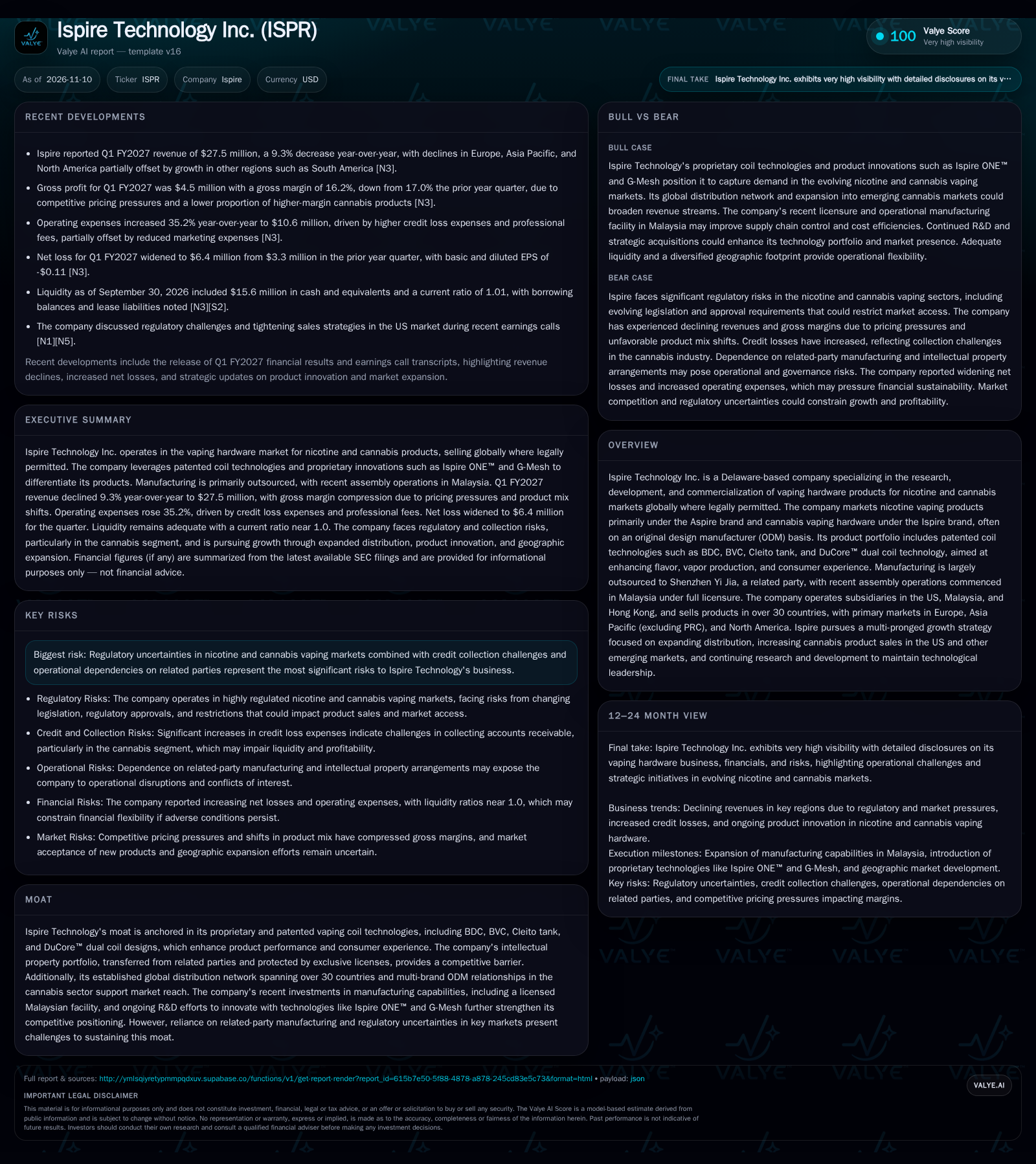
Ispire Technology is pursuing growth in vaping hardware through proprietary coil technology, global distribution, and new manufacturing in Malaysia. While product innovation and market expansion remain strategic priorities, the company faces increased operating expenses, significant credit losses—especially in cannabis—and regulatory headwinds.
Ispire Technology Inc. stands at a pivotal juncture as it seeks to leverage patented coil innovations and an expanding global footprint to capture share in the legal nicotine and cannabis vaping hardware markets. While the company’s product pipeline and new Malaysian manufacturing facility reflect a commitment to innovation and operational scale, recent results highlight intensifying credit losses, rising operating expenses, and increasingly tight liquidity. With regulatory environments in flux and competitive pressures mounting, the company’s ability to navigate execution risks and secure sustainable growth will be the central question for investors and stakeholders.
Recent Financial Pressures and Strategic Shifts Come to the Fore
Ispire Technology reported a 35.2% increase in operating expenses year-over-year, reaching $10.6 million, with the primary drivers being higher credit loss expenses and elevated professional fees—a combination that underscores both operational strain and the cost of risk management [N3]. [N3] [S2] The company’s pivot to Malaysian manufacturing—with full regulatory licensure for nicotine vapor products as of March 2026—marks a strategic effort to enhance supply chain control and potentially reduce costs, but adds executional complexity. Meanwhile, significant increases in accounts receivable credit losses—particularly in the cannabis segment—signal persistent challenges in collections and customer risk.
Revenue Engines and Cost Structures: How Ispire’s Model Could Scale—or Strain
Ispire’s revenue model is anchored in the sale of vaping hardware for both nicotine (Aspire brand) and cannabis (Ispire brand) markets, with a mix of branded and ODM (original design manufacturer) business. Proprietary coil technologies—such as BDC, BVC, Cleito tank, DuCore™, and the newer Ispire ONE™ and G-Mesh—enable product differentiation and may support premium pricing or preferred supply relationships, particularly as regulatory scrutiny and consumer demands for safety rise.
The company’s gross margin profile is sensitive to product mix, pricing pressures, and geographic distribution, with evidence of margin compression when unfavorable mix or competitive dynamics prevail. Outsourced manufacturing to Shenzhen Yi Jia (a related party) and now the newly operational Malaysian facility shapes fixed versus variable cost dynamics. While outsourcing can reduce capital intensity and enable flexibility, it introduces governance and operational risks, particularly with related-party exposure.
The ramp-up of Malaysian operations—if executed efficiently—could lower per-unit costs and enhance supply chain resilience, especially for nicotine products. However, this transition entails upfront investment, regulatory compliance, and potential learning-curve inefficiencies. Operating leverage may materialize if revenue growth outpaces expense inflation, but rising credit losses and professional fees have, for now, eroded this potential, contributing to continued net losses.
Defining the Moat: IP, Distribution, and the Limits of Differentiation
Ispire’s competitive positioning rests on a foundation of proprietary coil technology, an established global distribution network, and ODM relationships that embed its hardware into third-party cannabis brands. The company’s intellectual property portfolio—bolstered by patents and exclusive licenses—creates a barrier to direct imitation, particularly in regulated markets where product safety and consistency are paramount.
However, the vaping hardware sector is marked by rapid innovation, shifting consumer preferences, and intense price competition, especially from Asian manufacturers and large multinational tobacco or cannabis-adjacent companies. While Ispire’s technology claims (such as G-Mesh’s improved flavor and safety profile) may confer a temporary edge, the durability of this advantage depends on continued R&D, successful commercialization, and defensibility against both legal and illicit market substitutes.
Distribution in over 30 countries and the ability to serve both nicotine and cannabis segments provide diversification, but also expose the company to a patchwork of regulatory regimes and enforcement practices. The reliance on related-party manufacturing and IP arrangements, while facilitating scale, introduces potential conflicts of interest and operational vulnerabilities if those relationships destabilize.
If Innovation and Execution Align: Pathways to Margin Recovery and Geographic Growth
Ispire’s upside scenario hinges on the successful scaling of its Malaysian manufacturing operations, which could yield lower production costs, improved quality control, and enhanced supply chain reliability. If the company can leverage its proprietary technologies (Ispire ONE™, G-Mesh) to secure new distribution agreements or expand ODM contracts in both nicotine and cannabis markets, revenue growth could accelerate, especially as global legalization trends broaden addressable markets.
A key catalyst would be a reversal or stabilization of credit losses—particularly if the company strengthens customer vetting or diversifies away from higher-risk cannabis accounts. Evidence supporting this optimistic trajectory would include a return to gross margin expansion, reduced operating expense growth relative to revenue, and sustained or improved liquidity metrics. New regulatory approvals, successful product launches, and incremental market share gains in new geographies would further confirm the upside.
Balancing Innovation Ambitions with Persistent Margin and Collection Pressures
The most plausible scenario for Ispire is one of incremental progress tempered by persistent challenges. The company is likely to continue investing in R&D and new product introductions to maintain relevance and support modest growth in established markets. The Malaysian facility may gradually improve supply chain efficiency, but any gains could be offset by ongoing credit losses, particularly in the cannabis segment, and by the costs of compliance and operational scale-up.
Revenue growth may remain uneven, reflecting regulatory headwinds, competitive pricing, and shifting product mix. Operating expenses—especially for professional services and credit risk management—are likely to stay elevated as the company adapts to complex market and regulatory environments. Confirmation of this base case would come from stable, if modest, revenue growth, persistent but contained net losses, and liquidity ratios that remain near current levels without further deterioration.
Adverse Shocks: Regulatory Clampdowns, Escalating Credit Losses, and Governance Frictions
The downside scenario would materialize if regulatory tightening (in either or both the nicotine and cannabis sectors) restricts market access, triggers costly compliance mandates, or leads to product bans in key geographies. Escalating credit losses—especially from cannabis customers—could further impair liquidity, force write-downs, and erode confidence among suppliers and distributors.
Operationally, disruptions in the related-party manufacturing chain, or a failure to achieve targeted cost savings and quality improvements in Malaysia, could magnify losses. Governance issues stemming from related-party transactions or lapses in risk oversight could prompt regulatory scrutiny or investor pushback. Confirmation of a downside trajectory would include a sharp contraction in sales, precipitous margin compression, further deterioration in liquidity ratios, and heightened turnover in customer or supplier relationships.
Milestones and Metrics That Will Shape Ispire’s Next Chapter
Quarterly gross margin trends, especially as Malaysian manufacturing scales, would help test the company’s ability to control costs and sustain pricing power.
The pace and magnitude of accounts receivable credit losses—particularly in the cannabis segment—remain a critical indicator of customer quality and risk management.
Revenue contribution and growth rates by geography and product segment (if disclosed) would clarify the success of expansion and product innovation strategies.
Updates on regulatory approvals or new market entries, especially in the US and other legalization-frontier markets, would indicate growth potential and execution capability.
Operational milestones at the Malaysian facility—such as production ramp rates, cost per unit, and ISO/GMP audit outcomes—would provide evidence of manufacturing execution.
Any changes in the structure or terms of related-party manufacturing or IP arrangements would be material for assessing ongoing operational and governance risks.
Disclosure of customer concentration, contract structures, or recurring revenue metrics (if provided) would help evaluate revenue stability and long-term value capture.
Disclaimer: This is research-only, informational analysis and not investment advice. It may include AI-generated interpretation and general industry context. Always verify important details using primary sources.

Comments