
Zeta Global’s AI-Driven Marketing Platform: Scale, Differentiation, and the Stakes of Execution Risk
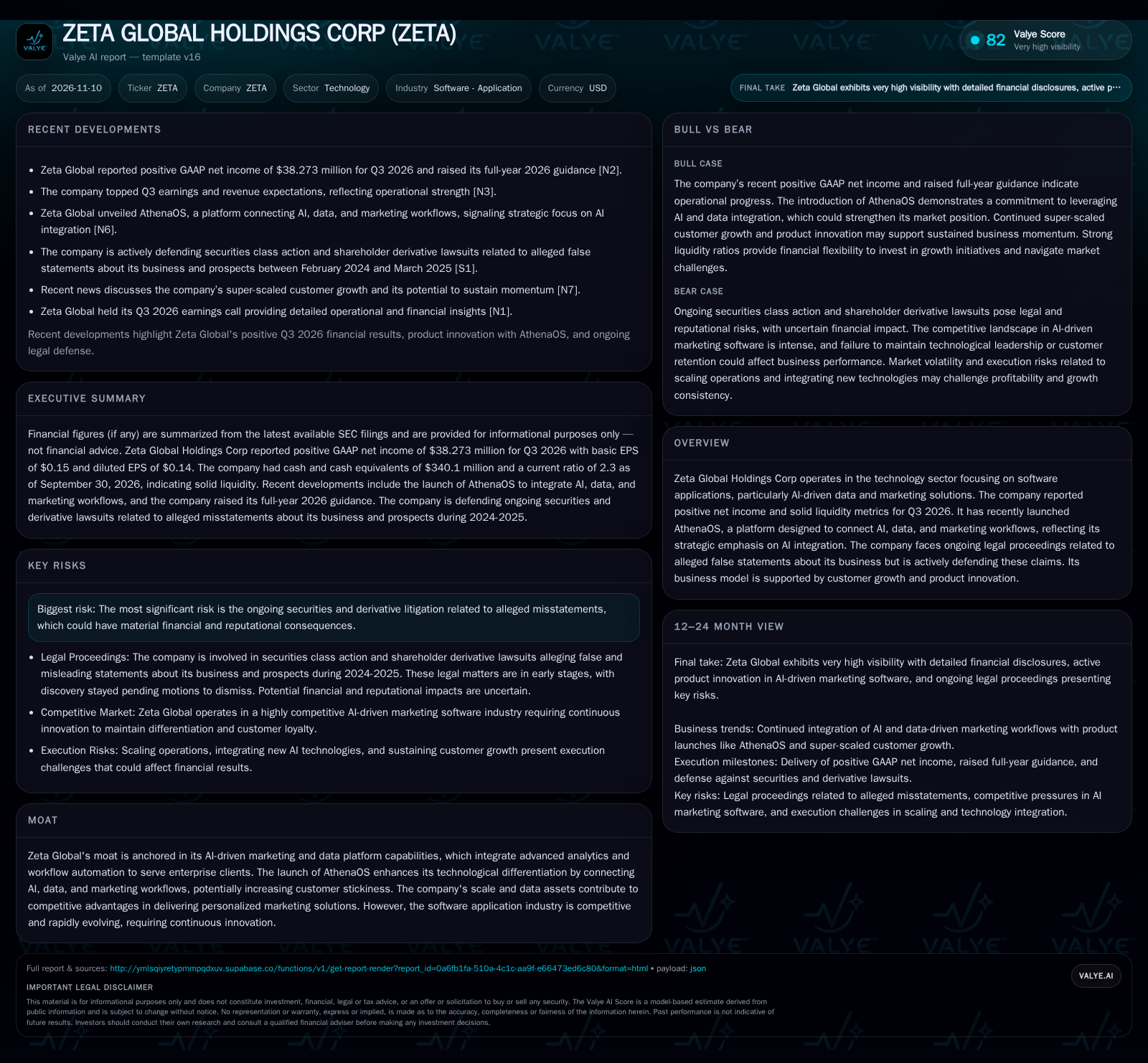
Zeta Global enters late 2026 with positive GAAP profitability, reported liquidity position, and product innovation in AI-driven marketing software. As AthenaOS debuts and customer growth accelerates, the company confronts legal uncertainty and a fiercely competitive landscape where execution and retention will determine its trajectory.
The recent launch of AthenaOS signals continued innovation, while super-scaled customer growth raises the stakes for operational execution. However, unresolved securities litigation and intense industry competition pose ongoing risks to both reputation and future earnings power. [S2] [N3] [N6] [N7]
Zeta Global Holdings Corp enters the final quarter of 2026 with a notable combination of positive GAAP earnings, a reported liquidity position, and visible investments in AI-powered marketing technology. The company’s recent AthenaOS launch and commentary around super-scaled customer growth suggest both ambition and traction in a crowded software landscape. However, Zeta’s legal overhang from ongoing securities litigation and the structural challenges of retaining differentiation in the fast-evolving AI marketing sector underscore the complexity of its growth story. The next phase will hinge on Zeta’s ability to translate platform innovation and customer acquisition into sustained profitability and defensible market position.
Profitability, Liquidity, and Legal Uncertainty Define Zeta’s Current State
Zeta Global reported positive GAAP net income of $38.273 million for Q3 2026, with basic and diluted EPS of $0.15 and $0.14, respectively. This marked a period of operational profitability, which stands out in the context of software application firms often prioritizing growth over earnings [S2] [N3]. The company reported cash and liquidity metrics for the period; these figures do not by themselves establish operating runway, investment capacity, financial flexibility, or financing capacity. [S2]
On the product front, Zeta launched AthenaOS in 2026, aiming to connect AI, data, and marketing workflows—an explicit signal of continued technology investment and differentiation ambitions [N6]. Meanwhile, the company is cited for achieving 'super-scaled customer growth,' elevating expectations for revenue momentum but also raising the execution bar [N7].
However, Zeta is actively defending securities class action and shareholder derivative lawsuits related to alleged false statements about its business and prospects during 2024–2025. The company cannot currently estimate potential losses, introducing an element of financial and reputational risk that could influence both investor confidence and operational focus [S1] [S2].
How Zeta’s Software Platform Could Scale Profits—and Where Margins May Pinch
Zeta Global’s core business model is anchored in selling AI-driven marketing software solutions to enterprise clients. While the general industry model often includes a mix of recurring software licensing, usage-based fees, and professional services, the exact commercial mechanics for Zeta—such as contract length, pricing tiers, or renewal rates—are not detailed in the supplied evidence. If Zeta’s arrangements are similar to industry norms, higher customer retention and upsell rates could drive operating leverage, as incremental software revenue typically carries high gross margins after initial R&D and sales costs.
Platform launches like AthenaOS suggest a strategy to deepen integration with client marketing operations, which may increase switching costs and justify premium pricing. The ability to ingest, analyze, and activate data across channels is central to the value proposition, and the more entrenched Zeta becomes in a customer’s workflow, the greater the potential for high-margin, sticky recurring revenue streams.
However, the sector is characterized by high customer acquisition costs (CAC) and ongoing R&D requirements to keep pace with AI and data innovation. If Zeta’s super-scaled customer growth translates into larger, longer-term relationships—or if the company can demonstrate net revenue retention above industry averages—profitability could inflect meaningfully upward. Conversely, if churn is elevated or pricing comes under pressure from rivals, margin expansion may prove elusive.
Differentiation Through AI: Durable Advantage or Commodity Trap?
Zeta’s competitive positioning hinges on the advanced analytics and workflow automation enabled by its AI-driven platform. The AthenaOS launch is designed to further integrate AI and data-driven marketing, potentially increasing customer dependency and decreasing the risk of client churn [N6]. The company’s scale and accumulated data assets could confer advantages in personalizing campaigns and optimizing marketing spend for enterprise clients.
Yet, the AI marketing software space is intensely competitive, with both large cloud vendors and nimble startups investing heavily in similar capabilities. Barriers to entry are relatively low for basic automation, but sustained differentiation requires continuous investment in proprietary models, data integrations, and workflow features. The question is whether Zeta’s current lead in AI integration and customer scale can be maintained as competitors iterate rapidly.
Switching costs may be meaningful if Zeta’s platform becomes deeply embedded in a customer’s marketing stack, but clients in this segment are often sophisticated buyers with the ability to pilot alternative solutions. The durability of Zeta’s moat will depend on measurable improvements in marketing ROI and demonstrable cost or revenue advantages delivered to its client base.
What It Takes for Zeta to Convert Innovation and Customer Growth into Market Leadership
The bullish scenario for Zeta Global is built on a virtuous cycle: AthenaOS and related product launches deepen customer engagement, driving elevated net retention and new logo wins. Super-scaled customer growth sustains or accelerates, and Zeta leverages its data assets to deliver demonstrable ROI improvements for clients. This translates into longer-term relationships, higher average deal sizes, and margin expansion as fixed costs are leveraged across a larger revenue base.
Evidence that would confirm this scenario includes clear disclosures of rising net revenue retention, sustained double-digit revenue growth, and expanding adjusted operating margins. Announcements of multi-year client relationships, major enterprise client renewals, or integrations that become industry standards would further validate the thesis. If Zeta can demonstrate that its AI-driven platform consistently reduces marketing costs or increases sales conversion rates for clients versus alternatives, its competitive edge could become self-reinforcing.
A falsifier would be stagnating customer growth, rising churn, or price concessions that compress margins despite product innovation.
Sustained Growth but Margin Pressures Persist as Zeta Battles Legal and Competitive Headwinds
A balanced trajectory for Zeta sees the company maintaining positive GAAP profitability and steady liquidity while continuing to invest in AI product innovation. Customer growth remains strong but gradually normalizes as the company matures, and new product launches like AthenaOS help defend share rather than dramatically expand it.
Legal proceedings remain unresolved but do not materially impair operations in the near term—potential settlements, if any, are absorbed by existing cash reserves. Competitive pressures force ongoing investment in sales and R&D, limiting margin expansion even as revenue grows. Zeta’s operating leverage improves incrementally, but headline profitability gains are offset by the costs of defending share and maintaining technological parity.
Evidence for this scenario would be continued positive net income, stable or slightly improving gross margins, and commentary indicating successful renewals and moderate upsell, but without breakout acceleration in either client wins or margin improvement. Falsifiers would include either a sudden drop-off in customer additions or a legal development that materially impacts cash flow or reputation.
When Legal, Competitive, or Execution Risks Derail the Momentum Story
The bear case materializes if one or more structural risks break against Zeta. An adverse legal ruling or costly settlement from the ongoing securities and derivative lawsuits could drain cash reserves, disrupt strategic focus, and damage the company’s reputation with clients and investors. Alternatively, if competitors leapfrog Zeta’s AI capabilities or undercut pricing, customer churn could rise, compressing both revenue and margins.
Execution missteps—such as failed integration of AthenaOS, inability to onboard new customers efficiently, or a deterioration in customer support—could further erode confidence. If the company is forced to increase spending to defend share, or if high-profile client losses are disclosed, the profitability story could reverse quickly.
Confirmation of this scenario would include material charges or cash outflows tied to litigation, negative customer growth or rising churn, and margin contraction despite ongoing R&D investment. Any guidance cuts attributed to legal or competitive factors would also be red flags.
Benchmarks to Test Zeta’s Ability to Turn AI Innovation and Customer Growth into Defensible Profits
Net revenue retention rate, if disclosed, would help assess whether Zeta is expanding its wallet share with existing clients or facing churn pressures.
Growth in enterprise customer count and average contract value—key for validating the impact of AthenaOS and new product launches.
Gross and operating margin trends, especially in the context of continued R&D and sales investment.
Resolution status of securities and derivative lawsuits, including any disclosed settlement amounts or adverse judgments.
Evidence of multi-year client relationships, major renewals, or integration partnerships that could entrench Zeta’s platform in client workflows.
Quantitative or qualitative disclosures on the realized ROI for clients using AthenaOS or other AI-driven solutions.
Any material changes in cash or liquidity metrics tied to legal outcomes or operational cash burn.
Disclaimer: This is research-only, informational analysis and not investment advice. It may include AI-generated interpretation and general industry context. Always verify important details using primary sources.

Comments