
AI Infrastructure Acquisition Corp.: SPAC Strategy in the Race for AI Data Center Assets
AIIA targets transformative acquisitions in AI and next-gen infrastructure but faces the classic SPAC tension: a sizable trust account and a narrowing window to secure a deal amid sector competition and evolving capital needs.
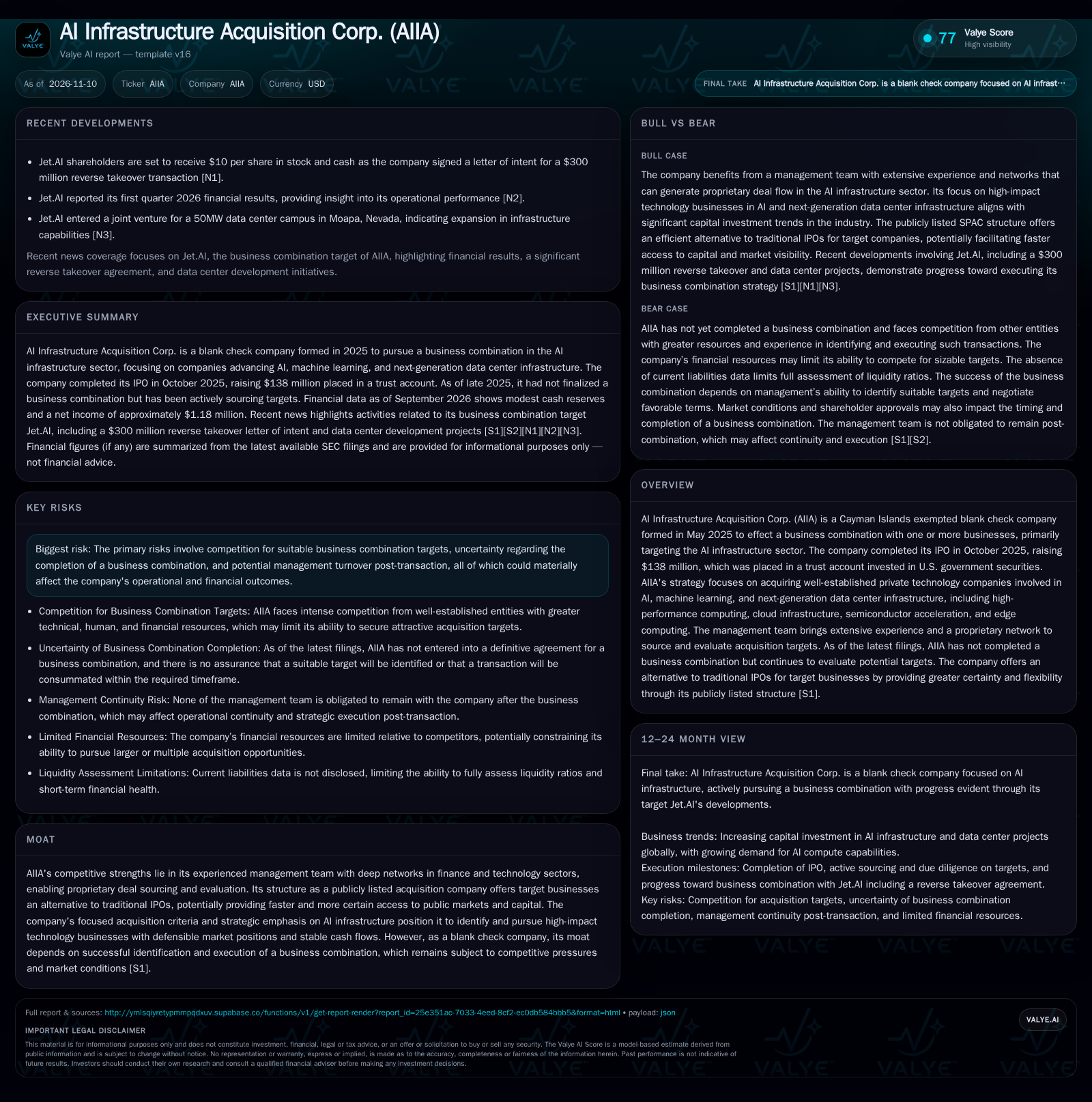
AI Infrastructure Acquisition Corp. (AIIA) raised $138 million in its October 2025 IPO, earmarked for acquiring private companies in AI and advanced data center infrastructure. As of September 2026, AIIA had not entered into a definitive business combination, with its trust account generating interest income but no operating revenue. The company’s acquisition criteria focus on large, defensible, cash-generative targets, but competition and finite financial resources may constrain deal prospects. The next phase hinges on securing and executing a high-impact transaction that leverages management’s sourcing network and sector expertise. [S1] [S2]
AI Infrastructure Acquisition Corp. (AIIA) stands at a pivotal moment typical of many SPACs: flush with IPO proceeds but yet to secure its transformative deal. With $138 million raised and held in trust since October 2025, AIIA aims to acquire a high-quality private company in the booming AI and advanced data center infrastructure space. The team’s sector expertise and proprietary sourcing network offer promise, but the competitive landscape for AI infrastructure assets is intense, and the clock is ticking to deploy capital before regulatory and market pressures mount. Whether AIIA can land and execute a deal that justifies its public listing—and achieves returns for shareholders—remains the central question.
IPO Proceeds, Deal Pipeline, and the Current State of Play
AI Infrastructure Acquisition Corp. completed its IPO in October 2025, raising $138 million by issuing 13.8 million units at $10.00 each. These proceeds are invested in a trust account, generating interest income but not operating revenue, as the company remains pre-acquisition. As of September 30, 2026, AIIA had not yet entered into a definitive agreement for a business combination, though it continues to perform due diligence and initial negotiations with multiple potential targets. Financially, AIIA reported cash and equivalents of $805,697 and current assets totaling $833,859 at the end of Q3 2026. The net income reported for the period is driven by interest earned on the trust account, with no revenue from business operations. The company’s focus remains on sourcing a large, defensible private technology business in AI or data center infrastructure, leveraging its management team’s experience and proprietary network. [S1] [S2]
How SPAC Economics Shape AIIA’s Acquisition Imperative
AIIA’s business model is structured around the acquisition of a private operating company, typically one that would benefit from public market access and accelerated capital formation. Until a deal is closed, AIIA does not generate operating revenue; its income consists solely of interest earned on trust account investments. Upon successful acquisition, economic outcomes will be dictated by the cash flow, capital needs, and growth trajectory of the target.
For the target sector—AI infrastructure, high-performance computing, and data center assets—business models often feature high upfront capital expenditures (e.g., data center construction, semiconductor procurement), with recurring revenue streams from cloud services, compute leasing, or infrastructure-as-a-service contracts. Margins and operating leverage can be substantial for scaled platforms, but fixed costs and capex requirements are significant, and capital intensity is a persistent challenge.
AIIA’s $138 million trust account, while sizable, may not alone suffice for large-scale data center or semiconductor targets, especially given the recent surge in valuations for AI-adjacent infrastructure. This may necessitate additional PIPE (private investment in public equity) financing or debt, diluting original shareholders or raising execution complexity. The economics of any eventual transaction will depend on AIIA’s ability to structure a deal that balances growth potential, capital intensity, and the retention of a committed management team post-combination. [S1] [S2]
Competing for Scarce, Defensible AI Infrastructure Targets
AIIA’s acquisition strategy pits it against other SPACs, private equity funds, infrastructure investors, and strategic technology acquirers—all seeking exposure to the explosive growth in AI and digital infrastructure. The most attractive targets—those with scale, defensible technology, and stable cash flows—are few, and competitive bidding has driven up valuations and tightened deal timelines.
AIIA’s edge lies in its management team’s deep networks in finance and technology, which could enable proprietary deal sourcing and early access to off-market opportunities. However, this advantage is countered by the sheer capital available to larger private equity and strategic buyers, as well as the potential for target companies to pursue traditional IPOs or remain private amid robust private capital markets.
Switching frictions—such as the need for scale, specialized technical expertise, and regulatory compliance—create some barriers to entry in the AI infrastructure space. Still, SPACs like AIIA must demonstrate clear value to target management teams, including speed, certainty, and alignment, to win deals. The risk remains that AIIA may need to stretch on price or accept less defensible assets if competition intensifies or its acquisition window narrows. [S1]
Capturing a Transformative Deal in AI Infrastructure: What Success Would Look Like
The most favorable scenario for AIIA involves securing a business combination with a high-quality, cash-generative company in AI, advanced computing, or digital infrastructure—ideally one with a defensible market position and a clear growth runway. Success would likely require leveraging management’s network for proprietary access, structuring a deal that retains key talent, and potentially augmenting the trust proceeds with additional financing to fund growth or acquisition premium.
Evidence confirming this trajectory would include the announcement of a definitive agreement to acquire a well-established company with an enterprise value above $100 million, disclosure of robust historical free cash flow, and public commitments from the target’s management team to remain post-transaction. Additional validation could come from PIPE investors or strategic partners participating in the deal, signaling external confidence in the transaction and the sector’s prospects. [S1] [S2]
If AIIA can execute such a deal, it could position itself as a listed platform for next-generation AI infrastructure, with the potential for operating leverage, sector tailwinds, and further consolidation opportunities.
Likely Outcomes: Navigating the SPAC Lifecycle in a Crowded Market
The most plausible scenario is that AIIA continues to evaluate multiple targets, ultimately securing a business combination with a private company that meets most—but not all—of its ideal criteria. Competitive pressures may force compromises on valuation, business quality, or deal structure. The final transaction could be smaller or involve a business with less clear cash flow stability or competitive defensibility than originally envisioned.
Confirmation of this scenario would come through public disclosure of a definitive business combination agreement, but one where the target’s profile is more modest or the deal involves significant seller rollover, earnout structures, or reliance on additional capital raises. Falsification would occur if AIIA either fails to announce a deal within its regulatory window or if it is forced to liquidate and return funds to shareholders due to inability to consummate a transaction. [S1] [S2]
Post-acquisition, success will depend on integration, the retention of key management, and the acquired company’s ability to deliver on growth and cash flow projections in a competitive sector.
Adverse Outcomes: Deal Failure, Forced Liquidation, or Value-Destructive Acquisition
The primary risk is that AIIA is unable to secure a business combination within the regulatory timeframe, leading to a forced liquidation and return of trust proceeds to shareholders, net of expenses. This could occur if competition for quality targets remains intense, if sector valuations become unsustainably high, or if due diligence uncovers fatal issues with prospective targets.
A secondary negative scenario is the consummation of a value-destructive deal—acquiring a company with overstated prospects, insufficient cash flow, or poor management retention. Such an outcome could lead to post-merger underperformance, share price decline, and loss of investor confidence.
Evidence confirming downside scenarios would include repeated extensions of the SPAC’s timeline without a deal, public disclosures about failed negotiations or abandoned letters of intent, or eventual liquidation filings. Alternatively, a rushed deal with a marginal target, followed by weak financial performance or management turnover, would also signal thesis breakdown. [S1] [S2]
Milestones and External Factors That Will Shape AIIA’s Acquisition Thesis
Announcement of a definitive business combination agreement with a named target in the AI infrastructure or advanced data center sector.
Disclosure of the target’s historical and projected free cash flow—if disclosed, this would clarify the acquisition’s ability to support growth and withstand capital intensity.
Details on the participation of PIPE investors or strategic partners in the transaction, which would signal external validation and improve deal execution odds.
Retention arrangements or post-merger roles for the target company’s management team, as continuity is critical for operational success.
Updates on the regulatory or SPAC timeline, including any required extensions or approaching deadlines for deal consummation.
Valuation metrics and acquisition multiples relative to sector norms, to assess whether AIIA is paying a premium or securing value.
Sector-wide trends in AI infrastructure M&A activity, as increased competition or deal scarcity could affect AIIA’s options and bargaining power.
Post-acquisition financial performance and integration milestones, if a deal is completed, to judge whether the thesis of operating leverage and growth is being realized.
Disclaimer: This is research-only, informational analysis and not investment advice. It may include AI-generated interpretation and general industry context. Always verify important details using primary sources.

Comments