
Kochav Defense Acquisition Corp.: SPAC Deadline Dynamics and the Stakes of Defense Sector Deal-Making
With its $253 million trust and an imminent business combination deadline, Kochav Defense Acquisition Corp. faces the classic SPAC challenge: convert capital and sponsor credibility into a viable deal in the crowded defense and aerospace landscape—or return funds to shareholders if time runs out.
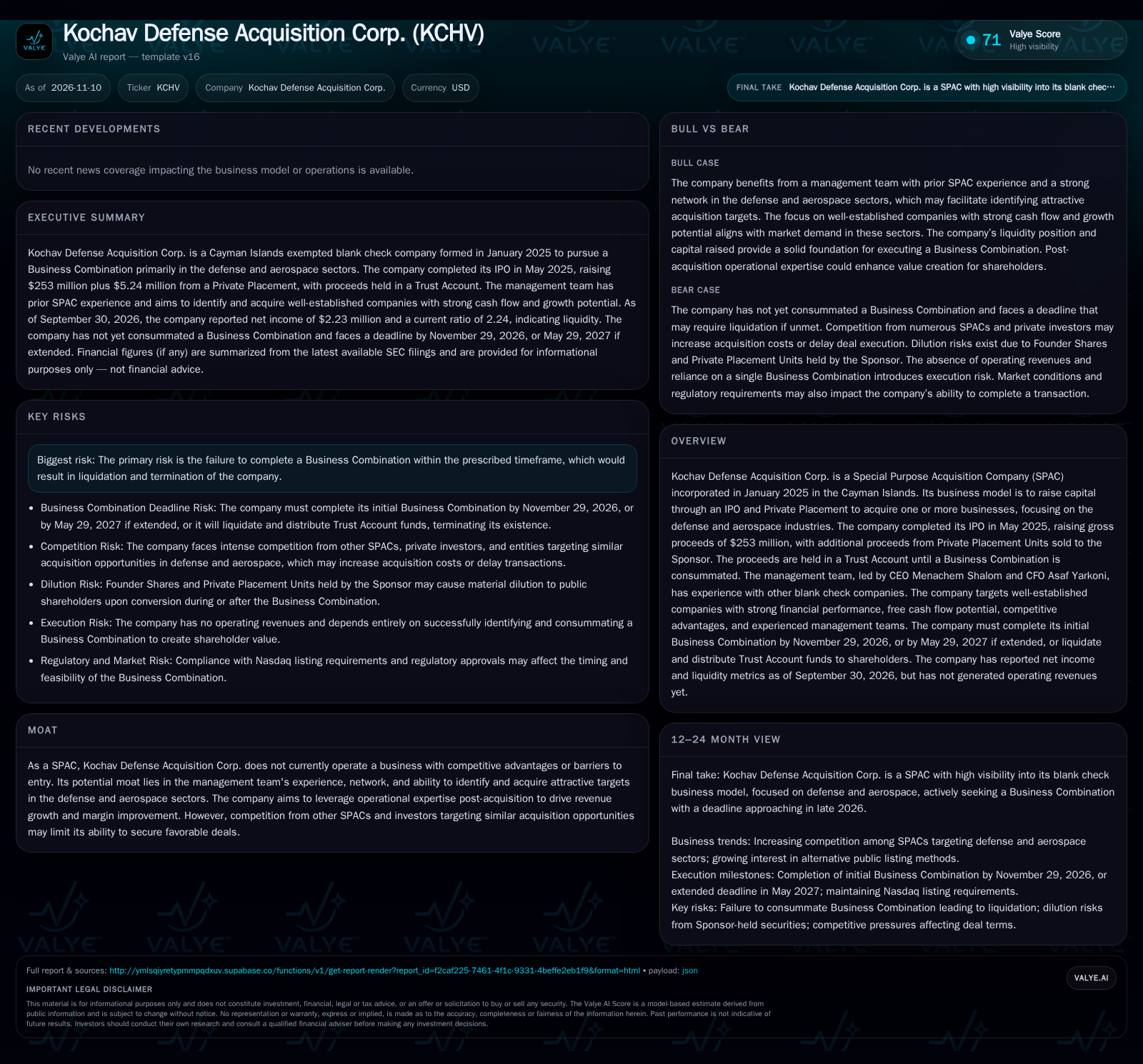
Kochav Defense Acquisition Corp. is a SPAC targeting defense and aerospace, holding $253 million in its trust account after a May 2025 IPO. The company must secure a business combination by November 29, 2026 (or May 2027 if extended), or liquidate. With no operating revenues and competition from other SPACs and private investors, execution risk is high. Sponsor-held founder shares and private placement units introduce dilution risk upon deal completion. The path forward depends on sourcing and closing a value-creating acquisition before the deadline. [S2]
Kochav Defense Acquisition Corp. (KCHV) exemplifies the modern SPAC dilemma: flush with capital from its $253 million IPO, led by a sponsor team with prior blank-check experience, but racing against a fixed timeline to deliver a transformative deal in the defense and aerospace sector. With no target announced and the clock ticking toward a late 2026 deadline, KCHV’s value proposition now hinges not just on deal sourcing, but on its ability to navigate competition, avoid excessive dilution, and satisfy increasingly wary public-market investors. The next twelve months are critical—either the company will leverage its sponsor’s sector relationships to secure a high-quality acquisition, or it will be forced to liquidate and return funds, ending its brief corporate life. [S2]
A Blank Check with a Countdown: Current State and What’s at Stake
Kochav Defense Acquisition Corp. has raised $253 million through its May 2025 IPO, with all proceeds placed in a trust account, and an additional $5.24 million coming from private placement units sold to the sponsor. As of September 30, 2026, the company has not identified or announced any acquisition target, and it has generated no operating revenues. The SPAC must complete its initial business combination by November 29, 2026, or, if extended, by May 29, 2027; failure to do so will trigger liquidation and distribution of trust assets to shareholders. Sponsor-held founder shares and private placement units represent a potential dilution overhang for public shareholders if an acquisition is completed. [S2]
How the SPAC Model Translates Capital into Value—If at All
KCHV’s business model is that of a classic SPAC: pool investor capital into a trust, identify a private company (ideally with strong cash flow and growth prospects), and take it public via a business combination. The economics hinge on two main levers: (1) sourcing a target at an attractive valuation relative to peers, and (2) structuring the deal to preserve value for public shareholders despite sponsor dilution and possible redemption pressure.
The fixed costs of running a SPAC are modest compared to an operating business, but the real economic opportunity is binary: a successful deal can create substantial equity value (and lucrative sponsor returns through founder shares), while failure results in trust liquidation and a return of capital to investors. The trust structure means most investor funds are protected unless a combination closes, but sponsors and management typically bear the costs of deal sourcing and due diligence. If a business combination is consummated, the resulting entity may face integration costs, capital needs for growth, and pressure to demonstrate operating leverage post-merger.
A critical variable is the dilution from sponsor shares and private placement units, which can meaningfully reduce the public float’s share of the combined entity—especially if redemptions are high or the deal is struck at a premium. The economics for public shareholders thus depend on both the quality of the target and the structure of the eventual transaction.
Crowded Skies: SPACs, Private Equity, and Strategic Buyers in the Defense Sector
KCHV competes in a saturated market for defense and aerospace assets, facing rival SPACs, private equity funds, and traditional strategic acquirers. The post-pandemic SPAC boom flooded the market with blank check vehicles, many with similar sector mandates and capital bases. This competition raises acquisition multiples and compresses expected returns, particularly for high-quality targets with strong cash flows and established customer relationships.
Defense and aerospace are traditionally relationship-driven sectors, with regulatory and national security overlays that can complicate due diligence and deal execution. While KCHV’s management touts sector experience, there is no structural moat versus other SPACs or well-capitalized private investors, aside from potential sponsor relationships or unique sourcing angles.
At the same time, public-market volatility and the higher bar for de-SPAC transactions (due to increased investor scrutiny and regulatory focus) mean that only clear, growth-ready assets are likely to attract support—further narrowing the field of potential targets.
If a High-Quality Target Emerges: Pathways to Outperformance
The most favorable outcome for KCHV is the identification and completion of a merger with a well-established, cash-generative defense or aerospace company at a reasonable valuation. In this scenario, the sponsor’s sector relationships could surface proprietary deal flow, allowing KCHV to outmaneuver rival SPACs or financial sponsors.
For public shareholders, upside would be realized if the acquired company demonstrates robust post-deal growth, margin expansion, or operational synergies from access to public capital. Confirmation of this scenario would come from a deal announcement with minimal redemptions, limited sponsor dilution, and favorable market reception. Additional evidence would include disclosure of a target with strong free cash flow, backlog visibility, and a defensible market position.
Most Likely Outcome: Time Pressure, Deal Sourcing, and Shareholder Redemptions
The base case is that KCHV will work to identify a business combination as the deadline approaches, negotiating with multiple targets in parallel. Given the competitive environment and the typical pace of SPAC deal-making, the most plausible scenario is a deal announcement in mid-to-late 2026, potentially with a less differentiated or smaller target than initially envisioned.
This outcome would likely entail elevated redemption rates by public shareholders—common in late-cycle SPACs—leading to a higher ownership stake for the sponsor and any PIPE investors. The combined company may face pressure to rapidly prove its value proposition to the market. Evidence for this scenario would be a last-minute deal announcement, heavy redemptions, and a focus on cost management and integration in post-merger guidance.
When the Clock Runs Out: Liquidation and Return of Capital
The principal risk is that KCHV fails to secure a business combination by its November 2026 (or extended May 2027) deadline, resulting in liquidation. In this event, shareholders would receive their pro rata portion of the trust account, less dissolution costs, and the sponsor’s founder shares and private placement units would be rendered worthless.
This scenario could be confirmed by a lack of deal announcements as the deadline nears, public disclosures of unsuccessful negotiations, or signals that regulatory or competitive barriers have derailed talks. The broader consequence is reputational loss for the sponsor team and a missed opportunity for public-market access for potential targets that may have been in discussions.
Milestones and Metrics That Will Determine KCHV’s Fate
Any public announcement of a definitive business combination agreement, including target identity, valuation, and deal structure.
Level of shareholder redemptions upon deal announcement and at merger close (if disclosed), which will impact public float and post-merger ownership dynamics.
Disclosure of PIPE (private investment in public equity) commitments, if any, to backstop trust outflows and support transaction funding.
Degree of sponsor dilution and conversion mechanics for founder shares and private placement units, as outlined in deal terms and proxy filings.
Evidence of regulatory or national security clearance hurdles for the proposed target, especially relevant in defense and aerospace.
Market and peer SPAC deal activity in the defense sector, which could signal acquisition multiples and competitive intensity.
Progress toward the November 29, 2026, (or May 29, 2027 if extended) business combination deadline, as measured by SEC filings and sponsor communications.
If disclosed, the financial profile of any announced target—specifically operating cash flow, backlog, and growth trajectory—to test alignment with SPAC promises.
Disclaimer: This is research-only, informational analysis and not investment advice. It may include AI-generated interpretation and general industry context. Always verify important details using primary sources.

Comments